Hurricane Fiona struck the Dominican Republic yesterday, Monday, after causing flooding and «catastrophic» damage in Puerto Rico, its neighbor in the Caribbean Sea, where residents are without power and continue to endure heavy rains.
In the Dominican Republic, the hurricane left one person dead and forced 12,485 residents to evacuate their homes, according to General Juan Méndez García, director of the emergency operations center.
Roads were flooded or blocked by fallen trees and power lines around the Punta Cana beach resort, in the eastern part of the Dominican Republic, where power was cut off, Agence France-Presse reporters found.
Winds reached speeds of up to 150 kilometers per hour, and Cyclone Fiona is expected to intensify «over the next two days,» reaching Category 3 today (on the five-point Saffir-Simpson scale), according to the U.S. National Hurricane Center (NHC), based in Miami.
The hurricane is heading toward the Turks and Caicos Islands.
Fiona, which made landfall in the Dominican Republic yesterday, «passed through at high speed,» said Vicente López, who works at a beach in Punta Cana, referring to the damaged stores.
Strong winds also swept through the city of Nagua (in the north).
Videos broadcast by local media show residents of the coastal town of Iguei, with water up to their waists, trying to salvage their belongings.
State of Emergency
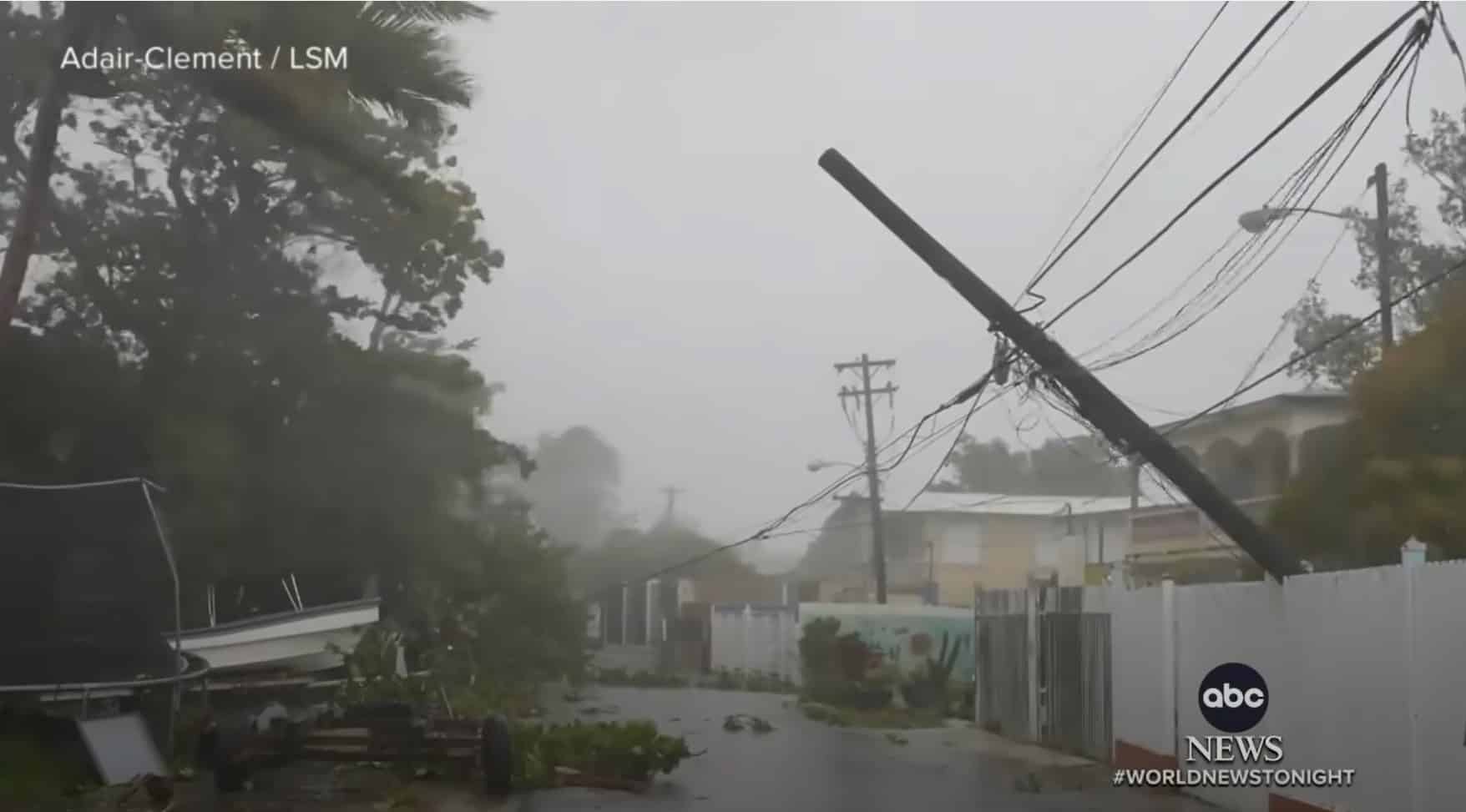
In Puerto Rico, where the hurricane first made landfall and where a tropical storm warning remains in effect, «the damage to infrastructure (…) and homes is catastrophic,» said the governor of this U.S. territory, Pedro Pierluisi, during a press conference.
The cyclone caused landslides, uprooted trees, knocked down power poles, made roads impassable, and swept away a bridge in the city of Utuado.
A man lost his life and was «burned to a crisp» while trying to refuel a running generator, according to authorities.
«Unfortunately, we expect more rain across the island today and tomorrow,» said the governor of Puerto Rico yesterday, urging residents not to risk traveling on the roads.
«In many areas where flooding had never been recorded before, we are seeing an unprecedented accumulation of water,» even greater «than what we saw during Hurricane Maria,» explained Mr. Pierluisi.
According to authorities, more than 800,000 people no longer have access to drinking water. «We have no electricity and no water,» said Elena Santiago, an anesthesiologist at the hospital in Aibonito (central region).
The passage of Hurricane Fiona «was violent,» he explained. «The hospital is operating on a generator; we are providing care only for emergency cases.».
Blackout
Puerto Rico, a former Spanish colony that became a U.S. territory in the late 19th century before being granted special status in the 1950s, has been facing very serious infrastructure problems in recent years.
It suffered extensive damage in 2017 from Hurricanes Irma and Maria, which primarily affected the power grid. This grid was privatized in June 2021, with the aim—at least in theory—of resolving the problem of frequent power outages. However, the island experienced a widespread power outage in April 2022.
All of Puerto Rico, with a population of more than three million, suffered a power outage as the hurricane approached the island. Yesterday, Monday, power was restored to the homes of 100,000 people, according to the governor.
On Sunday, Tropical Storm Fiona intensified into a Category 1 hurricane before making landfall on the southwestern coast of Puerto Rico.
U.S. President Joe Biden declared a state of emergency. He spoke with the island’s governor yesterday and said that federal agency personnel are already working to provide assistance; there are more than 300 of them already, and that number will increase.
Due to the rise in ocean surface temperatures, the frequency of powerful cyclones—with stronger winds and heavier rainfall—is increasing. Such phenomena pose an ever-greater risk to coastal communities.
Fiona had already caused serious damage as it passed through Guadeloupe on Friday night into Saturday. In some areas, the water rose to over 1.5 meters. One person lost his life when his house was swept away by the floodwaters after a river overflowed.
Several dozen people were forced to seek temporary shelter, major roads were closed, and parts of the archipelago still had no drinking water as of yesterday, two days after the storm passed.