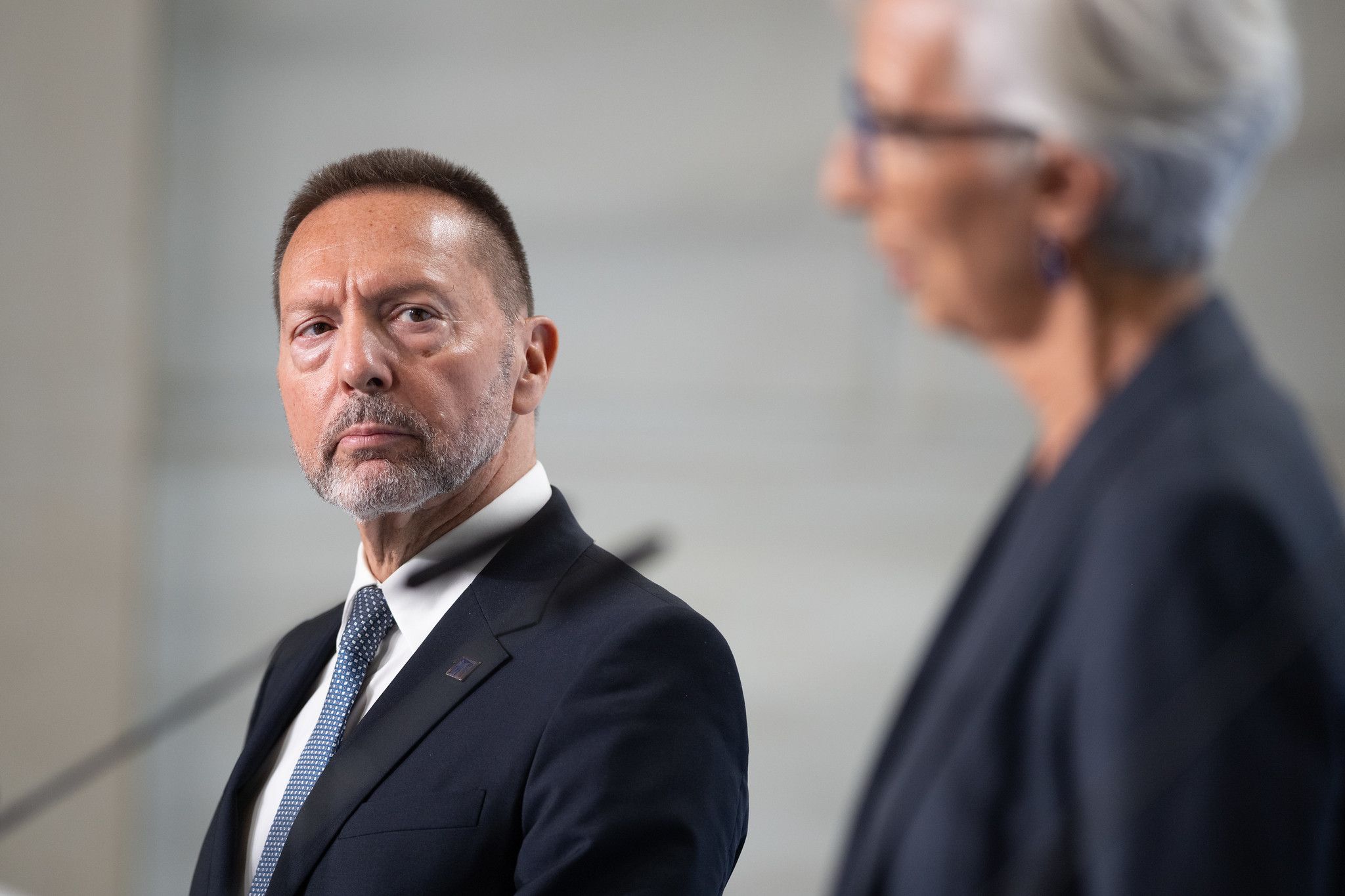
Bertolt Brecht said, «It's not what is said, but who says it.».
With Yannis Stournaras, the above resilient axiom is indeed true.
For there are words that, before they are even heard, have already been worn out by the mouth that hosts them.
Yannis Stournaras appears in public life not as a simple economist, but as a figure who claimed the privilege of foresight. As someone who was not content to interpret reality, but who wanted to foreshadow it and, at times, to legitimise it.
If history were a theatre, Stournaras would have the role of a prophet. Not the one who warns to prevent disaster, but the one who dresses it up with necessity to make it seem inevitable.
His career starts from the years of the economic formation of post-independence Greece, alongside Kostas Simitis and Giannos Papantoniou, when the country was preparing to put on its European clothes. There, in the numbers and reports, he built his belief that economies are not societies, but equations.
Later, at the helm of the Commercial Bank and then as head of the IOBE, he shaped the style of the technocrat who does not doubt. One who speaks with the certainty of those who will not pay the price for their predictions.
The climax came when, as finance minister in the government of Antonis Samaras, he found himself at the centre of a society that was changing violently.
The words «adaptation» and «rescue» became the everyday vocabulary of a country learning to live on less.
And then the top of the institutional structure, the Bank of Greece.
You don't know whether to think of him as a technocrat or as a courtier. Maybe both. Perhaps a man who has learned to survive through his usefulness to the powers that be. A man who managed to turn duration into an argument from truth.
In his recent public appearances, as his words found ears close to Kyriakos Mitsotakis, he looked less like the guardian of an institution and more like the narrator of a personal vindication. As if he wanted to convince us that history is nothing more than a series of his own right choices.
And opposite, as a shadow that still haunts him, the figure of Alexis Tsipras, as a reminder that power was once not a given. That he once had to defend, to warn, to convince. And that perhaps that moment of questioning was the only moment when his role became truly meaningful.
In the background, like an old European scene, the figure of Mario Draghi is applauding, or at least he wants to remember it that way. Because bankers, like actors, ultimately live off the memories of their applause.
Yannis Stournaras is a role that has survived governments, crises and hopes, that has learned to dwell in necessity, until he mistook it for virtue.
And just like that, it's still standing there. As a monument to stability and not as a guarantor of it.
Thus his word acquired the weight of fate.
When he talked about decades of austerity, it didn't sound like an estimate. It sounded like a decision. As if the future had already been written and he was just reading it aloud.
There is something paradoxical about people who survive all crises. They are not necessarily the most insightful. They are the most necessary to the system that needs them. The people who become bridges between political and economic power. Stournaras looks like such a man.
He made mistakes. But his mistakes never made him disappear. Every crisis still found him there. Not on the sidelines. But at the center.
Like a man who learned to live in the storm without ever getting wet.
And perhaps, after all, this is his most accurate portrait, a prophet who was not disproved, a man who learned to survive even his own prophecies.
When an institution descends from its height
Yannis Stournaras' appearance on the Truth Group was not just an interview. It was a move. A symbolic descent from the height of the institution into the realm of political debate.
Because the Governor of the Bank of Greece is not a mere commentator on current affairs. He is, or ought to be, the voice of institutional detachment. The man who speaks from a place where power is not asserted but balanced.
And yet, in choosing this particular step, he seemed to be looking for something that an institution never needs. Confirmation.
The choice of the medium was not neutral. It was a tacit recognition that the new mechanisms of influence are no longer found not only in traditional media, but in those digital hotspots where politics becomes narrative and narrative becomes a weapon.
And somewhere in there, independence, that fragile word that accompanies every central banker, seemed less like a given and more like a question.
I don't believe it was abolished by an interview. But what is certain is that he was exposed.
In the background, the shadow of Kyriakos Mitsotakis' power was present, even when he was not named. Because in every public statement of an institutional actor, there is always the unanswerable question, to whom is it really addressed?;
And perhaps the most worrying element is not the interview itself.
But what it symbolizes.
That in the modern political scene, institutions are no longer content to exist.
They feel the need to be accepted.
And when an institution begins to seek acceptance, it has already begun to lose some of its implicit power.
Not because he spoke, because he chose where to speak.