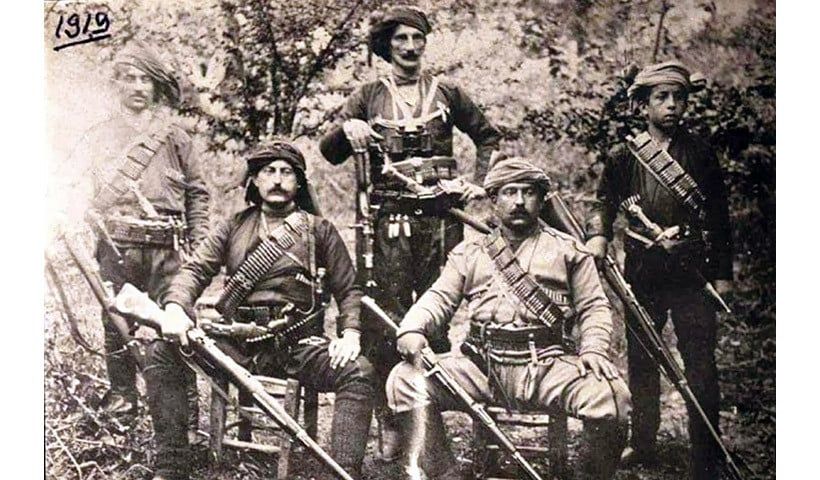
One of the biggest, horrible and yet not so well known - to the world at large - Genocide, is that of Pontian from the Young Turks which was systematically carried out in the period 1914-1923. It is estimated to have cost the lives of some 326,000-382,000 Greeks. These events are officially recognised as genocide by the Greek state, Cyprus, Armenia, Sweden, some federal republics of Russia, Serbia, eight states of the USA and Australia, as well as by international organisations such as the International Association of Genocide Studies.
It is considered part of the single genocide of the Hellenism of the East, which was one of the first modern genocides. It was a premeditated crime, which the government of the Young Turks carried out systematically. The methods he used were uprooting, exhaustion in hardship, torture, hunger and thirst, and death camps in the desert.
The international literature and the state archives of many countries are full of testimonies of the heinous crime committed against the Greek people. The genocide of the Greeks took place alongside genocides against other Christian populations of the Ottoman Empire, namely the Armenians and Assyrians.
Here are excerpts from different books and articles that provided testimonies from people who experienced the horrible and brutal practices of the Young Turks that resulted in the annihilation of the Pontian people.
Excerpt from his book Harry Tsirkinidis “The Genocide of the Greeks of Pontus”.
The testimony is that of Euripides' uncle:
“With much suffering we finally reached Kerasounda. The town was full of ragged refugees who had fled the terror of the Turks in the countryside and were gathering in the cities. There, in Kerasunda, we were warned by our compatriots that they were rounding up all the Greeks and the big ones were locked up in the church of St. George to be banished every time the number of 250 people was reached, and the small ones were taken in small boats to unknown places.
In the church the number 250 was never reached, because there, without food, without water, in their own filth, most of them died in a few days. With our own eyes, my brother and I saw the children being taken just outside of Kerasunda and there handed over to the savage Chetnik rebels. They would grab them by the legs and beat their heads against the large rocks on the coast , until they died.”.
Excerpt from the book by Savvas Kantartzis where he describes his terrible experiences in 1975 in Katerini:
One of his stirring accounts refers to the destruction of the village of Beyalan, in the Cotyora district, by the Topal Osman Cheetahs. Beyalan is one of the hundreds of Greek villages destroyed by the Turkish gangs:
“At dawn, on Wednesday, February 16, 1922, a nightmarish news that the Topal Osman's Chetas were coming to the village, made the inhabitants frightened and upset. The men, those who were in the village at night, rushed to the forest. Other men who had hiding places in houses and stables crept into them and camouflaged themselves so that no one would suspect them.
The women and children and the old people shut themselves up in their houses and waited with heartbeats to see what would happen... It was only a few minutes later and the Chetas, more than 150 of them, entered the village shouting and shooting. They were followed by Turkish villagers from the neighbouring villages. They had been initiated into their criminal plan and were called in for looting.
As soon as the bandits entered the village, the atmosphere was electrified and the horizon took the form of a storm that erupted wildly. With shouts and curses, banging on the doors and windows with their submachine guns, they called on everyone to come out of the houses and gather in the square; otherwise they threatened, they would set the houses on fire and burn them.
Soon, all the women and children and old people were shaking and crying in the streets. The bandits with shouts and threats suspected, from the first moment, the great evil that awaited everyone and tried to flee out of the village. The chetas, foreseeing such a possibility, had caught the bogies beforehand, from which one could flee. So, as soon as the girls arrived, running, at the boyazas, they were shot at point blank range by the lurking chetas. Some were left on the spot killed, while the others were wounded and turned back.
These murders revealed for good the criminal intentions of the bandits and became the signal for the terrified crowd of women and children, who had thrown themselves into the streets in a silent and unrestrained weeping and in heart-rending cries of despair. None of this was able to soften the cruelty of the monster that Topal Osman had chosen for his ’patriotic’ campaign. Tough as hyenas, thirsty for blood, and perverted sadists, who revel in the pain and torture of their victims, they poured furiously into the women and children and the old men, screaming, cursing, beating, kicking and pushing them to gather in the square.
Mothers disheveled, pale from the bitter cold and fear, with infants in their arms and toddlers tangled at their feet. The girls, some with old parents and others with old women or sick people in their arms, were huddled in this brutal way, in the square like sheep for the slaughter, amid a pandemonium of heart-rending cries and wails and mourning. The first phase of the indescribable tragedy of Beyalan thus closed triumphantly for the sad heroes of the neo-Turkish crime of genocide.
When all the women and children and the old people had gathered in the square, the chetas started the second phase of their evil operation. They ordered everyone to go to the two-roomed houses, which were located in the square and which they had chosen to complete their criminal purpose. The reluctance shown by this tragic herd of the dying to obey the order, for it was now obvious that death awaited them all, infuriated the bandits who were in a hurry to finish their gruesome operation quickly. And then, like maddened beasts, they threw themselves upon the women, babies and old men, and with fists, with shorts and kicks they thrust and crammed into the two houses these innocent and harmless creatures, whose number was approaching three hundred.
And when they were sure that no one was left outside, they closed the doors, while the wild wailing from the windows, the heart-rending cries, the desperate weeping and the heartfelt pleas for mercy and help, formed a musical concert of wild tragedy, which tore the sky and echoed in the surrounding mountains and forests...
And now all that was left was the third and final phase of the patriotic... operation of the sad heroes-soldiers of Topal Osman.
All it took was an armful of dry grass and a few broken horseshoes (cardboard) to start the fire. And in a short time the two houses became a firework and were alive, inside and out, with tongues of fire and black and red smoke. What followed at that hour is not described.
The mothers were going crazy, clutching their babies in their arms, crying and screaming with all the strength of their souls, crying and screaming “Mama, mama!”. The girls and the other women with the old parents, children and sick people, cried out and clung to each other as if to get and give courage and help, as their hair and clothes caught fire and flames began to lick the body. Screams, tearing throat and ears, maniacal shouts and thundering cries, wild howls of men, losing their minds in terror and pain, blows to chests, to the fiery air and walls - a world gone to hell, a living piece of hell on earth! This nightmarish picture was represented, in the first few minutes, by the two houses which had been embraced by the flames.
Some women and girls, in their pain, horror and despair, tried to throw themselves out of windows, preferring to be killed by falling down or by bullets from a gun, rather than to suffer a horrible death in the fire. The chetas, who were gleefully and gleefully enjoying the gruesome spectacle, had their way - they shot and killed them.
It didn't last many minutes, this heartbreaking tumult, of the cries, the wild screams, the bitter shouts and the frantic crying. At first the volume of the roar rose high, to the point where screams, shrieks and cries from some three hundred human mouths could be heard. But quickly the tone began to drop, so that all at once the shouts and cries were cut off and extinguished. And there was only the sound of wood, crackling from the fire, and the burnt walls and beams, falling with a thud on the bodies, now lying in heaps of coals and ashes down on the floor, in the two haunted houses of Beyalan.’.
An excerpt from the transcript of the testimony of Ouell, head of the American Commission who lived through the events and recorded them in reports for his government, describes:
“Of the 30,000 Greeks displaced from the coasts of Pontus in 1921, only 5,000 arrived in Harpout! The others were executed or died on the road to exile. We counted 3,000 corpses along the roads en route, north of the dogs, wolves and vultures, because the Turks forbade their relatives to bury them. Turkish officers and soldiers engaged in unheard-of rapes of women and virgins, who were left half-dead to die on the roads ’to die there“, as they said. So indescribable is their cynicism that they confess to seizing women from the masses of displaced persons and leading them to their harems”.
An excerpt from the testimony of Ethel Thompson, a famous American journalist who was an eyewitness, wrote:
“On the way we met groups of old people, children, in an endless march of martyrdom, where they fell dead from exhaustion and from the blows of the Turkish escorts. Most of them begged for death. In the town of Mezereh we suddenly heard the voices of about three hundred little children, gathered in a circle. Twenty chandarmas - gendarmes who dismounted from their horses - were beating the children hard and mercilessly with their whips and piercing them with their swords to keep them from crying. The sight was unprecedented, horrible! The little children bent down and put their little hands on their heads to avoid the blows. One mother, rushing to save her child, was stabbed in the heart and fell to the ground. We had a nervous breakdown! Everywhere we saw bodies of women, children and old people. The American Service estimates the number of Greeks exterminated by the Turks in Sebasteia at thirty thousand!’.