Under the title «The Gulf and the Gulf that Russian oil is washing out Greece», the electronic edition of the “Journal of the Editors” notes in an article on its main page the “occupation” of the international waters of the Laconian Gulf by dozens of tankers, which carry out daily transshipments of crude oil of all origins.
Many of these tankers remain anchored west of Kythera, with a visible risk of fuel spillage into the sea.
The article raises questions about the origin of the fuels, while it also expresses the opposition's concern about the uncontrolled activity of fuel transfusion in international waters that may lead to an accident with incalculable environmental consequences.
Here is the article:
The trick and the trick that launders Russian oil in Greece
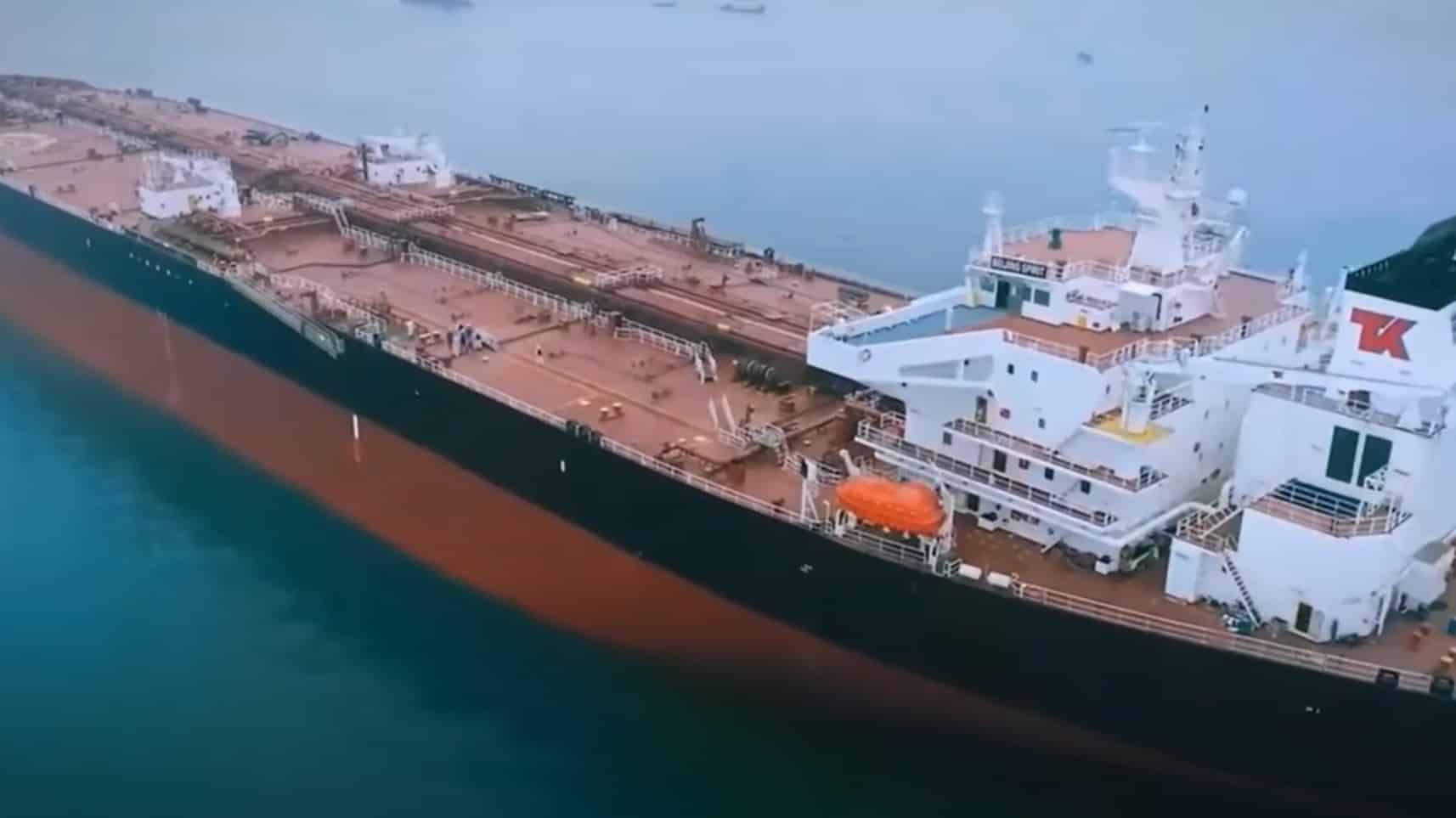
More than 20 crude oil or LNG tankers were spotted by their satellite tracking last Monday 15 August in the centre of the Gulf of Laconia, between Elafonisos and Tainaros, at a distance of at least 6 nautical miles from the coast - some of which were tied together - and several more were anchored west of Kythera waiting for a position to open up.
We have seen it sporadically in the past especially in the neighbouring Messinian Gulf while the 6 n.m. in the Ionian Sea was in force. Now with the 12 n.m. the Ionian Sea has been «closed» to international activities and oil transhipments at sea have moved a little further east, to the Gulf of Laconia, where after February it has been chaos.
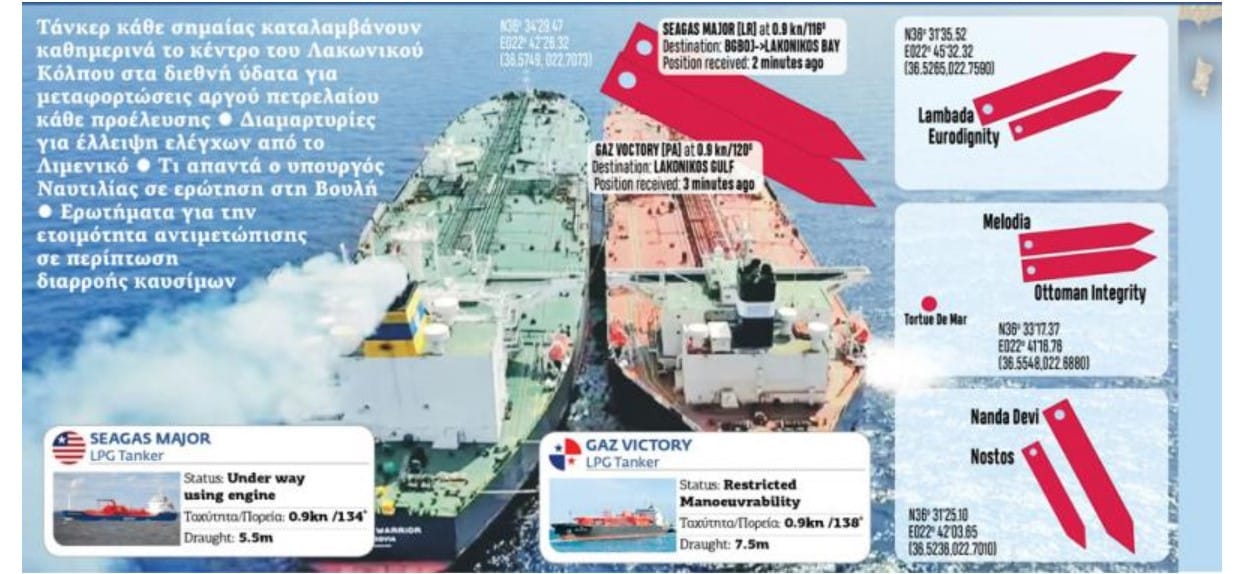
The new area operates as a protected natural harbour, but because it is located beyond 6 nautical miles (just over 11 km) from the coast, the giant tankers are neither inspected for their cargo and activities, nor do they pay docking fees (which in their case are correspondingly... giant).
These are tankers under various flags (Hong Kong, Liberian, Cayman Islands, etc.), most of them of Greek interest, which have started from Russian and Turkish ports or from the Persian Gulf and of course from Greece, as we recorded from the special applications that track ships' routes and cargoes. Indeed, a crew from the German state television channel ZDF recorded on video last week transhipments from tankers belonging to the Russian state shipping company SCF.
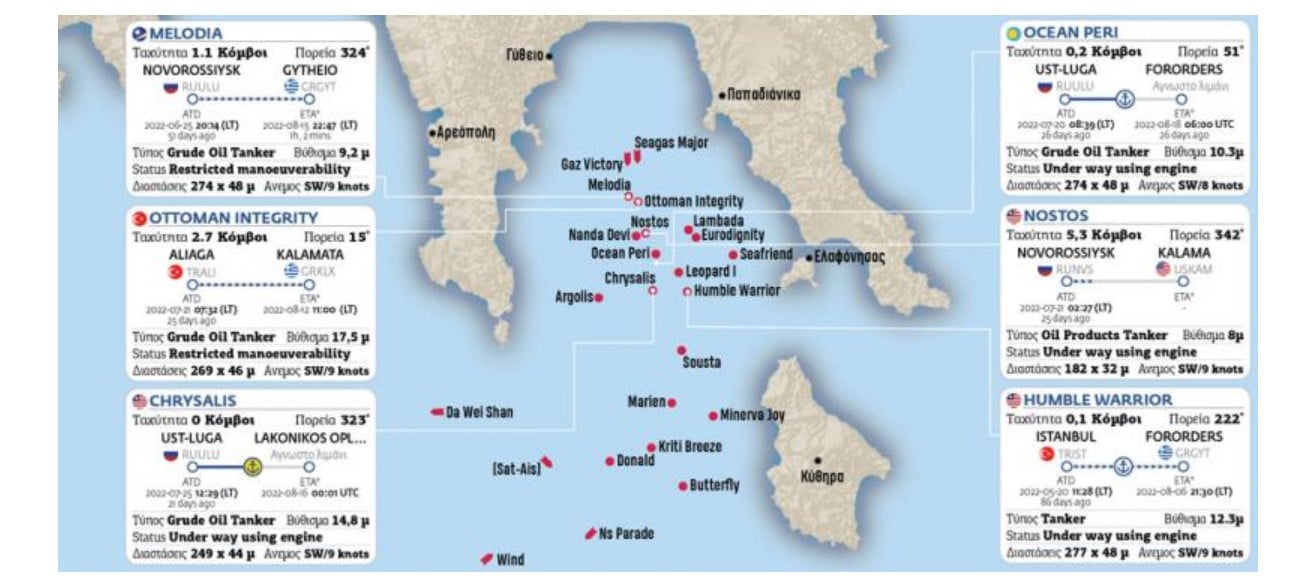
In one night alone (15/8) we recorded, among other things, at least four tankers in the Gulf of Laconia loaded with Russian crude oil from the ports of UST-Luga and Novorossiysk in the Black Sea and two others that started from Bosphorus ports carrying the so-called «Turkish Blend» crude oil, i.e. Russian mixed with residues from the previous transport.
It is common knowledge among analysts at Lloyds, the largest ship insurer, that much of Russian oil exports are origin masked in our part of the world (in international waters), allowing tankers of any flag to be covered by insurance and unaffected by geopolitical balances.
Of course, ship-to-ship (ShipToShip/STS) transshipment of crude oil in international waters is an old practice and many Greek or Cypriot companies specialize in providing logistics services, personnel, tugs and special security balloons.
In fact, according to the research of the Eph.Syn. revealed that similar activities of transhipment of oil products have been carried out in recent months off South Evia, while in an advertisement of a Cypriot company (with presence in Kalamata - Gythio) we read that it covers transhipments in the international waters of Greece - Turkey off Lemnos or off Malta (mainly in the summer months).
It is obvious that these transhipments are not problematic by definition - but they are certainly problematic for the safety of the area and for the absence of controls, especially with regard to the part of MARPOL rules (e.g. Annex 22 Chapter 8) invoking international waters.
Obviously there are questions about the origin of the fuel (the patriots have proven in the past that they do not hesitate to try in cases of embargo), questions that will grow in the coming months as European restrictions on the movement of Russian oil tighten.
The questions obviously do not only concern today, when at the insistence of Greece and Cyprus the EU has allowed for a few more months the transfer of Russian oil from shipowners to Europe. With today's experience it seems impossible to check where the oil comes from and where it goes.
The Ministry of Shipping confirms the complaint
A complaint about the strange and dangerous transhipment activities of oil products was recently made in Parliament by SYRIZA MPs Stavros Arachovitis and Nektarios Santorinios, stressing that in the Gulf of Laconia more than 15, up to... 30 Oil/Chemical or Crude Oil tankers are recorded daily by the AIS tracking system.
In their question they clearly described fuel transhipment operations in international waters and, concerned about the consequences of this uncontrolled activity in the wider Gulf region, noted that the port authorities «although they are responsible for the entire Gulf of Laconia in terms of legality of transactions, environmental protection, navigation safety and rescue control and control of fishing activity, they have no jurisdiction to control these activities» in international waters.
Regarding the part of the country's responsibility within the 6 nautical miles, the two MPs note that it is a closed bay that is particularly environmentally sensitive, with «increased tourist activity in Elafonissos, Neapolis, Plytra, Archangelos, Gythio and Mani, with clean waters that are honoured every year with numerous Blue Flags and significant economic activity due to the wealth of fish».
So they ask the Minister of Shipping «what he intends to do at the level of legislation to ensure that no accident will occur that will destroy the unique environmental, tourist and social ecosystem of Laconia» and of course they ask for answers to be officially recorded, for the type of activity and its safety for the ecosystem of the area, but also information if someone controls the type, legality and safety of these activities.
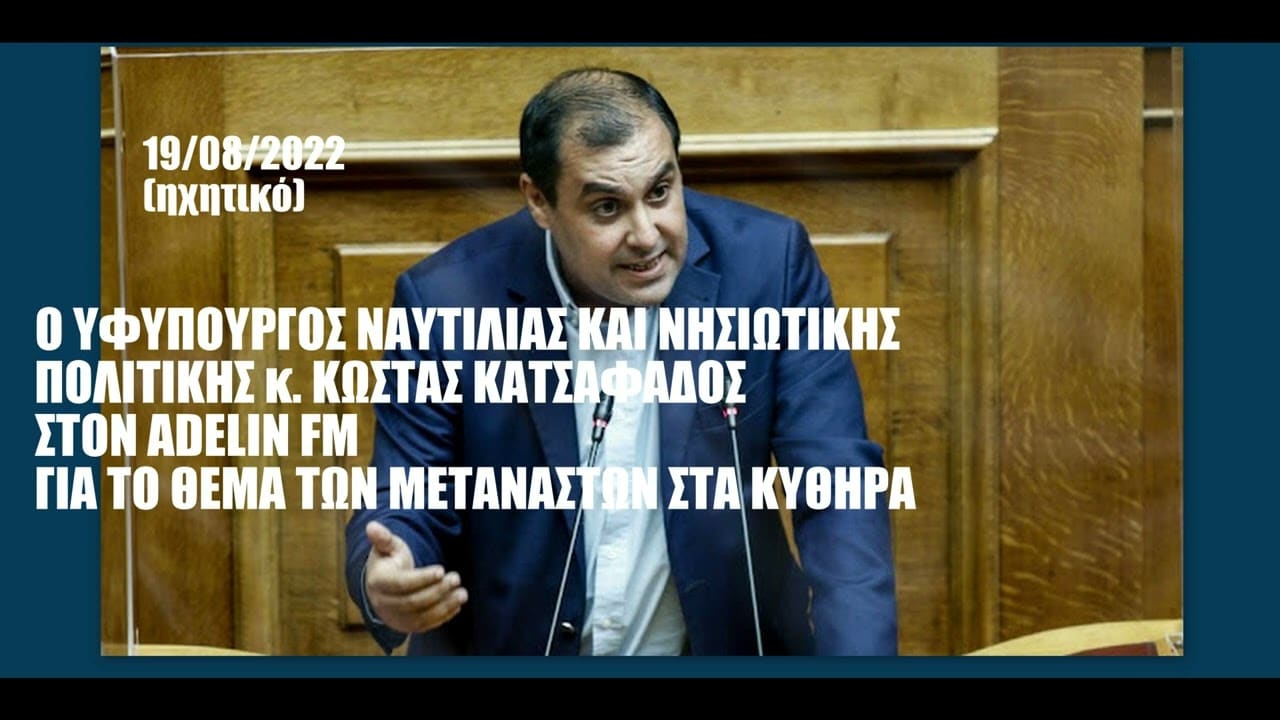
Shipping Minister Yannis Plakiotakis admits in his reply that «the described activities within the Gulf of Laconia concern transfers of oil cargoes between tankers (Ship To Ship/STS Transfer), which take place in international waters, i.e. at a distance of more than six nautical miles from the coast, during which the ships involved do not call within Greek territorial waters».
The Minister notes that «the transhipment of oil cargoes between tankers is a common practice internationally. For this reason, general rules for the prevention of environmental pollution when carrying out such operations are set out in Regulations 40, 41 and 42 of Chapter 8 (VIII) of Annex I of the International Convention for the Prevention of Pollution from Ships (MARPOL 73/78), which has been ratified by our country by Law No. 1269/1982 (A»89)«, specifying that »in accordance with the provisions of Regulation 41, each tanker engaged in STS operations must carry a plan describing how to conduct STS operations, which is approved by the flag of the ship and is formulated taking into account the information contained in the best practice guidelines for STS operations established by the International Maritime Organization (IMO)".
It also points out that «the movements of ships involved in “STS Transfer” processes are monitored by the local Port Authorities, through the AIS system, in real time and if any violation is detected, such as the entry of ships into Greek territorial waters, the procedure for the imposition of legal sanctions is initiated» etc. noting the obligation of the masters of the ships involved that are within the search and rescue area of Greece (according to the Decree 49/2005) to immediately inform the Coastal Centre of our country about any incident or occurrence that affects the safety of the ship, endangers the safety of navigation, may cause pollution of the waters and coasts, etc.
Responses requested
It is of particular interest that the Ministry's announcement lacks answers regarding information on the presence of such tankers at a distance of less than 6 nm or any fines imposed or the possibility of immediate intervention in case of escape of oil products in the marine area, since the nearest special decontamination vessels need several hours to reach the Laconian Gulf from Patras or Piraeus. Besides, merely relying on IMO regulations and practices is no guarantee.
Interestingly, according to the annual pollution incident reports of the Ministry of Shipping, ships are the most polluting means of transport and, surprisingly, the type of pollutant is not oil products, but mainly sewage with waste. However, incidents of pollution with oil products are the most dangerous and require more attention. Indeed, in the nearby area of the Gulf of Navarino and the lagoon of Yalova, there have been many accidents involving oil tankers in recent years.
As all this is recorded, the role of a spectator of the developments in the games of the shipowners does not honour the country.