Article by Georgios Mandakas* and Nikolaos Proutsos
Juniperus phoenicea L. or Juniperus turbinata;
This species in Greece is found under the common names: juniper, palmetto, bush cypress, wild cypress, cedar, tame cedar, fiddlehead, veni, invisible. The previous eastern Mediterranean and Greek references to Juniperus phoenicea actually belong to Juniperus turbinata with a distribution from the Canary Islands to southwest Asia, while Juniperus phoenicea in the narrow sense is found in Mediterranean Spain and France.
Genus Juniperus
The genus Juniperus is the second largest genus of conifers, comprising 68 species widely distributed in semi-arid regions almost all over the world. All but one species grow in the northern hemisphere. The species of the genus Juniperus that grow in Europe form habitats that are classified as priority habitats in the European Union.
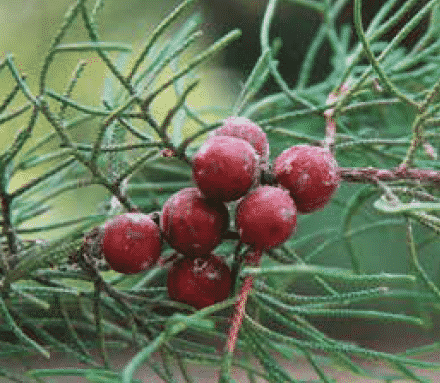
Description: The palm juniper is a shrub or small tree 4-8 m tall. Flowering takes place in March-April. Its fruit, the ray-flower, is almost spherical, 0,8-1,4 cm in diameter. It ripens in the second year after flowering, when it becomes reddish brown and shiny. The seeds are 3-9.
Geographical distribution: Phoenician juniper is spread around the Mediterranean basin, from the Canary Islands and the Iberian Peninsula to Saudi Arabia and the Sinai Peninsula. In Greece, it is found mainly in the central and southern part of the mainland and on the islands of the southern Aegean and Ionian seas. It generally occurs from sea level up to 900 m and in Central Greece (South Fokida) and on some islands up to 700 m (Paros, Naxos, Crete).
Interesting: It is a species resistant to dry stations and is a typical component of the conformation of evergreen hardwoods (macaques) in southern Greece. It is often found in coastal sites with sand dunes, toadstools, degraded scrub, stony and rocky limestone slopes. It is characteristic of the species' ability to colonise and adapt to the particularly harsh conditions of the Aegean islands, which include loose and rocky soils, drought and strong winds. There are ecophysiological and morphological adaptations that make juniper tolerant of high environmental stresses. The stands and hummocks of J. phoenicea are of great importance for biodiversity, as they provide habitat for fauna and numerous floral species, many of which are rare or endemic, such as the narrowly endemic Viola scorpiuroides in Antikythera. The presence of protected oryxes and cyclamen is also common. The occurrence of junipers in extreme environments, where other plant species are difficult to adapt to, means that they are often found together with rare and endemic plant species.
Protection status - conservation status: The arboreal juniper scrub, J. phoenicea, which does not form a high forest, is a habitat included in the European Directive 92/43. The habitat type is 5210: Arboreal matorrals with Juniperus spp. and includes Mediterranean and sub-Mediterranean hardwood shrubs with cedar (Juniperus spp.) species on a variety of substrates and at altitudes ranging from 100 to 900.
This dry-thermal type of vegetation is an aspect of the evergreen hardwood vegetation.
Ecological importance: From an ecological point of view, these bushes are very important, on the one hand for providing habitat (for fauna and flora) and on the other hand for maintaining soil quality (protection from erosion).
The functions they perform are very important especially on islands and other islets where they create a special vegetation environment in the Eastern Mediterranean and the Aegean. Their importance for biodiversity in terms of species, bio-communities and landscape is great as they are usually characterised by a high floral diversity with many herbaceous plants participating in the composition and structure and contributing to the mosaic of the landscape as they alternate with small meadows, topsoils or even seasonal tidal flats.
Usage: The wood of tree-sized individuals (Fig. 6) has characteristic «waters», is relatively heavy, aromatic, has antiseptic properties and mainly natural durability due to its resistance to rot and insect and fungal attack, which is why it is rarely used for furniture, cabinet interiors and interior panels. In our country it is used as a stake for fences and other agricultural implements or, formerly, as a structural element for roof beams. etc.
Threats: Mature junipers are threatened by illegal felling, due to the desirable characteristics of their wood, which was an important building element of construction in the island area. The constant degradation of soils and the adverse natural conditions that characterise some areas are the cause of the low height of the bushes, while in other areas they are the result of anthropogenic influences.
Their greatest threat, however, is their relatively low regenerative capacity, especially after fire, as in most species of the genus. This is confirmed by observations in other areas of the Mediterranean, where it has been found that their regeneration is generally quite low compared to other woody species. This is undoubtedly a species whose natural recovery is difficult and particularly long, while after a fire natural regeneration is almost zero. The Mediterranean dry and hot summer season seems to be a decisive factor in the low regeneration in junipers, which is also aggravated by the limited availability of suitable soils, by the very low seed viability due to non-pollination (hence the high percentage of empty seeds) and by insect and fungal attack. Seed production is erratic and it can take 50 years for plants to reach vegetative maturity.
Finally, their reaction after fires is not effective and therefore efforts to artificially restore their habitat after fires are absolutely necessary, despite the relative difficulty in producing juniper seedlings. In other words, it is a species that is not adapted to the occurrence of fire, a component of Mediterranean ecosystems, and therefore requires concerted, painstaking efforts of artificial restoration.Spore dispersal by mammals, which is typical, is often problematic because they deposit seeds in unsuitable microenvironments.
Status of palm juniper in Kythera
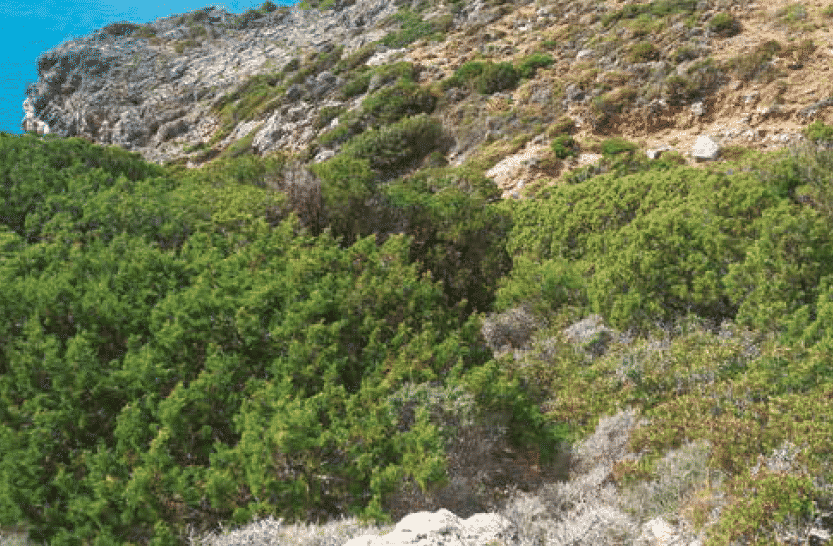
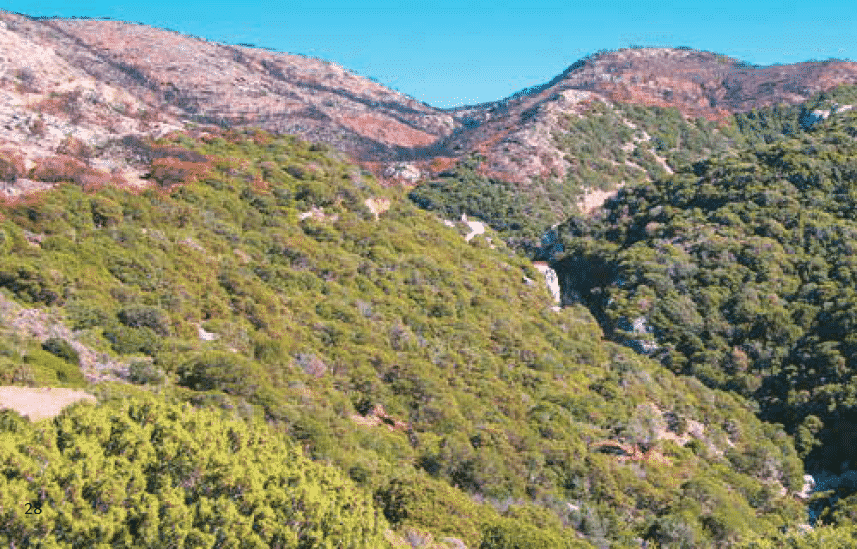
The best occurrence of Phoenician juniper in Kythera is mainly observed on the western slopes of the island in the area of Kalami (Fig. 1) and around the monastery of Panagia Orphani (Fig. 2). There are formations of tall and dense evergreen hardwood shrubs characterized by the dominance of Juniperus phoenicea and secondarily by holly and fir at higher elevations or myrtle and alder at lower elevations. In the wetter places there are also individuals of Cretan maple. Other bush species around the area of Panagia Orphani are the climbing honeysuckle and bear's bush.

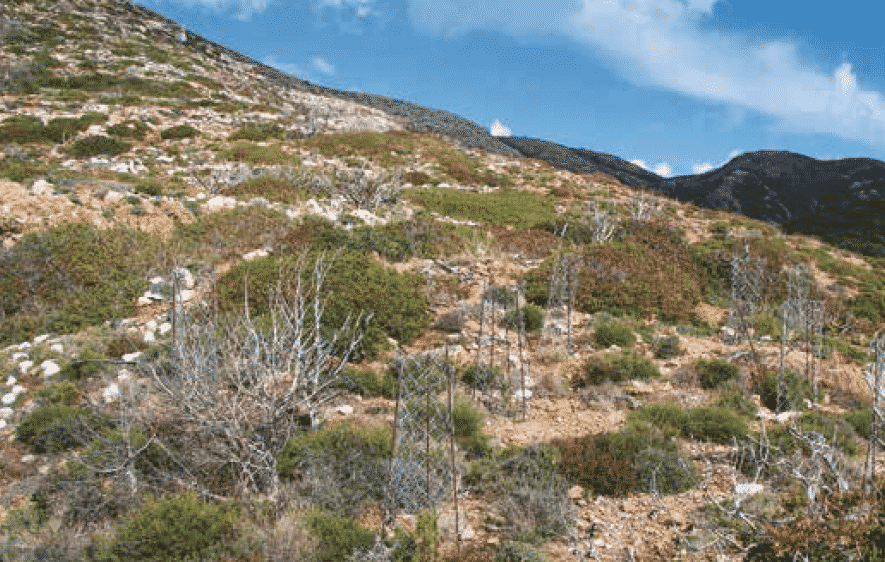
In these well-developed Juniperus phoenicea communities the cover reaches 100% and the plant height reaches 2 or even 3 or even 5 m, when they now take tree form.These compact forms are more distant from areas with human activity. The above vegetation with junipers starts from the western steep slopes up to 250 m. They can also be observed on steeply sloping slopes (60- 70%). Where the vegetation has been destroyed or degraded, various toadstools or herbaceous species grow. Both the 2000 and August 2017 fires burned a portion of this forest (Fig. 2). The reforestation efforts that have been made have been particularly arduous (Fig. 3) but so far appear to be paying off.

Southwest of Mylopotamos, in the area of Limnionas, there was an area of such bushes. The fire that occurred in August 2000, when 1 372 hectares burned, burned a considerable area of juniper palm bushes. After another smaller fire in 2007, the result after all these years is that the habitat has essentially disappeared with the exception of a few patches (Fig. 5) and a few individuals planted in clusters after the fire. Much effort is needed to reestablish the habitat of the palm juniper in the Pond, a species whose restoration, as mentioned, is difficult, long and arduous. However, these efforts concern a valuable woody, bushy or even arboreal species that is perfectly adapted to difficult soil and weather conditions, but not to fire.
Bibliography
Angelidis H, Georgiadis N, Kordopatis P, Portolou D, Tsiopelas N (2017) Inventory and Evaluation of the Natural Environment of Kythera and Antikythera. Athens: Mediterranean Institute for Nature and Man - Hellenic Ornithological Society.
Giannitsaros A. G. (1969). Contribution to the knowledge of the flora and vegetation of the island of Kythera. PhD thesis. Physico-mathematical School of the Kapodistrian University of Athens.
Pavlidou Eleni (2016) Environmental factors affecting the spread of juniper (Juniperus phoenicea L) bushes in Northeast Attica. Diploma thesis. Harokopio University of Athens.
Dimopoulos P, Raus Th, Bergmeier E, Constantinidis Th, Iatrou G, Kokkini S, Strid A, Tzanoudakis D (2013). vascular plants of Greece: an annotated checklist.Supplement - Berlin: Botanischer Garten und Botanisches Museum Berlin Dahlem; Athens: Hellenic Botanical Society
* George Mandakas is a forester, a specialist scientist at the Institute of Mediterranean Forest Ecosystems and Forest Products Technology of the Hellenic Agricultural Organization «Demetra»
The text is republished from the magazine «NATURE» of the HELLENIC NATURE PROTECTION ASSOCIATION (Issue 160), which is released with the tribute: «The journey to the rebirth of Kythira»