British policy on the representation of men and women
Gaining the political vote was a gradual process for both men and women in Britain. As far as the electoral system is concerned, from 1750 to 1832 there was no constitutional change. Only men holding property or office were entitled to vote and therefore only British men could be members of the House of Representatives; indeed the House of Lords (life members) could repeal any law previously passed by the House of Representatives (elected members). Neither women nor all men still have full political rights since there is a total exclusion of the working class from elections. Therefore, the issue of voting in Britain is a class problem in addition to a socio-political issue of any gender segregation. The Great Reformation of 1832 opened the way to the vote for male subjects in the empire who owned property. Women's suffrage comes up for debate in Parliament but receives no support. Men were left unsatisfied no doubt as only one in seven Britons were currently eligible to vote. The above frustration gave birth to the short-lived Chartist Movement from 1839 to 1848 when men for themselves demanded the extension of the male vote from 21+ years of age with petitions of support to Parliament.
Active woman suffrage became the main electoral parameter by the Liberal candidate John Stuard Mill when he raised the issue in 1866 with an official Memorandum, while in his book Station The Enslavement of Women he advocates political equality between men and women through education. However, the Second Reformation of 1867 left women out of the new bill even if they owned personal property. Finally, the Third Reform, which took place in 1884 when Liberal William Ewart Gladstone was Prime Minister, again leaves women out of the legal vote and/or election, even though women had supported Liberal policies on many occasions. With the above reforms of the 19no century, the selective male electorate stands at 4.5 million men, or 60% of the male population in Britain - yet men are still excluded on the basis of class and low income. Since then the political movement of men and women for the vote has intensified the social struggle.
Emmeline Pankhurst, an important personality
Emmeline Pankhurst (1858-1928), née Goulden, was a leading figure in the British women's suffrage movement. Her work began in 1870 with the Local Board of Public Education to improve the Education Act and related social legislation. With her husband Richard Pankhurst, a champion of women's social and political emancipation, he with a strong record of political activity for women's suffrage, later founded with her the first activist Group for Women's Right to Vote (1889). The lawyer Richard Pankhurst as early as 1870 had drafted a bill introduced in Parliament by the radical Liberals Charles Dilke and Jacob Bright who were in the line of John Stuard Mill. But the House of Representatives rejected this proposal by Richard Pankhurst. So Emmeline and Richard Pankhurst joined the Independent Labour Party. In 1898 Richard Pankhurst died. In 1903 Emmeline Pankhurst alone now founds the Social and Political Union of Women (WSPU: Women's Social and Political Union). In 1919 she emigrated to Canada where she remained until 1926 and died in 1928 - she passed away having just fulfilled her goal in the same year (1928) when women in Great Britain were granted full political equality with men, the political rights of suffrage and suffrage.
The Women's Social and Political Union (Manchester 1903)
Η Social and Political Union of Women is founded by the energetic Emmeline Pankhurst in October 1903 with a group of women from the Independent Labour Party in Manchester, where as early as 1870 the newspaper Women's Suffrage Journal by Lydia Becker. Η Social and Political Union of Women was more closely identified than other women's organisations with the struggles of British women for the vote at the beginning of the 20th century, and this is because their actions and militancy have been remembered in historical memory. Their key slogan was the iconic «Vote for Women» which they wrote everywhere and even published a magazine of the same name Votes for Women and in 1907 they start publishing the newspaper Suffragette. Purple and green become their propaganda colours on hats, handkerchiefs and other everyday items. There was general coordination of actions and the steely will of all members of the organization. Three periods can be distinguished in the activities of this association: (a) the pursuit of all kinds of publicity, either negative or positive (1903-1908); (b) the disturbance of order (breaking of windows, chaining, attacks on politicians) with the ultimate aim of being arrested, going on hunger strike and embarrassing the government (1908-1913) and finally c) hardening their stance culminating in the death of suffragette Emily Wilding Davison (1913-1914).
Violence and Activism for Social and Political Union
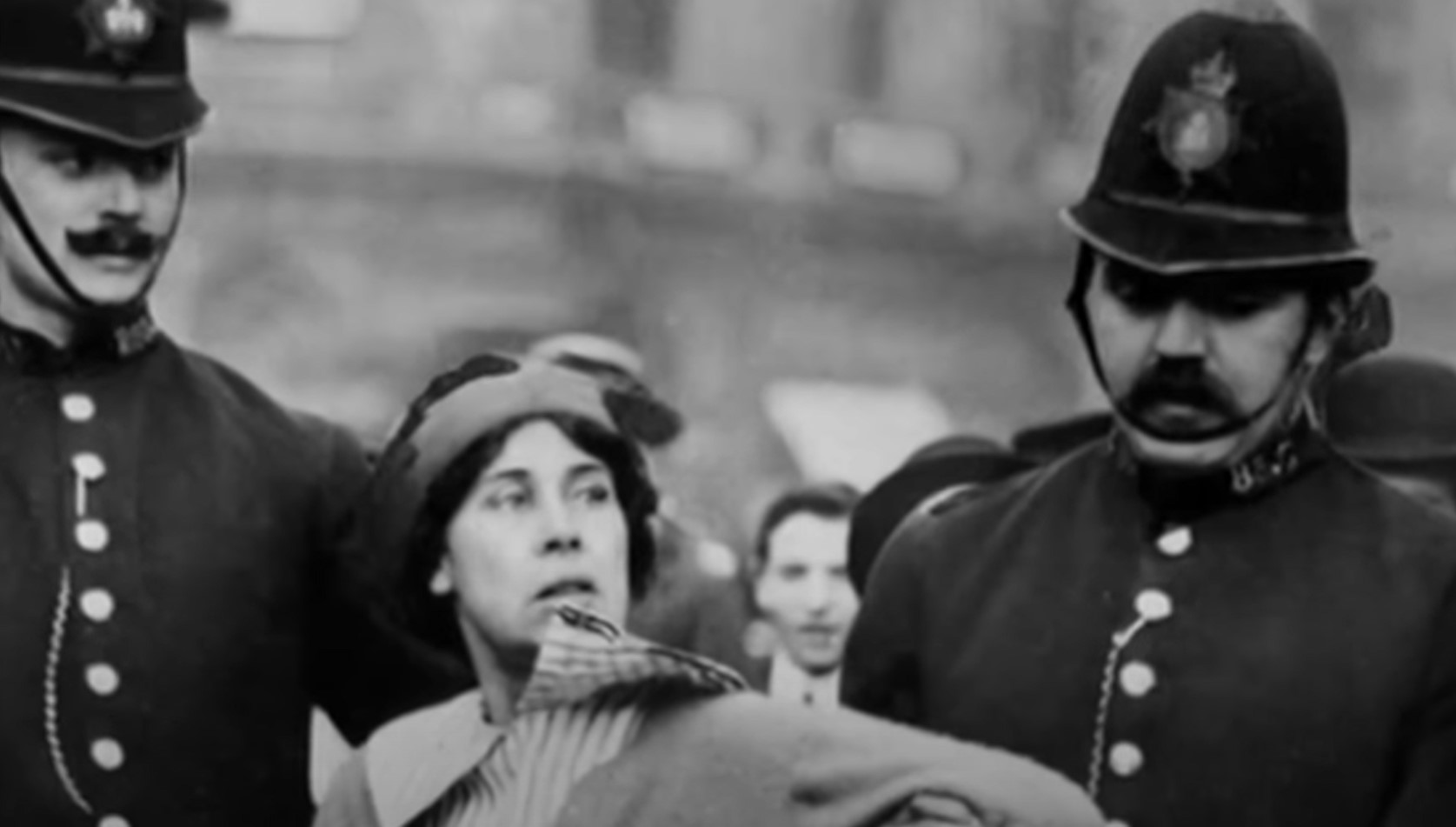
The neologism «Suffragette» appearing in the British newspaper Daily Mail (1906) is but the name given to accurately identify the activist of the Women's Social and Political Union when its members made sensationalist gestures with the ultimate aim of attracting the spotlight. The women's organization under Emmeline Pankhurst, the Social and Political Union of Women gradually adopted struggle and political activism consciously as a method of pressure on the deputies. Their aim was to impress and shock with symbolic violence. For these actions they were often arrested, fines they refused to pay were imposed and they were punished with imprisonment, during which they forced themselves to go on hunger strikes to the point of extreme extermination. Emmeline Pankhurst herself between 1908 and 1912 was arrested a total of six times.
It was the first case of people of urban origin who clashed with the police and were imprisoned without being granted the rights of political prisoners. The Union was initially non-violent in orientation. Its gradual conversion took place in stages. On 12 May 1904 Emmeline Pankhurst as the official representative of the Independent Labour Party supported with a group of textile workers and 400 women from the Women's Co-operative Union a bill being debated that day for women's suffrage. To this end they stood outside Parliament only to eventually receive the rejection of the legislation amidst derisive comments and derision from male legislators.
Evolutionarily, they have since then turned to direct activism and open confrontation with the government of the day and the British state. A similar such harassment occurred on 13 October 1905 when a shift from peaceful assertion to violent activity was noted: Christabel Pankhurst, the daughter of Emmeline Pankhurst, together with the worker Annie Kenney, the two girls enter the Manchester Shopping Centre with the following question: «Will the Liberal Government give women the vote?». This action is recorded as the first strong protest by the Suffragettes. Only their presence there went against the male establishment. At a political rally again in Manchester in 1906, the above question was repeated by Hanna Mitchell to Liberal Winston Churchill and Sir Edward Gray.
Developments would be rapid from then on and their vandalism intense: the Suffragettes refusing to pay taxes and cooperate with the police, burning churches because the Anglican Church did not support women's suffrage and breaking windows on Oxford Street, one of London's most commercial streets. They go so far as to chain themselves to Buckingham Palace because Queen Victoria and the royal family were opposed to their demands and they also sail the Thames in boats they hire, protesting against Parliament, and rumours have it that they are also targeting certain political figures such as David Lloyd George.
On June 4, 1913, Emily Wilding Davison in a moment of extreme protest fell at the feet of the royal horse during the races in front of the royal family and a crowd of people and was fatally injured. The horse races back then were not just horse races, but were mainly of a social nature since all the British elite gathered there. The highly educated Suffragette Emily Wilding Davison (1872-1913), highly educated at the Universities of London, University of London, Royal Holloway and Oxford University, had joined the Union in 1906 and because of her activities was imprisoned several times between 1909 and 1912. Emily Davison is the first martyr of the women's movement.
Vindication for the Suffragettes
In the summer of 1914 before the war, the Liberals, worried by the convergence of Labour and Suffragettes, then began «peace» talks in order to find a solution. George Lansbury and Sylvia Pankhurst, representing East London Suffragette Association. It even seems that things would have had a happy outcome if the war had not broken out. Women's right to vote was recognised after the war and was granted in two phases, in 1918 partially and in 1928 fully.
The First World War ends in November 1918. From March 1917 the House of Representatives endorses the partial extension of the parliamentary vote. The Representation of the People Bill is ratified in 1918 with 385 votes in favour and 55 against. Women are treated as citizens this time: active voting rights are given to unmarried women over 30 (voting) and passive voting rights to all women over 21 (voting), but those who own property or are university graduates and those who are married to a man who can vote or who are married to a man who can vote, provided they are themselves heads of household or pay a rent of more than £5. At the same time men are granted the right to universal suffrage: now all men over the age of 21+ are entitled to vote in Britain.
The negative side of the 1918 law is that women workers were again excluded because they were too young and of course because they had no property. The bourgeoisie seemed to benefit the most. The fact is, however, that this electoral arrangement no longer speaks of man, but of people in the wake of John Stuard Mill's ideas. The electorate is 21 million where 8.4 million are women voters (about 40%). British women vote for the first time in 1919 and in the same year the legal profession was opened to women with the «Representation of the People Act». The ultimate vindication would come ten years later. On July 2, 1928 the men and women will now be politically equal. Women in England are given equal political rights with men from the age of 21+, without any kind of class or economic restriction.
In 21 European countries women's suffrage was introduced after World War I, with the bright exception of Wyoming, USA, where women had been voting since 1869. Women's political participation was effortlessly accepted in countries where there was little or no class rivalry; New Zealand, for example, was the first country in the world to give women the right to vote in 1893 and to stand for election in 1919, just four years after full political rights for men. In 1906 Finland became the first European country to give both women and men (over 21 years of age) the right to vote after the country's liberation from Tsarist rule (1809-1917); women had contributed to the national effort by keeping Finnish culture alive and teaching their children the Finnish language. Finland's example was followed by Norway a year later because women's organisations supported the country's secession from Sweden.
In the case of the Nordic countries, there is a kind of recognition of the previous adverse situation and rehabilitation immediately afterwards. In contrast, in the case of England, the positive outcome for women seems to have been a combination of individual factors: the social activity of women before they reached the point of effectively claiming their vote, the pre-war energetic preparatory work of the Suffragettes in this direction, and the post-war goodwill resulting from women's contribution to the Great War. The change in the political scene played an important role, of course, when David Lloyd George took over as Prime Minister in 1916, who was more conciliatory than his predecessor Herbert Asquith and himself looked favourably on women's political rights.
International Political Movements
At the international level, there is a constant ferment on the issue of women's suffrage. The demand for women's political rights has been first raised by American women. In 1850 in Massachusetts the first American convention for women's rights takes place, inspired by the liberal ideas of John Stuart Mill, and in 1890 the National League of American Women for the Vote, so international understanding is gradually beginning. In 1888, an International Congress meets in the US capital with the participation of a few Europeans from France, Finland, Ireland and Denmark. England is then represented by Alice Scatcherd (Leeds), Laura Ormiston Chant and Margaret Dilke. Elizabeth Cady Stanton closes the conference. From this International Congress was born in the same year the International Council of Women.
But Elizabeth Cady Stanton and a group of British women envisioned the establishment of an international women's suffrage organization, an idea that was met with opposition but eventually realized. And so in 1904, from the sparrows of the International Council the International League of Women's Vote. The core is made up of women with a radical orientation who broke away from the conservative International Council of Women. In the 1920s the international union would be renamed the International League of Women's Vote and Equal Civil Rights because of the new times that require a different orientation and is represented in Britain by National Union of Associations for Equal Civil Rights.
A Historical Assessment
The women's struggle for the political vote is inextricably linked to the British Suffragettes. The long-running «first wave» has on its agenda the three major social issues of work, education and voting, i.e. the important bourgeois political right to vote and be elected for women from 1850 to 1950. This was a direct result of the Industrial Revolution, which took place mainly in Great Britain and gave birth to the two movements of trade unionism and feminism. The British history of women's suffrage is similar, mutatis mutandis, to that of universal male suffrage. However, the democratic right to vote is synonymous with the political emancipation of the female sex. And although in the example of England male and female suffrage go together, the conquest of the vote has not been seamless for women, unlike the male vote, which has followed a straight and smoother path. Men seem to have been ahead of women in the political vote because of their already acquired civil liberties, while women simultaneously added to their agenda the struggles for civil, political and social liberties.
The history of the Feminist Movement today is in flux as the first demands from the «first wave» resurface in perpetual cyclicity. Women's work in the West has again gone from a social conquest to a post-feminist stake in the 21st century.ο century when sexual harassment in the workplace is re-emerging as a major obstacle to advancement in professional contexts. Women's education and especially academic careers are often interrupted either by reasons of nepotism or patriarchy when gender transforms hierarchy into class oppression. The political equation that in practice is broken down when men outnumber women in parliaments becomes a phoenix of egalitarianism when laws are drafted and passed by males only or a few women. However, the contemporary trajectory of the feminist movement has been a reversed direction, where without lights of real democratisation the path is dead-end and often misguidedly conservative.
*THE C. G. Tsatsani is a philologist - comparativist
Author of the article:

Georgia Tsatsani is a philologist and comparative literature scholar.