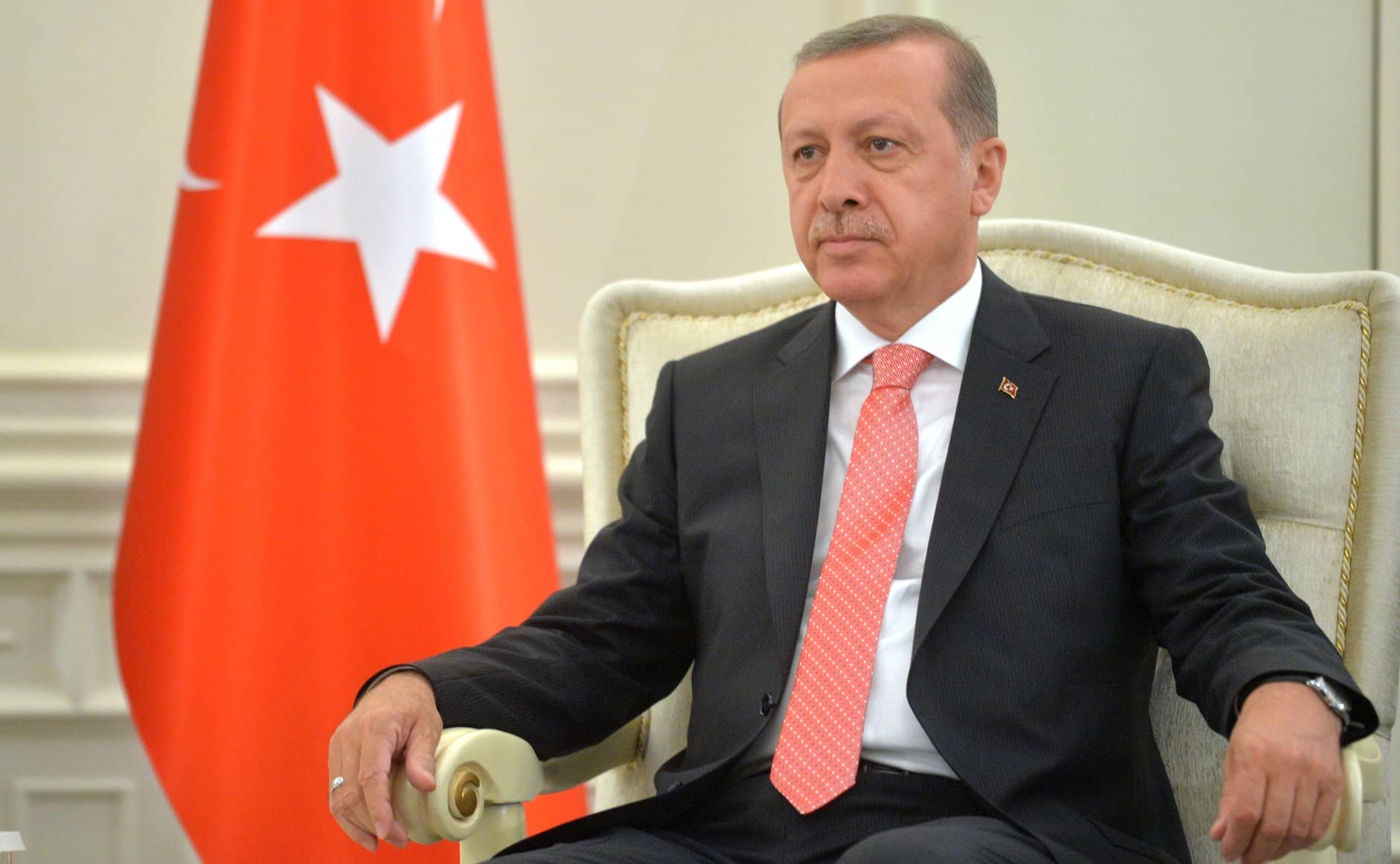
He must be very cramped. Recep Tayyip Erdoğan. On the one hand, America's Joe Biden He openly shows that he «doesn't like him» and has already opened channels of communication with his former colleagues, such as Ahmet Davutoğlu. On the other hand, the domestic opposition accuses him of wasting $128 billion in 12 months to support the Turkish lira, money that has gone up in smoke. Since 2017, the Turkish currency has lost 50% of its value. and the downward trend continues.
Moreover, Turkish aggression towards the West inspires anything but confidence in international markets, which believe that the Turkish economy is seriously ill. Beyond all this, US President Joe Biden recognized the Armenian genocide, which in itself speaks volumes. According to members of the US Foreign Affairs Committee, the presidential initiative «is a clear message to Turkey that must get back into the fold and cooperate with NATO, creating a cordon around Russia.» Russia, China, and Iran are considered the three major priorities of US foreign policy.
This means that despite the US's orientation towards Asia, it is by no means certain that the US will leave the Mediterranean, Africa, and Europe, its most reliable allies, out of its priorities. It is clear from this point of view that they are currently showing Turkish President T. Erdogan that they are well aware of both his games and his far-reaching imperial ambitions, which are considered excessive. At the same time, especially The Biden administration has long been in complete disagreement with Turkey's stance toward Russia. and asked the Turkish side to abandon the S400 supply. Of course, for many reasons, this did not happen, which certainly hastened the American decision to recognize the Armenian genocide.
In this context, Turkey's participation in the F-35 program was officially canceled, a move with significant negative implications for the prestige and future course of the Turkish economy.
Another blow is the travel advisory from the US State Department for American tourists, who are discouraged from visiting our neighboring country.
All of the above developments are indicative of the problems posed by Turkey's anti-Western policy., which is now also bothering powerful Arab countries. The latter, far from wishing to resurrect the Ottoman Empire, are now making this clear. in their visible and invisible contacts and cooperation with Israel, Greece, and Cyprus. If we add Egypt, Turkey's sworn enemy, to this network Muslim Brothers, then the climate for the Turkish president and his system of power becomes particularly heavy but also slippery at the same time.
Beyond the above, From an energy perspective, Turkey is no longer a key country for Europe.. With Kavala becoming an energy hub for the transport of liquefied gas in Europe and the upcoming operation of the pipeline East Med, the construction of which has already been approved, the landscape is changing in our wider region.
Europe is gradually becoming independent from energy sources controlled by third countries. Very soon Turkey will be bypassed. After all, it needs enormous amounts of energy, which it is trying to cover by controlling the sources in the Eastern Mediterranean and by building three nuclear power plants.
Under current circumstances, this Turkish effort is not facilitated by the geostrategic reality. And this fact is the most serious problem for Tayyip Erdogan, as Greece's role in the Eastern Mediterranean is becoming increasingly important. This role is vividly described in a recent article-analysis in the British newspaper The Times. In its presentation, the British newspaper points out that Greece and Cyprus take on security role in the Eastern Mediterranean, in cooperation with Gulf countries.. The United Arab Emirates (UAE) is described as the driving force behind new initiatives and Arab opposition to Turkey's intense flirtation with radical political Islam.
According to the latest report by the European Council on Foreign Relations (ECFR), Turkey is causing nothing but mistrust and is now considered by the EU to be a «problematic player» that requires very careful handling.
Under these circumstances, the EU does not expect anything positive to come out of the five-party talks in Geneva, while it does not rule out further displays of bravado from Tayyip Erdogan, an Islamist who thirsts for power and money.
By Ath. H. Papandropoulos