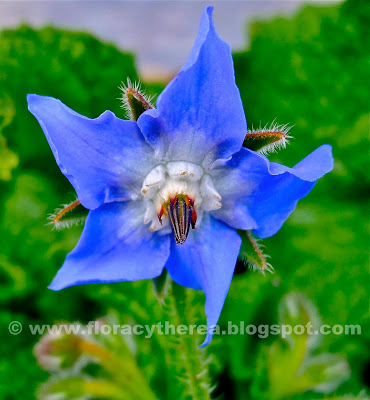
Borago officinalis L.
Buranca, Vatsinia
Annual plant originating from the city of Aleppo (Halab) in northwestern Syria. As an epigenetic plant it is now native to most of Europe, North Africa and North America. It is cultivated as an herb with enviable medicinal properties, but also as a vegetable.
The scientific name is derived in one version from the Latin burra>borra meaning rough woolen cloth because of the appearance of the plant, which is hairy. In another version the name comes from the Celtic word barrach meaning “brave man” ( Henslow), since since ancient times borago is thought to have a positive influence on the human psyche. A third view claims that it is a corruption of the Latin word cor = heart + ago = promote.
The adjective officinalis is derived from the noun opificina>officina = laboratory, warehouse > herb store > pharmacy, officinalis = medicinal
Pliny the Elder mentions that mixing it with wine makes a drink euphrosynon that drives away fear and depression and fills the soul with courage and optimism. According to Dioscorides, borago was Homer's famous infusion which, in wine, brought total oblivion.
Even today, in many parts of the world, the flowers are used for decoration in salads and summer cocktails or as sweets, to give joy and mental euphoria. Its tender shoots are used in salads and have a fresh taste reminiscent of cucumber. ( In Crete one of its common names is αγγουρίτσα.) The fresh leaves are eaten raw or boiled. The famous Green Sauce made in Frankfurt contains, among other herbs, borage. The seeds are used to produce oil rich in gamma linoleic acid, which is extremely valuable in the cosmetics industry.
Some people associate it with the boglossom, a name commonly attributed to the species anchusa officinalis (see earlier post anchusa italica). However, all three plants, which belong to the same family, have similar properties.