«We continue with the same determination and constant vigilance, on the path we have charted, fully aware of the new challenges that are emerging. We are continuing the impressive recovery of 2021 so that it can translate into strong growth in 2022,» emphasized Finance Minister Christos Staikouras at the conclusion of the five-day debate in the Plenary on the 2022 Budget.
He accused the leader of the official opposition of choosing the slippery slope of extremism, irresponsible populism, and polarization at a time when unity, solidarity, responsibility, prudence, and sobriety are needed..» The ND government, he said, «plans and acts prudently and responsibly, has its feet firmly planted in the real world, and seeks with wisdom to shield the country and make the living conditions of all citizens continuously better,» while SYRIZA «engages in a sterile and fruitless confrontation without substantiated arguments or well-thought-out counterproposals. It points fingers at us without offering anything of substance to the political dialogue. It invites citizens to take new flights into the pink clouds of populist promises. However, citizens have had unpleasant experiences since the previous ride turned into a nightmare due to constant air pockets, and that is why the invitations of the official opposition fall on deaf ears.’.
He accused the official opposition of «seeing only disaster everywhere, despite the fact that there is evidence that the economy is recovering steadily, sooner than expected.» You are, he said, «the only ones who say we are on the wrong track, when everyone in Europe recognizes that we are heading in the right direction. You are constantly complaining, despite the fact that the country is gaining recognition and praise from partners, international institutions, rating agencies, financial organizations, investors, and, above all, Greek society.».
On a personal note, he addressed the president of SYRIZA, saying, «Mr. Tsipras, you remain captive to a world of self-delusion, pessimism, populism, irresponsible one-upmanship, and missed opportunities. In an endless navel-gazing, you either do not want to or cannot read the signs of the times.» He reminded him that the same predictions he made today, that “the government will not succeed, will have weak growth, business closures, and unemployment,” were also made last year, «but the results prove you wrong.» This will be the reality «that will prove you wrong again in what you say about the budget being fictitious and falling short.» Throughout the crisis, Mr. Staikouras said, the measures we took seemed inadequate to you, but we provided the fourth largest support package based on GDP worldwide, noting that at the same time, all economic indicators are improving. We have managed to get the country to borrow at historically low costs.
The Minister of Finance stated that «the New Democracy government, led by Prime Minister Kyriakos Mitsotakis, governs with seriousness and foresight. It is moving forward under the banner of responsibility, not the flag of demagoguery,« and he reflected »what the course of Greece would be if, in this extremely demanding period, Kyriakos Mitsotakis and New Democracy were not at the helm of the country.«.
He emphasized that even «in this period of intense turmoil, the government's economic policy is paying off. It is yielding tangible, measurable, multifaceted results that strengthen its position and prospects. With results that serve as a springboard for Greece's further, all-round progress, making 2022 the starting point for a dynamic growth path.’ In particular, he mentioned the seven goals for 2022, which are: Achieving high rates of economic growth from 2021, which is already being achieved. Achieving sustainable growth with a significant increase in investment and exports from 2021, which is already being achieved. Reducing economic inequalities from 2021, as poverty is already declining and we are optimistic that there will be further progress through dynamic growth and increased employment. The country's exit from the Enhanced Surveillance regime in 2022. Achieving a single-digit percentage of »red« loans in bank portfolios in 2022, with systemic banks already achieving this from this year. Achieving realistic primary surpluses from 2023 onwards through strong and sustainable economic growth. Obtaining investment grade status by 2023.
The finance minister said that achieving these goals is entirely realistic. He set eight priorities, which are: Targeted support for households and businesses until normality is restored from the effects of the health crisis. To this end, support measures amounting to €3.3 billion have already been included in the budget for 2022. He also announced five additional interventions:
1. The payment of the first of the 60 interest-free installments of the refundable advance payment is postponed from January 31, 2022, to June 30, 2022.
In addition, the entire refundable amount can be repaid by March 31, 2022, with a discount of 15% on the amount to be refunded.
2. The expiration date of credits issued under the Fixed Expenditure Program is extended until June 30, 2022.
3. The SYN-ERGASIA Program is being extended with the subsidization of part of the wage and insurance costs for employees until March 31, 2022.
4. As we are currently discussing in Parliament, the reduced VAT rates for goods used in dialysis, as well as personal protective equipment and hygiene products for protection against viruses, will be extended until June 30, 2022.
In addition, the suspension of the obligation of Chronic Hemodialysis Units to pay 5% of the hospital fees they collect to the State is extended until June 30, 2022.
5. From 2022 and for 3 years, selected expenses related to the green economy, energy, and digitization will be deducted from the gross income of small and medium-sized enterprises at the time they are incurred, increased by up to 100%.
The second priority, Mr. Staikouras said, is to provide targeted support to society from the effects of the international energy crisis, which is placing a significant and growing burden on households, especially the most vulnerable. That is why we are taking initiatives both within Greece and abroad. We are implementing measures to permanently increase citizens' disposable income in order to support their purchasing power. These include measures to reduce taxes and social security contributions, as well as successive increases in the minimum wage. At the same time, we are implementing short-term measures to address the energy crisis.
– We are increasing the state subsidy for electricity and natural gas bills.
– We are increasing the heating allowance by broadening the income and asset criteria.
– We are doubling the amount of the minimum guaranteed income for the month of December.
– We provide additional support to low-income pensioners, increased for each dependent member.
– We provide additional assistance to people with disabilities.
– We are planning to reinstate the special consumption tax on diesel fuel for farmers.
– We are reducing VAT on animal feed.
To date, the total amount of short-term interventions alone to limit the impact of rising costs on family budgets amounts to €1.1 billion. Obviously, given the current situation, this is not enough, as it only covers part of the growing problem. That is why there will be additional interventions!
The third priority is to continue implementing a prudent fiscal policy, with a view to further reducing taxes and strengthening social policy measures. We are taking advantage of the fiscal space created by the economy's strong performance and the increase in national wealth, distributing it fairly throughout society. For example:
– The first stamp is provided to young people who have no previous work experience.
– Insurance contributions for new employees are subsidized.
– OPEC is being strengthened in order to pay family allowances and allowances for people with disabilities, and to finance other social actions, such as the provision of school meals.
– Social welfare centers and other welfare agencies are funded.
– The «Housing and Work» program for the homeless is being implemented.
– The circle of beneficiary families for access to nurseries and kindergartens is expanding.
The fourth priority set by Mr. Staikouras is to continue implementing a smart publishing strategy, with the aim of maintaining strong cash reserves so that we are secure in the face of any external turmoil and changes. With initiatives such as:
– regular and coordinated access to money and capital markets,
– managing the obligations of the existing public debt portfolio,
– the early repayment of part of the bilateral loans that Greece took out with eurozone countries in 2010,
– the completion of the repayment of loans from the International Monetary Fund.
The repayment of the International Monetary Fund initiated by the New Democracy government is being implemented by the New Democracy government and will be completed by the New Democracy government.
The fifth priority is to strengthen liquidity in the real economy through policies such as, among others, broadening the scope of businesses that are potentially eligible for loans from the banking system, and utilizing the loan portfolio of the Recovery and Resilience Fund.
And sixth, the implementation of structural changes, such as:
– Tax incentives to further increase electronic transactions.
– Granting an increased deduction for expenses related to the green economy, energy, and digitization.
– Incentives for business growth.
– Strengthening the capital market.
– Integrating the environmental dimension into the budget.
– Overview of expenses and income.
– Continuing to make the most of public property.
Specifically, plans are underway, among other things, to develop the property in Gournes and the regional ports of Alexandroupolis, Kavala, Igoumenitsa, and Heraklion, the completion of the tender for the concession of the Kalamaria Marina, the launch of procedures for the development of the Pylos and Lefkimmi Corfu Marinas, and the preparation of the tender for the re-concession of Attiki Odos.
As a seventh priority, he set the rapid and optimal utilization of European development tools and resources, such as those of the Recovery and Resilience Fund and the new NSRF, contributing to a substantial reduction in the investment gap.
And as an eighth priority, the country's active participation, as has been the case for the last 2.5 years, in shaping the new European economic architecture, which must ensure the long-term stability and sustainability of public finances, while strengthening recovery from the shock of the pandemic, providing the necessary flexibility to manage the economic cycle and ensuring successful response to future crises. It should protect and encourage public investment that boosts economic growth, with a focus on priority areas such as the green and digital transitions.
The new architecture must strengthen national ownership of its provisions, through a framework that includes positive incentives, and maximise synergies between the components of the overall policy mix.
The Minister of Finance concluded by saying, «We are continuing, with the same determination and constant vigilance, on the path we have charted, fully aware of the new challenges that are emerging. We are continuing so that Greece can stand out and inspire even developed economies. We are continuing the impressive recovery of 2021 so that it can translate into strong growth in 2022. We owe it to our country. We owe it to the Greek people. We owe it, first and foremost, to the younger generation.»
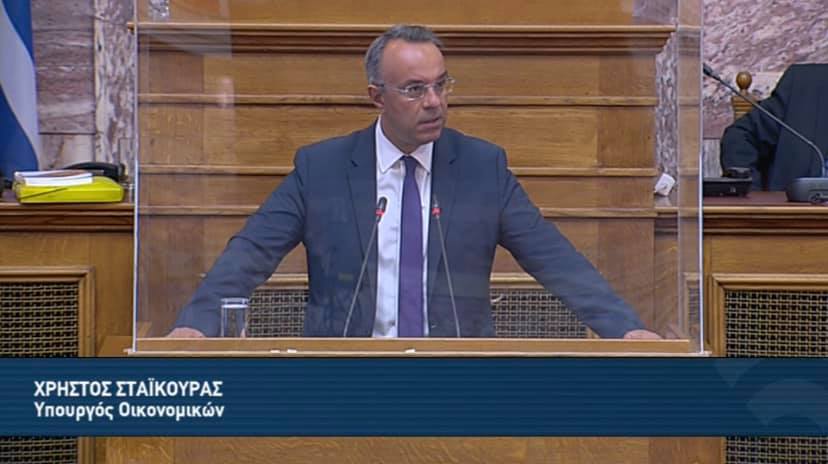
Chr. Staikouras: The New Democracy government is grounded in reality, not in SYRIZA's rose-colored glasses.

📢 Stay informed!
Follow Kythera.News on Viber. Be the first to hear the island's news.








Popular Categories

Previous article
Next article