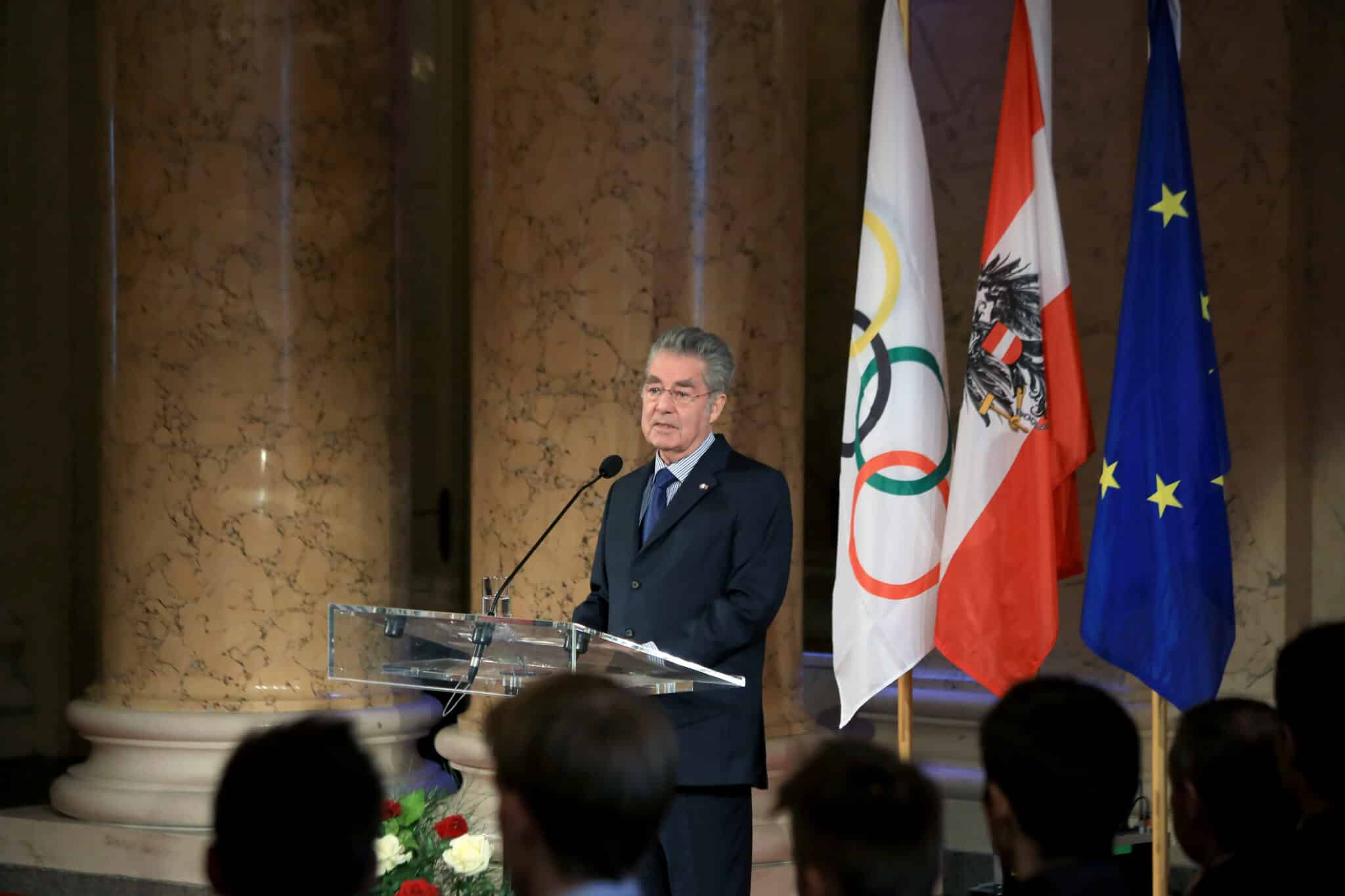
A very important, wise, and unique step toward supporting economic recovery in Europe and support, particularly for economically weaker countries, characterises the Recovery Fund of the EU, former President of Austria from 2004 to 2016, Heinz Fischer.
In an interview with APE-MPE, on the occasion of his participation this year as a speaker at the Delphi Economic Forum, which will take place May 10-15, he believes that A European framework for vaccination certificates is urgently needed to get the international transport system and freedom of trade and travel up and running again.
When asked about the main challenges after the coronavirus season, Heinz Fischer responds that the impact of COVID-19 The impact on the global economy is enormous, and the consequences will be felt for many years to come.
On the occasion of this year's 200th anniversary of the start of the Greek Revolution, the former Austrian president sends a message of congratulations to the Greek people., emphasizing the good and friendly relationship between Greece and Austria.
Furthermore, he openly advocates the need for greater solidarity and effective European management of migration, as well as a fair distribution of burdens. At the same time, he expresses his belief that the number of refugees and asylum seekers that Europe can receive and distribute is higher than the number it has received over the last 3-4 years.
Referring to Euro-Turkish relations, Heinz Fischer observes that the differences between the EU and Turkey today are much greater, especially in the last 5 or 6 years. «Erdogan's policies, his misunderstanding of democracy, his authoritarian rule, his violation of human rights, his military interventions in neighboring countries, etc., make it impossible to build trust.», He also believes that in recent months Erdogan's tone towards the EU has softened, mainly due to the deterioration of the economic situation in Turkey, high inflation, low real incomes, and many other problems.
He also makes special reference to the recent incident at the Turkish Presidential Palace during the visit of the presidents of the European Council and the European Commission to Ankara, emphasizing that President Erdogan has made it very clear that he is unwilling or unable (or both) to bridge the gap between his policies and European values. He recalls that a few days earlier, Turkey withdrew from the Istanbul Convention on combating violence against women and notes that there is no guarantee that the next parliamentary elections in Turkey will be fair and free if some of his main opponents remain in prison because they are his opponents.
When asked about the future of European integration, he stresses that today we need the EU more than ever, but notes that decision-making in the EU is more difficult than ever.
Finally, he responds to questions about what he expects from the Biden presidency and the prospects for rebuilding Euro-Atlantic relations.
Below is the interview with former Austrian President Heinz Fischer by Dimitris Manolis for the Athens-Macedonian News Agency.
2021 marks the 200th anniversary of the start of the Greek Revolution, and Greece is celebrating its independence. As former President of Austria, would you like to send a message to the Greek people?;
The Greek Revolution of 1821 and the subsequent successful struggle for independence from the Ottoman Empire laid the foundation for the establishment of the first Hellenic Republic. From Austria's perspective, this revolution was chronologically situated between the French Revolution of 1789 and the Austrian and Hungarian Revolution of 1848.
I have great understanding and sympathy for the Greek Revolution and, as former President of Austria (2004-2016) and good friend of former Greek President Karolos Papoulias (2005-2015), it is my honor and pleasure to send a message of congratulations to the Greek people, emphasizing the good and friendly relationship between Greece and Austria.
What will be the main challenges for the world, and especially for the EU, after the coronavirus, and how can they be addressed? What is the significance of the EU Recovery Fund? Are the resources of the EU Recovery Fund sufficient?;
The COVID-19 pandemic is a major global crisis and should not be underestimated. The policy of US President Donald Trump in this regard was completely irresponsible, and the policy of President Bolsonaro of Brazil and certain other countries continues to be so.
By April 5, 2021, 2,850,521 people worldwide had lost their lives to the pandemic. The impact of COVID-19 on the global economy is enormous, and the consequences will be felt for many years to come.
In this context, the EU Recovery Fund was a very important, wise, and unique step toward supporting economic recovery in Europe and, in particular, supporting the economically weaker countries. As we all know, it was not an easy decision, and many difficulties had to be overcome before a common solution could be agreed upon.
Following a Greek initiative, the European Commission is working quickly to approve a common European framework for vaccination certificates. Could this initiative be the solution for international transport after the pandemic?;
In my opinion, a European framework for vaccination certificates is urgently needed in order to get the international transport system and freedom of trade and travel up and running again.
As far as I know, there are different ideas and proposals on the table. I am not enough of an expert to support a specific proposal, but there is no doubt that we need a workable solution as soon as possible, and the ideas from Athens are useful in order to find common ground.
How do you see the future of European integration?;
That's a good question: I was born in 1938 and started elementary school when World War II ended. I was a student when the EEC was founded in 1957 (Treaty of Rome) and I have always been a strong supporter of European integration.
I cannot describe the entire positive development of European integration, but when Austria joined the EU on January 1, 1995, together with Sweden and Finland, I was the rapporteur in the Austrian Parliament and campaigned for a YES vote in the referendum on Austria's accession as best I could. I will never forget the strong support for Austria from the Greek government, especially Greek Foreign Minister Karolos Papoulias (later President) and then Theodoros Pangalos.
Many years have passed since then, and today we have two main problems. First problem: The generation after World War II, which suffered greatly from war and extreme nationalism, was enthusiastic about the idea of European integration. However, that generation (and even the next) has passed away.
Today, support for the European Union and European integration is not a matter of enthusiasm, but rather a matter of different interests, and national interests do not really help solidarity.
The second problem is that the unanimity rule was not a major problem in a Union of 6, 9 or even 12 Member States. But it is a big problem in a Union of 27 members, as we see every week and every month in Brussels.
Today we need the European Union more than ever, but today decision-making in the European Union is more difficult than ever. This is a major problem for the future of the European Union and reduces optimism that the European Union can make great strides and reforms in the coming years.
The EU is discussing the new Migration and Asylum Pact. What do you think would be a comprehensive and effective framework for managing migration, with fair sharing of responsibilities and solidarity among EU member states? And how can the EU deal with Turkey's renewed instrumentalization of migration?;
I say yes three times to the need for effective European management of migration and a fair distribution of burdens and responsibilities. And I regret that some European countries, including Austria, were not even prepared to take in a group of children from the refugee camp in Moria. I am not pretending that I have a perfect solution in my pocket that is acceptable to all EU Member States.
But I am convinced that the number of refugees and asylum seekers that Europe can receive and distribute is higher than what we have received in the last 3-4 years. Especially if there is a fair distribution across Europe.
In my opinion, there are too many political parties and groups in Europe that do not want to help solve this problem, but rather keep it unsolved and use it for political turmoil.
We need more solidarity and more readiness to share responsibilities in this area.
With regard to the agreement with Turkey, I would like to remind you of Winston Churchill's quote about democracy. It is not a good political system, but it is better than all the others. In that sense, I would say that the treaty with Turkey is not a good solution, but it is still better than other non-existent or non-functional solutions.
What do you consider to be an effective and lasting deterrent policy for the EU against Turkish provocations and illegal actions in both the Eastern Mediterranean and the Aegean?;
It is a fact that Turkey, with its 83 million inhabitants, is part of Europe. It is a member of the Council of Europe, a member of NATO, and 50% of Turkish foreign trade is exchanged with the European Union. It is linked to the EU in many areas. Therefore, relations between Turkey and the European Union are important for both sides.
Twenty years ago, negotiations and contacts between the EU and Turkey were quite intensive: not for full membership, but for a kind of association agreement. But the differences could not be bridged. Meanwhile, the differences have become even greater, especially in the last 5 or 6 years.
Erdogan's policies, his misunderstanding of democracy, his authoritarian rule, his violation of human rights, his military interventions in neighboring countries, etc., make it impossible to build trust. This would have been possible with Abdullah Gul a few years ago, but clearly not with Erdogan. It is true that in recent months Erdogan's tone has softened towards the European Union. But this is not so much the result of a new way of thinking and new core values, but rather the result of the deteriorating economic situation in Turkey, higher inflation, lower real incomes, and many other problems.
And just a few days ago, during the visit of European Council President Michel and European Commission President von der Leyen to Ankara, President Erdoğan made it very clear that he is unwilling or unable (or both) to bridge the gap between his policies and European values. A few days earlier, he withdrew Turkey from the Istanbul Convention on combating violence against women.
And there is no guarantee that the next parliamentary elections in Turkey will be fair and free if some of his main opponents remain in prison simply because they are his opponents.
What do you expect from the Biden presidency? What are the prospects for rebuilding EU-US relations under the Biden administration? Do you think there is an opportunity for a new beginning, and in which areas?;
Honestly, I was afraid that Donald Trump could win the US presidential election in November 2020 for a second term.
And I was very happy and relieved that Joe Biden was elected in the end.
This means a White House that is dignified, credible, and a democratic representative of American interests with good relations with Europe.
But that does not mean that American interests will not remain the top priority in US policy.
Let me mention a few areas: I believe that the rule of law and democracy will be in better hands than they have been over the past four years.
I also believe that moral standards (such as telling the truth) in the White House will be higher than before.
I believe that maintaining good relations with Europe will be one of Joe Biden's priorities, as I have already mentioned.
On the other hand, what will not change is the fact that we live in a multipolar world and that the United States is the world's number one military power, while China could reach the top spot in the global economy in about a decade. Therefore, competition between the US and China, between the strongest military power and the (soon to be) strongest economic power, will continue and become even fiercer.
Peacekeeping will therefore remain one of the most sensitive missions in international relations.
However, there is a strong possibility that global cooperation in other sensitive areas, such as climate protection, pandemic control, disarmament, trade agreements, the role of the United Nations, etc., will be in better hands in Washington in the coming years than it has been in the last four years.
Is that too optimistic?;
I don't think you can do politics without optimism.