By Dr. Georgios Karetsos, Dr. Alexandra Solomou*
The natural environment of Kythira
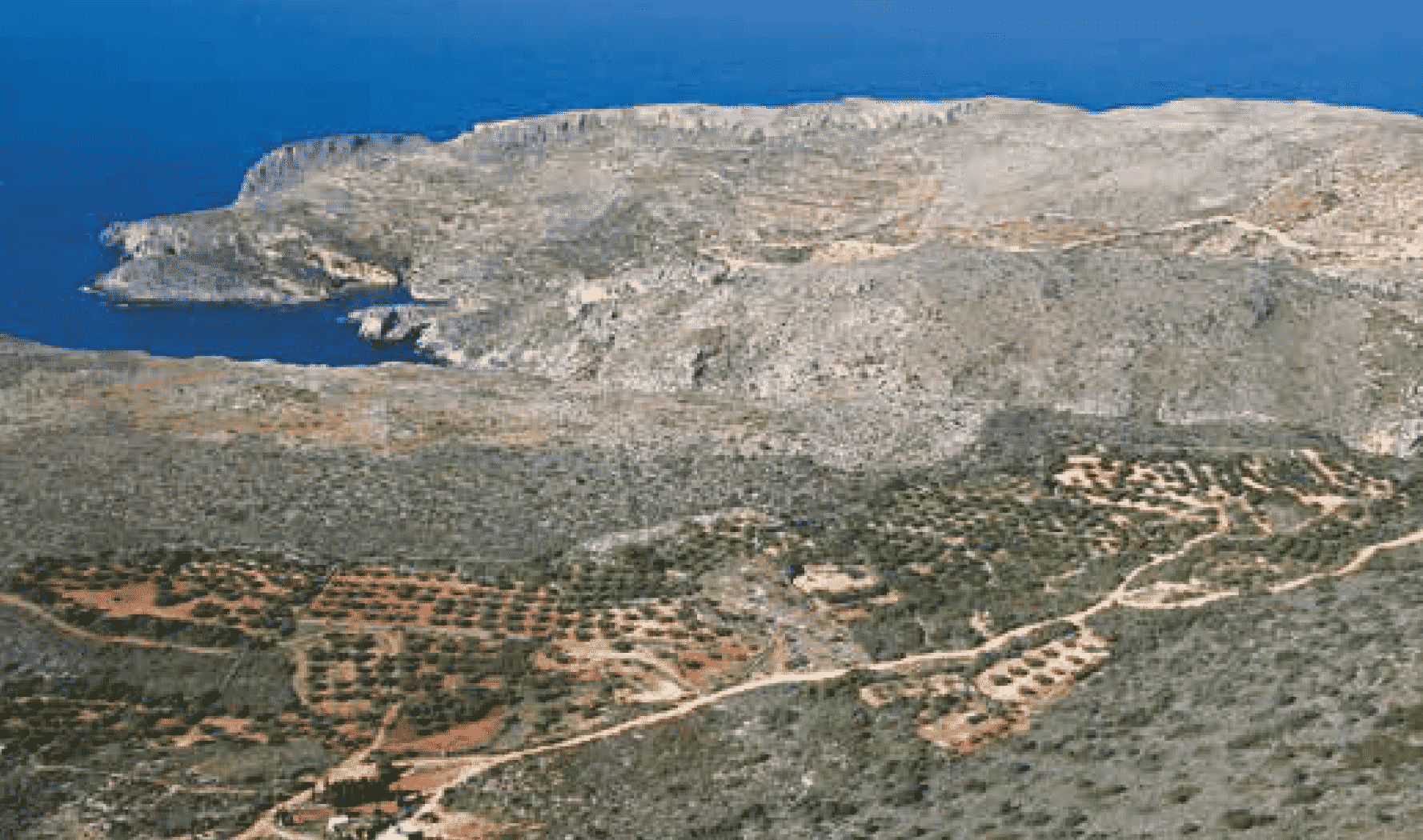
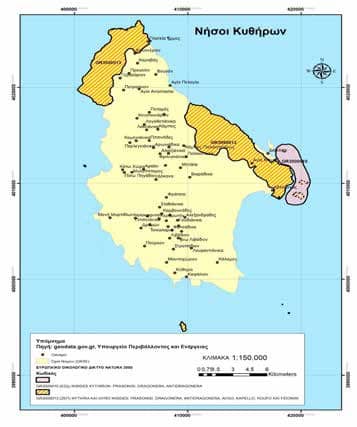
The island of Kythira, also known by its older name Tsirigo (Cerigo), is located south of the southeastern tip of the Peloponnese. Kythira covers an area of 277.28 km² and has a coastline of 114.24 km. Including the 22 islets around its perimeter, the total area is 278.65 km². The general geomorphological picture is semi-mountainous, dominated by a low plateau of 200-300 meters, which is often interrupted by ravines and certain formations reminiscent of valleys. This plateau ends in steep cliffs to the west and south, while to the east and north, it ends in gentler and lower formations with many beaches. There are several islets and rocky islets around, the most important being Dragona in the east and Avgo or Chitra in the south.
Most of the area of Kythira belongs to the category «forests and semi-natural areas» (63.35%), 36.38% of the total area falls into the category of «agricultural areas,» while 0.27% is classified as artificial surfaces.
The climate of Kythira is temperate Mediterranean. According to statistics from the National Meteorological Service (period 1955-1997), the region is characterized by a dry, hot period during the summer months, with relatively high temperatures and moderately low temperatures during the winter months.
It is noteworthy that Kythira has significant natural wealth, forming a particularly diverse mosaic that can offer visitors a wide range of experiences. It is an island characterized by high diversity, both in terms of flora and fauna.
Dynamics of stone terraces and walls in the natural environment
The island of Kythira is a crossroads of Mediterranean cultures. The fire that broke out in 2017 revealed stone terraces and walls (Figure 2), structures that are hundreds of years old. Their maintenance and expansion continued until the 1960s, as they are elements of the Greek countryside and characteristics of the Greek landscape. According to Koulouri (2004)[5], terraces are, historically, one of the most important and characteristic human interventions in the formation of the Mediterranean landscape. They are a very important element of the historical and cultural heritage of the Mediterranean peoples and, at the same time, an element of great aesthetic and environmental value.
The stone terraces and stone walls were most likely invented by the island's inhabitants in ancient times so that they could cultivate the land, mainly due to the steep slope of the terrain, and ensure their survival to some extent. Traditionally, the art of terrace building was passed down from generation to generation among the members of each family of craftsmen. To a large extent, terrace farming was abandoned with the mechanization of agriculture, extensive farming, and the reduction of the proportion of human labor in the production of agricultural products.
It is noteworthy that stone terrace and wall systems provide numerous benefits for both the environment and human societies. In other words, they provide ecosystem services that are vital, especially in island regions. The most important benefits of preserving stone terraces and walls are as follows:
- Prevention of soil erosion, both from the action of water and air. Protection during extreme weather events, preventing flooding and contributing to the creation of a local microclimate.
- Production, under certain conditions, of high-quality products.
- Creation of suitable microhabitats for the conservation, protection, and enhancement of biodiversity.
- Preserving the high aesthetic and cultural value of the Mediterranean landscape[1,5].
Contribution of stone terraces and walls to biodiversity conservation
Stone terraces and walls are an integral part of the Mediterranean landscape. In many cases, they create ecological niches/microhabitats/ecological nests, offering permanent or temporary shelter to various components of biodiversity such as invertebrates, reptiles, birds, etc. One of the reasons why terraces create niches is that they are usually oriented so that the retaining walls store solar energy during the day, which is released at night, thus creating local microclimates suitable for supporting a multitude of organisms, leading to an increase in biodiversity[7]. In essence, they create an artificial multitude of habitats and a refuge for organisms, which is facilitated by the increased mosaic nature of the landscape.
The microenvironment at the base of stone terraces and walls is a refuge with high humidity and increased primary productivity (dense vegetation), factors that are important for invertebrate populations (e.g., spiders, Phalaena, Carabidae, Staphylinidae, Curculionidae, etc.) [8,9].
During the summer months, the crevices and openings in the stone terraces and walls host large numbers of other invertebrates (e.g., snails) that spend the dormant period in groups, in a protected microclimate. snails) that spend the dormant period in groups, in a protected microclimate. This is probably due to both the high humidity of the stone terraces and walls and the increased calcium requirements for the construction of snail shells, factors that make them ideal environments for these organisms.
As for reptiles, their exothermic nature plays a decisive role in choosing «good» thermoregulation sites where there is abundant food and protection from predators[10].
Stone terraces and walls are ideal locations for this activity and are therefore chosen by reptiles. In addition, these areas of the island's agricultural landscape are very important for wildlife, as they provide shelter for a large number of species (e.g., reptiles, small mammals, and insects) that are an important food source for many bird species.
The stone terraces and walls are also an important source of flora diversity and a habitat for xerophilous or shade-loving plants that find a safe place of retreat, a refuge for life. The flora that grows in these areas consists of pioneer species, originating from the natural flora of neighboring areas. Plant species vary greatly from place to place, depending on geographical location (climate, altitude, distance from the sea, etc.) [11].
In addition, the age of the building, the maintenance of humidity at least during one period of the year, and the northern orientation or shading (which indirectly regulate the amount and/or duration of humidity) favor the growth of herbaceous plants.
In conclusion, stone terraces and walls are part of the island's cultural tradition and heritage, which should be preserved and utilized, aiming at environmentally sustainable spatial development with effective and coherent protection of the environment and cultural heritage, preservation of natural space and biodiversity, and adaptation to climate change.
Bibliography