Dioscorea communis (L.) Caddick & Wilkin
Syn. Common tamarisk L.
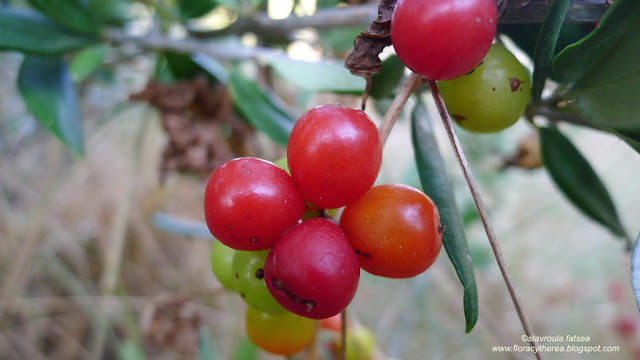
A climbing plant that can reach 3 m in height. Native to the Mediterranean basin, it has now spread throughout Europe and Western Asia. It loves well-drained limestone soils and grows in areas with sufficient moisture and sun. Its large, shiny leaves are heart-shaped and its fruits are red berries. The tiny male and female flowers on different plants are pale yellow and grow in loose clusters. Its large tuberous root has a dark brown skin and, although it is considered one of the oldest purgatives, it contains dangerous toxic components and its use should be avoided.
All parts of the plant are toxic to humans, and although its therapeutic properties (diuretic, anti-asthmatic, emetic, anti-arthritic, burn treatment, laxative, anti-kidney stone, etc.) have been documented since ancient times, it is recommended to avoid its use entirely. emetic, anti-arthritic, burn treatment, laxative, anti-kidney stones, etc.), it is recommended to avoid internal use altogether.
Several researchers believe that this is the plant that Pedanius Dioscorides describes as “melaina vine.” Recent research refutes this theory, as this plant has tendrils and black fruits, while Dioscorea communis is a twining vine without tendrils and has red fruits. (see excerpt below) It is more likely that there is confusion between the species tamus communis L. and the species bryonia alba, as the two plants have similar medicinal properties. (S.S Renner, J.Scarborough et al., 2008)
Similarly, the plant retained a common name related to bryonia (avronia, avronies obrioi in various parts of Greece, avrineoi in Kythira, black bryony in England, etc.). The common name in French, herbe aux femmes battues = herb for beaten women, apparently due to the fact that, according to tradition, a poultice made from the root of the plant combats bruises and helps skin contusions heal more quickly.
The older name of the species tamus communis probably comes from the words taminia uva = the fruit of the tamno, which Pliny the Elder used for a related plant. The modern name of the genus dioscorea was given in honor of Pedanius Dioscorides. The characteristic adjective of the species comes from the Latin communis = common.
In Kythira, the young shoots of the plant are called avrineoi, and the older ones are harvested in March and April along with the asparagus. They are usually eaten lightly boiled, with coarse salt and olive oil and lemon juice. This is a very popular dish, especially for those who enjoy bitter flavors. Several people told me that they even drink the juice in which the avrineoi were boiled, which changes color dramatically when lemon is added (from brown to orange-red). They consider it an excellent remedy for the kidneys and for detoxifying the body in general. Some, especially in the southern part of the island, eat them fried in an omelet.
CAUTION! PLANT IS TOXIC TO POISONOUS IF CONSUMED RAW OR USED UNPROCESSED.