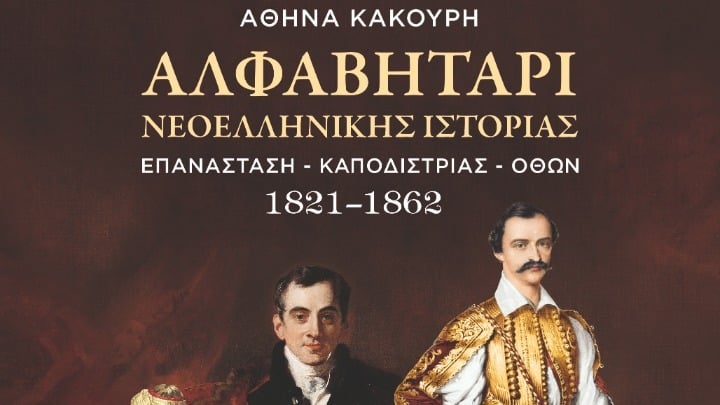
Concise, easy to understand, essential. Athina Kakouri's new, historic book entitled «Alphabet of Modern Greek History. Revolution – Kapodistrias – Otto. 1821-1862,» recently published by Kapon Publications, includes all of the above. Above all, however, it manages to provide—with the help of its excellent publication—a continuity of events in our country from the outbreak of the Revolution to the expulsion of King Otto. «If one narrates these three phases as a continuation of one another, then the picture becomes clearer,» «the reader can follow the life journey of all the protagonists of the Revolution» and «correctly assess how much and what each of them contributed overall, and not only during the Struggle,» Athina Kakouri emphasizes to APE-MPE, adding that what should inspire us today from 1821 is «fortitude and harmony.».
Below is the interview given by author Athina Kakouri to APE-MPE and journalist Eleni Markou.
When and why did you start writing the book «Alphabet of Modern Greek History. Revolution – Kapodistrias – Otto. 1821-1862»?;
This idea has been on my mind for many years. You see, if one narrates these three phases as a continuation of one another, then the picture becomes clearer. I mean that the reader can follow the life journey of all the protagonists of the Revolution from their appearance on the Greek scene until their political disarmament or death around 1850. In this way, they can accurately assess the overall contribution of each of them, and not just during the Struggle.
In 2013, your book «1821. The Beginning That Was Never Completed» was published. How does it differ from «The Alphabet Book»?;
«1821. The Unfinished Beginning» covers the Revolution and the three and a half years of Kapodistrias' rule. This is a brief history of the first forty-one years of our modern Greek state.
What attracts you to this period of modern Greek history?;
It is the beginning—the start of our modern Greek state. And the beginning usually determines what follows. But I am not exclusively interested in this period. In fact, most of my works refer to events between 1870 and 1920.
In «Alphabet,» you refer to the English loans to Greece in 1824-5, of which very little money reached our country, and the management of the second loan by the English of the Philhellenic Committee was scandalous: Of the 1,100,000 pounds that remained after expenses and commissions, the Greeks did not receive a single penny (!), as you say in your book. Would you like to comment on this fact? Do you know if these events were ever presented in their true dimension at that time? Was there ever an «assessment» of responsibilities?;
There were two loans. They were agreed with English bankers and the mediation of the Philhellenic Committee in London, with national lands as collateral. The first was for £800,000, followed a few months later by a second for £2,000,000. From the first loan, after deducting expenses, interest payments, commissions, and various other costs, a total of £298,700 reached the Kountouriotis government after many months. Most of this money was spent to entice and bribe, on the one hand, the leaders of the mainland to come down and attack the Peloponnesian leaders and, on the other hand, the warriors of the Peloponnesian faction to abandon them. Thus, the faction of Kountouriotis, Mavrokordatos, Kolettis, and Trikoupis prevailed.
From the second loan, of two million pounds sterling, 1,100,000 remained after deducting expenses, interest, commissions, etc. This amount remained entirely in the hands of the English members of the Philhellenic Committee in London. Without even consulting the Greeks, ordered warships and heavy weaponry from various factories in England and America, under such terms, in such a manner, and with such meager results that the scandal broke out even in the English newspapers. Greece, as was predictable, could not pay the interest and thus went bankrupt in 1827 before it was even recognized as a state (1830). This debt later became a tool in the hands of England to repeatedly humiliate our country until the end of the 19th century, when, under George I, our ambassador to London, Ioannis Gennadius, achieved a compromise solution and the issue was settled.
I note here that, both then and now, there are those who argue that the loans were financially unprofitable, but that they paved the way for our recognition by British and, consequently, international diplomacy. Whether this argument is valid or not is up to each of us to decide.
The Revolution of 1821 was followed by many hardships: population decline, anarchy, civil wars, negative involvement of foreign powers, controversial politicians, assassinations of capable politicians (Kapodistrias) and heroes of 1821 (Odysseas Androutsos, Panos Kolokotronis), imprisonments (Theodoros Kolokotronis)... In your book, you convey the overall picture of complex situations in a clear and concise manner, without attempting to embellish them. How easy or difficult was it to locate your sources? How easy or difficult was it to understand the deeper causes of events that still cause concern today?;
The evidence for all this is accessible to everyone, as it has been studied and published for some time. So I had no difficulty there. As for the conflicts, I think they were to be expected. When a situation collapses and it is unclear what will replace it, many different forces emerge, aspiring to fill the void that has been created. This was also the case in the Struggle. Leaders and military commanders vied for the power they had just wrested from the Ottomans. The history of all countries and all eras is full of such phases. Even the involvement of foreign powers is common, either with armies or secretly, with money, as England did to us at that time.
Civil wars have always been a curse for us Greeks. But let's not secretly boast that they are unique to us and proof of our direct descent from the adversaries of the Peloponnesian War. They are not. They are simply common misfortunes.
Looking back at the events from a distance, which figure from that period do you admire and why? Conversely, which figure do you think did the most damage to Greek affairs?;
The most admirable personality is, of course, Kapodistrias. He would have left his mark on European history even if he had never been interested in Greece. We were incredibly lucky to have him. And even more incredibly foolish that we murdered him, then at the instigation of the British and French, and today, for reasons I cannot understand, we are murdering him again with poisonous epithets such as «dictator.».
On the contrary, I have serious doubts about Ioannis Kolettis, the doctor who, having lived in Ali Pasha's court, had copied his methods. He, who without Greece would have been non-existent, became Minister of the Interior and, under the Bavarians, Prime Minister and ultimately died highly honored by King Othon—and he also came up with that phrase about the «Great Idea,» which I fear we paid dearly for. But the worst thing for me is that, as Minister of the Interior in the Mavrokordatos government, in 1824, during the second civil war, he called on the leaders of Central Greece to go down to the Peloponnese to plunder the local dignitaries and their loan money. Is there any service to the homeland that can compensate for such an incitement to mutual destruction?;
Do we really know (or care to learn) our modern Greek history?;
There is interest in our history. Countless history books are published, and even more historical novels. What I think is missing is not serious studies, but short, simple, and easy-to-read books that are accessible to the average reader and make them understand, first, that these past events concern them and, second, leave a clear impression of the sequence of events in their minds.
What do you think about the way it is taught in schools?;
I don't have enough knowledge to answer that responsibly. What I do know, because teachers tell me so and I see it myself every time I go to speak at a school, is that young people are indifferent to history and find the subject itself boring, if not repulsive. This is also due to the fact that textbooks are difficult because they have eliminated narrative, and boring because both the layout and the illustrations are not appealing.
At the same time, teaching is often assigned to teachers who have neither studied nor are interested in history. This leads to rote learning. In my day, this was forbidden; the teacher would immediately notice if a student was «parroting» and would interrupt them. «Tell me in your own words, my child!» they would say. But when the teacher is irrelevant—because they have been hired to teach a foreign language, for example—then they trust only what they find in the book and use exactly the same wording, i.e., parroting.
Of course, there are many excellent history teachers. I have met some of them and admire and respect them greatly. But I fear that they are not the norm.
Two hundred years after the Revolution of 1821: What inspires us (or should inspire us) today on this anniversary?;
It should teach us the need for harmony. When we are not in harmony, we destroy ourselves. It should also teach us the need for perseverance and fortitude. What broke the Powers and forced them to recognize an independent Greek state was that the Romans suffered one terrible blow after another—the massacre of Chios, the destruction of Kasos, the destruction of Psara, the destruction of Messolonghi—and yet they did not stop fighting. Courage and unity, then.
You have dabbled in almost every genre of writing: crime fiction, historical novels (Primarolia was one of the most beautiful novels I have ever read), journalism, and translations. Which genre expresses you best, and which would you have liked to have worked on more?;
I wish I had written at least two more novels. One set in the era of George I, and specifically after the war of 1897 that we lost. I would like to show in detail how we gathered our strength at that time for the next day. The action could focus on the Parnassos Literary Society, this amazing project that was started by four young people and became the leading intellectual and social institution in our country. And another novel, which would be the sequel to ’Thekla« and »Xifir Faler,« would take place between 1917 and 1920, the three years of Venizelos's rule, when the fateful decision to land in Smyrna was made.
Would you like to add anything?;
I wish we could escape the strange servility that has taken hold of us lately and makes us read much, much more foreign historians who write about Greece than we read Greeks who write about their homeland. One might say that after the closure of our industries, «Pitsos,» «Isola,» and «Peiraiki Patraiki,» we decided that only foreign products are worthwhile and that using them poses no threat to our self-awareness.
And I would also like to express my hope that we will once again delve into our history. It is truly unique. Full of surprises. It constantly refers to European developments, where its role has not been and is not negligible.
Eleni Markou