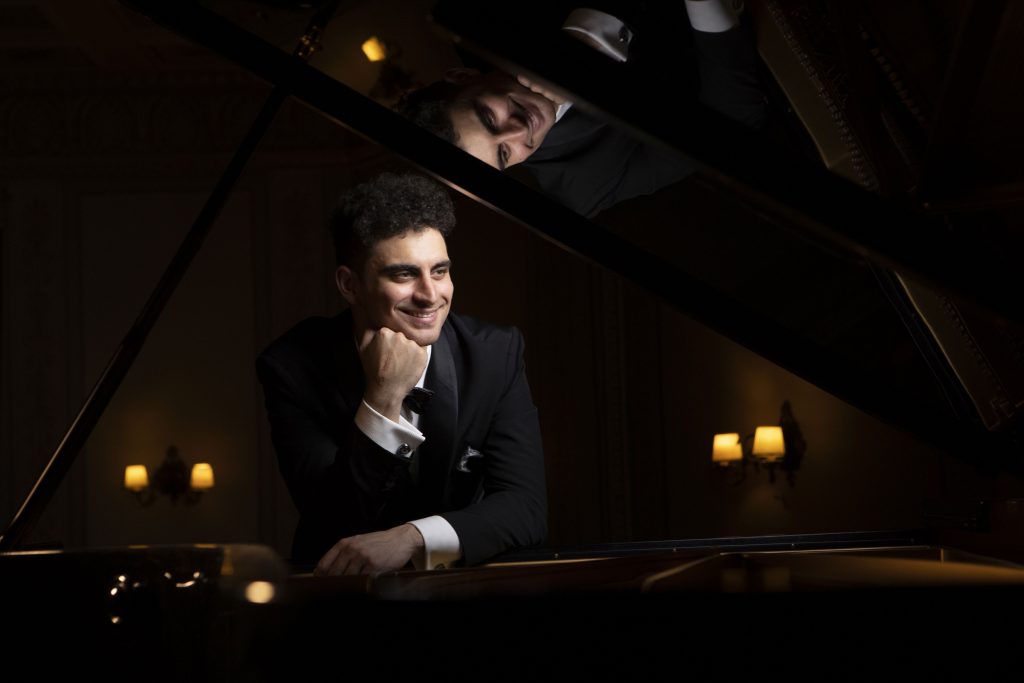
Ο Alexander Kyriakopoulos belongs to the new generation of Greek artists who excel abroad. Since 2020 he has been living and creating in Boston, where the his musical path meets contemplation, silence and the constant search for the meaning of art. With sensitivity and clarity, he speaks about the «double identity» of the Greek who creates in America, about the artist's position in a world that is in turmoil, and about the silence that - as he says - hides the truest music.
Interview with «NEA» and Zoe Liaka
Your art crosses countries, but also cultures. How do you experience the “dual identity” of the Greek who creates in America?;
I carry Greece not as a flag, but as a sound. Something of the air, silence and sea of Kythera always returns to me - even if I am in the most industrialized part of America. The “dual identity” for me is not a division; it is a dialogue. These two worlds converse and will converse forever. America has taught me discipline, vision, breadth. Greece reminds me why I create: for the human element, for emotion, for the soul. I am an artist every moment of my life; and when these two universes meet, music takes on a voice that belongs to no nation.
How do you see the role of the artist today? Can music make a meaningful difference in such a noisy time?;
The role of the artist today is to keep the human element alive in an increasingly mechanical world. Everything around us is becoming faster, smarter, more lifeless. Art is one of the few things that remains handmade. It is not the artist's job to fix the world, but to remind the world what it means to be human. I don't believe in big statements; I believe in small movements of the soul. That's where true change begins. When I play, I'm not trying to impress, I'm trying to communicate. If even one person is moved, then the music has done its job. Its power is not to shout louder, but to silence us for a moment and remind us who we are.
Your presence in music is not limited to the piano. You create projects, collaborate with organisations, organise concerts. Do you feel that your artistic identity is beginning to expand beyond the role of performer?;
Yes, because music for me doesn't stop at the instrument. It's a way of thinking, a way of seeing the world. Over the years I have felt that it is not enough for me to perform works; I want to create contexts in which music can acquire new meaning. That's why I started organizing my own projects, curating concerts and working on ideas that unite art, space and audience. I'm not interested in ’management« in the strict sense, but in the possibility of envisioning and realizing experiences. In addition to being a classical pianist, I see myself moving towards the role of artistic director - the artistic visionary. I am not interested in repeating what has already been done. I want to bring together different art forms and create experiences that audiences have never experienced before. Every concert can become a new universe; and that, for me, is the future of art.
In America they often talk about the «resonance» of the artist. How do you measure the impact of your music?;
I don't care about numbers, ratings or headlines. But not at all. I see “impact” in the looks on people's faces. Music for me is not a tool for making an impression; it's a way to open up pathways, evoke emotions and remind people that they are alive. When I play, I feel like I'm sharing something that doesn't belong to me. Like it's passing through me and going beyond. If a play, a concert or a moment can make someone stop, think, change their perspective even a little bit, then there has been a real impact. I don't just want to play music; I want to diffuse it, to share it, to give it forms that will continue to move after I have left the stage.
What does silence mean to you? You have stated that music often begins where words end.
Silence is the most honest part of music. That's where it begins and that's where it ends. It is not a pause; it is a space. The only space where there is nothing to prove. In silence you understand who you are and what remains when everything else stops. When I play, I don't try to avoid it, but to reach it. And every time I reach it, even for a little while, something inside me clears. Maybe that's the point after all - to learn to listen before you speak.