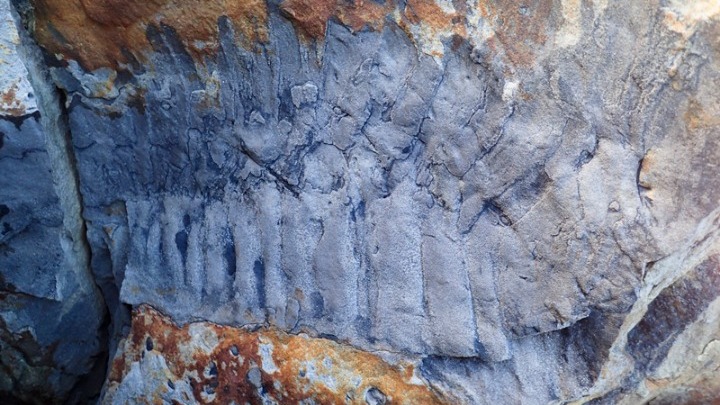
The largest fossil of a giant myriapod (an arthropod related to the centipede) ever found on Earth, which was as big as a car, has been discovered on a coast in northern England.
The fossil of the creature - scientifically named Arthropleura - dates back to about 326 million years ago, at least 100 million years before the age of the dinosaurs. It is the largest known invertebrate of all time, larger than the sea scorpions that have so far held this record in the animal kingdom.
The fossil was found on a beach in Northumberland, about 55 kilometres north of Newcastle. It is the third of its kind ever found, but the oldest and largest (the other two were found in Germany about a century ago). The fossil that survived, which comes from the back of the animal, is about 75 centimetres long and 36 centimetres wide, but the animal is estimated to have been 2.7 metres long and 55 centimetres wide, and weighed around 50 kilograms. The number of legs is estimated to have been at least 32, perhaps as many as 64.
The researchers, led by Dr Neil Davis of the Department of Earth Sciences at the University of Cambridge, who published the paper in the Journal of Geological Society, discovered the fossil by accident in a large sandstone rock that had fallen from a cliff above Hove Beach. The fall created a large crack in the rock and thus exposed the fossil.
Unlike its present cold and wet climate, northern England had a near-tropical climate at the time of the fossil, because the present-day land of Britain was then near the equator. Invertebrates and amphibians lived off the scattered vegetation of the area. The part of the preserved fossil belonged to the exoskeleton of Arthopleura, while its head has not been preserved. Its large size cannot be well explained at present. These animals existed on Earth for about 45 million years, before becoming extinct during the Permian period for unknown reasons (probably due to climatic-environmental pressures or the emergence of reptiles that gradually became dominant). The fossil will be on display from the New Year at the Sedgwick Museum in Cambridge.