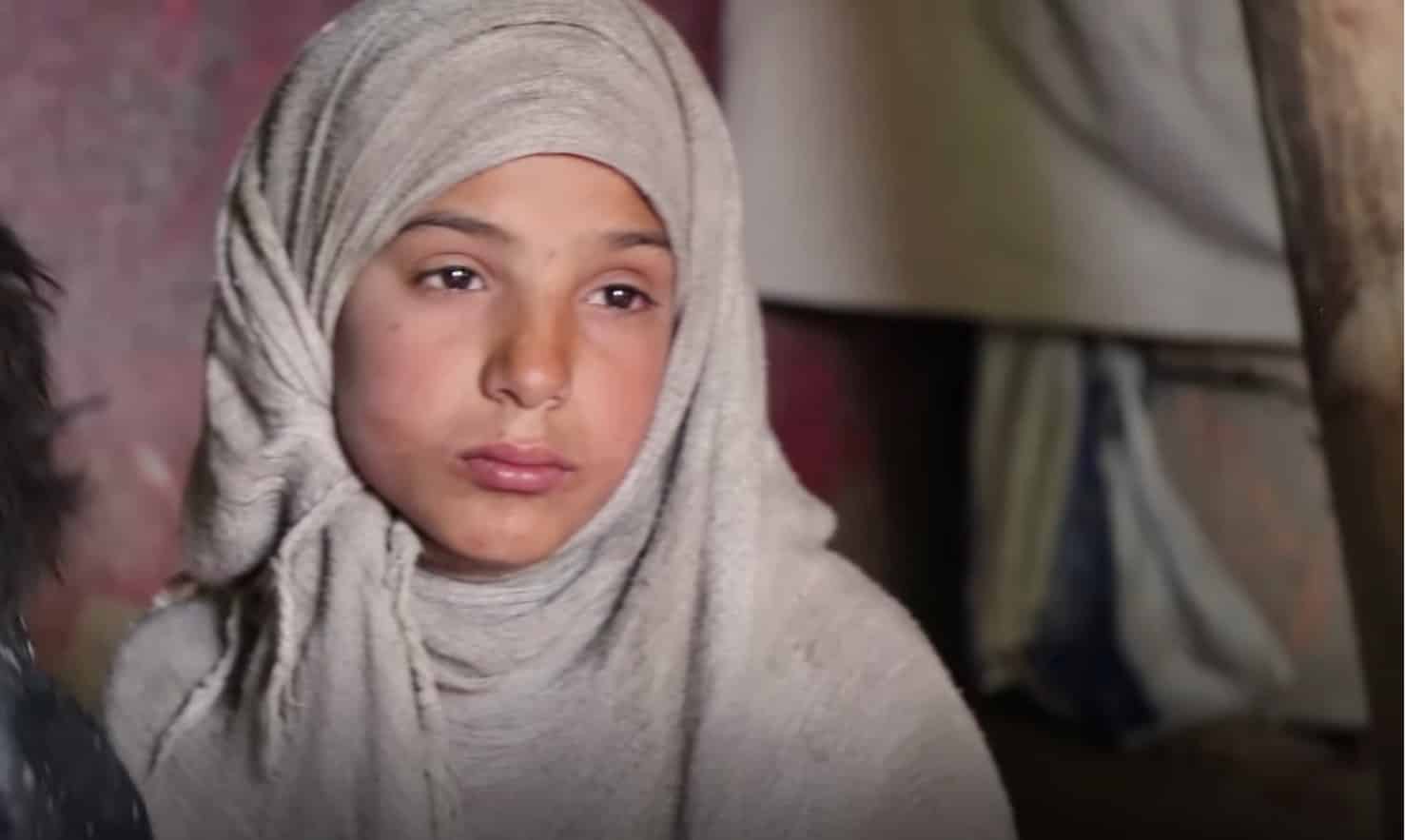
When her husband told her that they would have to sell their two little girls so that their family would not starve to death after being displaced by the drought in western Afghanistan, Fahima «cried a lot».
Their two little girls, six-year-old Faristech and one-and-a-half-year-old Sokriya, with their clothes and faces in the mud, are smiling near their mother in their shelter made of tarpaulins.
They do not know that they have recently been sold to the families of their future spouses, who are also minors. The families of their husbands paid about $3,350 (2,870 euros) for the eldest and $2,800 (2,400 euros) for her sister.
Once the full amount has been paid, which could take years, the two girls will have to say goodbye to their parents and to the IDP camp of Kala-i-Nau, the capital of Badjies province, where their family, from a neighbouring region, has found shelter to survive.
This story is all too common for thousands of families displaced - most of them by drought - in the region, one of the poorest in Afghanistan.
In the IDP camps and villages, AFP journalists met about 15 families, who have been forced, in order to survive, to sell their baby girls for amounts ranging from $550 to almost $4,000.
This practice is widespread. Representatives of camps and villages list dozens of such cases since the 2018 drought, with the number increasing with this year's drought.
The family of 25-year-old Sabehreh, who lives next door to Fahima, gets verified food from a grocery store. The owner threatened to «put them in jail» if they didn't pay him.
To pay off their debts, the family sold their three-year-old daughter, Zakereh, who was to marry four-year-old Zabiullah, the grocer's son. The little girl has not understood anything, as her future husband's father has decided to wait for her to grow up first before taking her into his family.
«I'm not happy that we did this, but we have nothing to eat (...) If this continues, we will have to sell our three-month-old daughter,» says Sabehreh in despair.
«Many people sell their girls,» comments another neighbour, Gul Bibi, who has also sold hers, Aso, now aged eight or nine, to a 23-year-old man to whom her family owed money.
This man is still in Iran and Gul Bibi thinks with dread of the day he will return to take Aso.
«We know it's not right (...) but we have no choice,» says Hayatullah, another resident of the camp, who overheard the conversation.
Nightmare without end
In another camp in Kala-i-Nau, Mohammad Asan is buzzing as he shows photos of his daughters, 9-year-old Shiana and 6-year-old Edi Gul, who have gone to their young husbands' homes far from the city.
«We've never seen them before», he says. «We didn't want to do this, but we had to feed our other children.».
«My daughters are definitely better off there, they have something to eat», he continues, trying to console himself, and points to the pieces of bread given to them by neighbours, which is all they have to eat that day.
Asan, who has expenses for his wife who is ill, is still in debt. A few days ago he started looking for a buyer for another of his four-year-old daughters.
«Some days I go crazy, I come out of the tent and I don't really remember where I'm going,» his wife, Dada Gul, recounts, sitting in their tattered tent.
For mothers it is a nightmare without end: the decision to sell their child, the wait until he or she leaves, which often lasts for years until their daughter is 10 or 12 years old, and then the separation.
Rabia, a 43-year-old widow, also displaced by the drought, does everything she can to postpone it. Her 12-year-old daughter Habibeh, who was sold for about $550, should have been gone a month ago, but Rabia has pleaded with her daughter's future husband's family to be patient for another year.
«I want to stay with my mom,» says the sad-eyed girl.
Rabia would take her daughter back if they «had to eat.» But she and her three other children are finding it very difficult to make a living. Her 11-year-old son works in a bakery for half a dollar a day and the other one, who is 9 years old, picks up garbage for 30 cents.
«My heart is bleeding, but I had to save my children,» he justifies.
In the camps, they live on a few cents a day, which they earn by begging or pushing carts and thinking about how to survive as winter approaches.
«It's not right»
Every evening, Abdul Rahim Akbar collects bread to help the most deprived families. «I have seen about a hundred families who have made it to this camp. Even my brother,» he says of the child marriages.
The day before, he had gone to see Taliban officials to ask them for help. However, they are unable to help in a province where 90% of residents are in danger due to lack of sufficient food.
These marriages «are due to economic problems, not to a rule imposed by the Taliban», Malawi's interim governor, Malawi Abdul Satar, tells AFP.
Marriages of girls under 16 are not allowed under a law of the previous government, which held the reins before the Taliban took power in August.
According to a 2018 UNICEF report, 42% of families in Afghanistan have a daughter married before the age of 18. Mainly for economic reasons, because marriage is often considered the means to ensure the survival of a family. However, girls who marry at a young age are at serious risk, from complications in childbirth to the possibility of being victims of domestic violence.
For the husband, buying a girl is advantageous because it costs less than an older woman.
This scourge is also affecting the IDP camps of Herat, Afghanistan's third largest city, located just to the south. Alahudin, a displaced person from Badjis, also says he sold his 10-year-old daughter.
«I would never do it if I had a choice,» he says. He has another daughter, aged 5, and if he can, he will «sell her too».
However, harsh words are not enough to hide the suffering of the fathers. Their voices, their eyes betray the desperation caused by the fact that they cannot provide for their families.
«I know it's not right,» says Baz Mohamad, a former Badlands grower. «But I thought we were all going to die.».