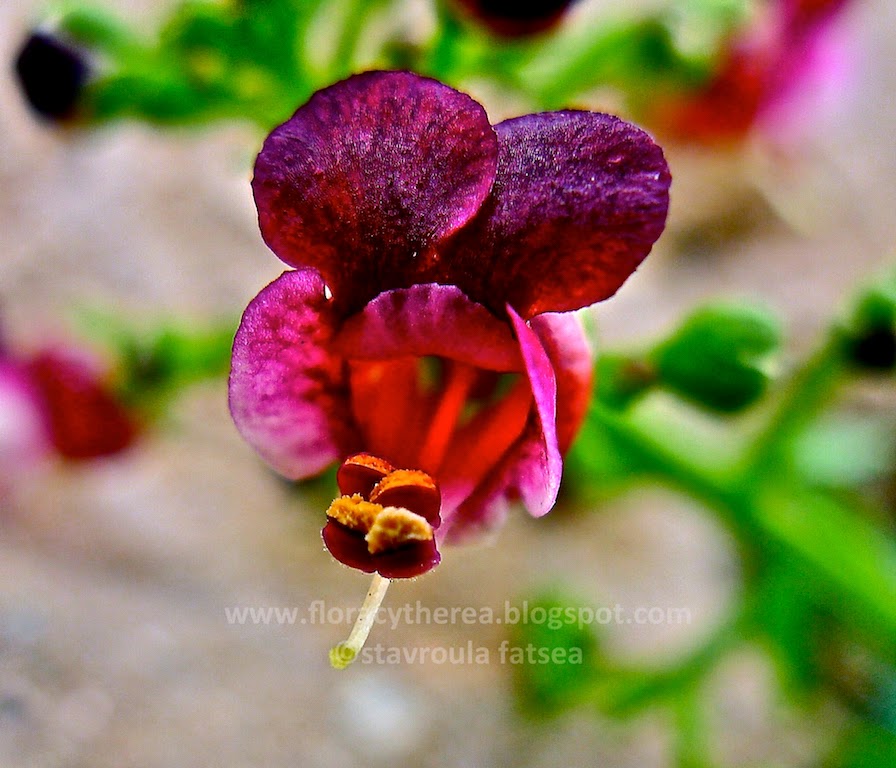
Heterophyllous Figwort Willd
Scrophularia heterophylla subsp. laciniata Waldst.&Kit.
Syn. Scrophularia caesia Sibth. & Smith
A relatively rare chasmophyte, found on limestone rocks in crevices and even in cracks in stone walls throughout the eastern Mediterranean and the Balkans.
The genus scrophularia It includes approximately 200 species that are widespread in the Northern Hemisphere, while in Southern Europe and North Africa there are far fewer native species.
The most widespread species in Kythira is the scrofularia heterophylla. I encountered it in many different locations, mainly near the sea in rock crevices and cliffs in the north, east, and south of the island. The reference in scrophularia peregrina at the Castle of Chora is obviously incorrect.
In traditional Chinese medicine, Scrophularia ningpoensis was used to treat several diseases such as arthritis, rheumatism, sore throats, inflammation, etc.
Another species, Scrophularia nodosa, is used in folk medicine in Europe and America as a diuretic, laxative, heart stimulant, and tonic for the body, against boils, and generally for skin conditions involving irritation and itching. It is also a powerful homeopathic remedy.
In Crete, the species scrophularia peregrina, It is called stinkweed or stinkgrass and has similar uses. Caution is advised when using it as it may also have toxic effects. The same species exists on Kythira in limited populations in places with high humidity.
Contemporary research shows that plants of this genus contain ingredients with powerful analgesic properties comparable to those of cortisone, without the side effects, while numerous other therapeutic properties have also been demonstrated. (Biologically Active Substances from the Genus Scrophularia, Galindez, Lanza & Matellano, 2002)
The name of the genus comes from the Latin word scrofula = scrofula (a type of tuberculosis), for which plants of the genus were used as a treatment. The specific epithet, from the Greek words έτερος + φύλλο, is a possible reference to the uneven shape of the leaves. The common name in Crete, βρωμόχορτο, is due to the somewhat unpleasant smell of the plant's leaves.