Could the Edward Jenner (Edward Jenner) went down in history as the father of vaccination, since the first vaccine in the history of medicine is said to be the smallpox vaccine; however, It turns out that two great Greek doctors had gone before them following pioneering studies and practices.
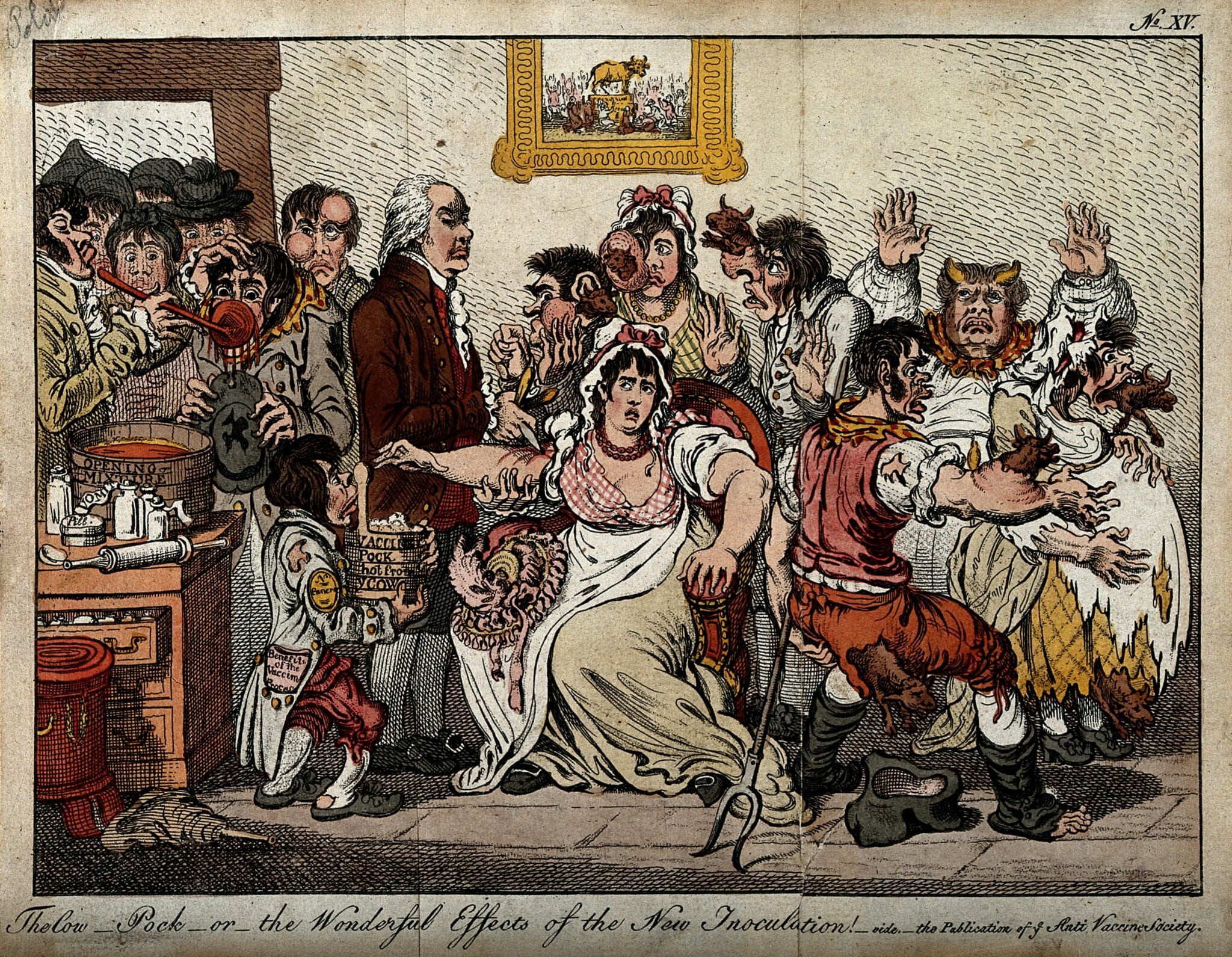
In 1796, the British physician Edward Jenner noted that the women who milked the cows had blisters on their hands (cowpox) and they did not have smallpox. In 1978, Jenner used the pus from these blisters to vaccinate an eight-year-old boy, the James Phillips. James came into contact with people who had smallpox but did not contract the disease, so the first vaccine went down in history. However, according to the Yiannis Sarris (Professor of Medicine at Aristotle University of Thessaloniki, with an article in *Philalithia*) the scientific The method of vaccination was invented by two Greeks doctors.
Timonis and Pylarinos
This is the Emmanuel Timonis (1669–1720), from Chios, who studied in Padua and Oxford, became a physician to the Sublime Porte and a member of the Royal Society of Medicine in London. The second was Iakovos Pylarinos (1659–1718) from Kefalonia, who also studied in Padua and served as the personal physician to several prominent figures, including Peter the Great.
Smallpox Mortality 30%
Up until the 18th–19th centuries, the childhood disease of smallpox, with mortality in 10-30%, it was among the most common causes of death. However, the two doctors proposed an approach that was revolutionary by the standards of Western science.
Timonis Leads the Way
Timonis, together with J. Woodward, based on his previous experience in dealing with the epidemic in Istanbul In 1714, he published in the 29th volume of the journal Philosophical Transactions his paper titled «An account or history of the method of inducing smallpox by incision or inoculation, as it has been practiced for some time in Constantinople.».
Pylarinos in Venice and Thessaly
Pylarinos, for his part, published his study in Venice in 1715 «A New and Safe Method for Inducing Smallpox by Transplantation, Recently Invented and Put into Practice», which was republished in 1718 in Nuremberg and in 1721 in Netherlands.In his work, Pylarinos mentions a woman in the Thessaly who rubbed her child’s scraped hands against the wound of an infected sheep. They realized that the administration of a small amount of a pathogen In the human body, it causes a relatively mild (and therefore safe) course of the disease, as well as lifelong immunity to subsequent infections. Fatal as it was, they established the practice of «variolation» (variolatio).
«Pylarinos, the First Immunologist»
«The initial conception of this idea in abstract form (in the absence of more modern scientific knowledge and tools) was remarkable, and its success is evident from the international impact of the works of Timonis and Pylarinos. It is by no means a coincidence that the contemporary scholar J.N. Norman characterized Pylarinos as the first immunologist», says Yannis Sarris. Iakovos Pylarinos died in Padua on June 17, 1718.
Voltaire wrote that, too
«The Blessing» It appears in a medical entry in the French Encyclopedia (1751), while even Voltaire raised this question in a letter he wrote in 1728 because the practice followed by the Greeks is not followed in his country. The practice was finally recognized and implemented on a massive scale in the second half of the 19th century, after Edward Jenner refined it with minor modifications that made the vaccine safer (cowpox vaccination).
«Today, the father of vaccines is considered to be the Jenner »While very few people are aware of the contributions made by these two Greek doctors, the worst part is that Anglo-Saxon sources refer to Timonis and Pylarinos as being of Italian descent," concludes Yannis Sarris. The Georgios Destounis In *Kefaliniaka* (Athens, 1968), pp. 114–121, writing about the lecture he gave in 1928 on Iakovos Pylarinos, he says: «... It is well known to all that the history of medicine in the 18th century was enriched by the wonderful discovery of vaccination.».