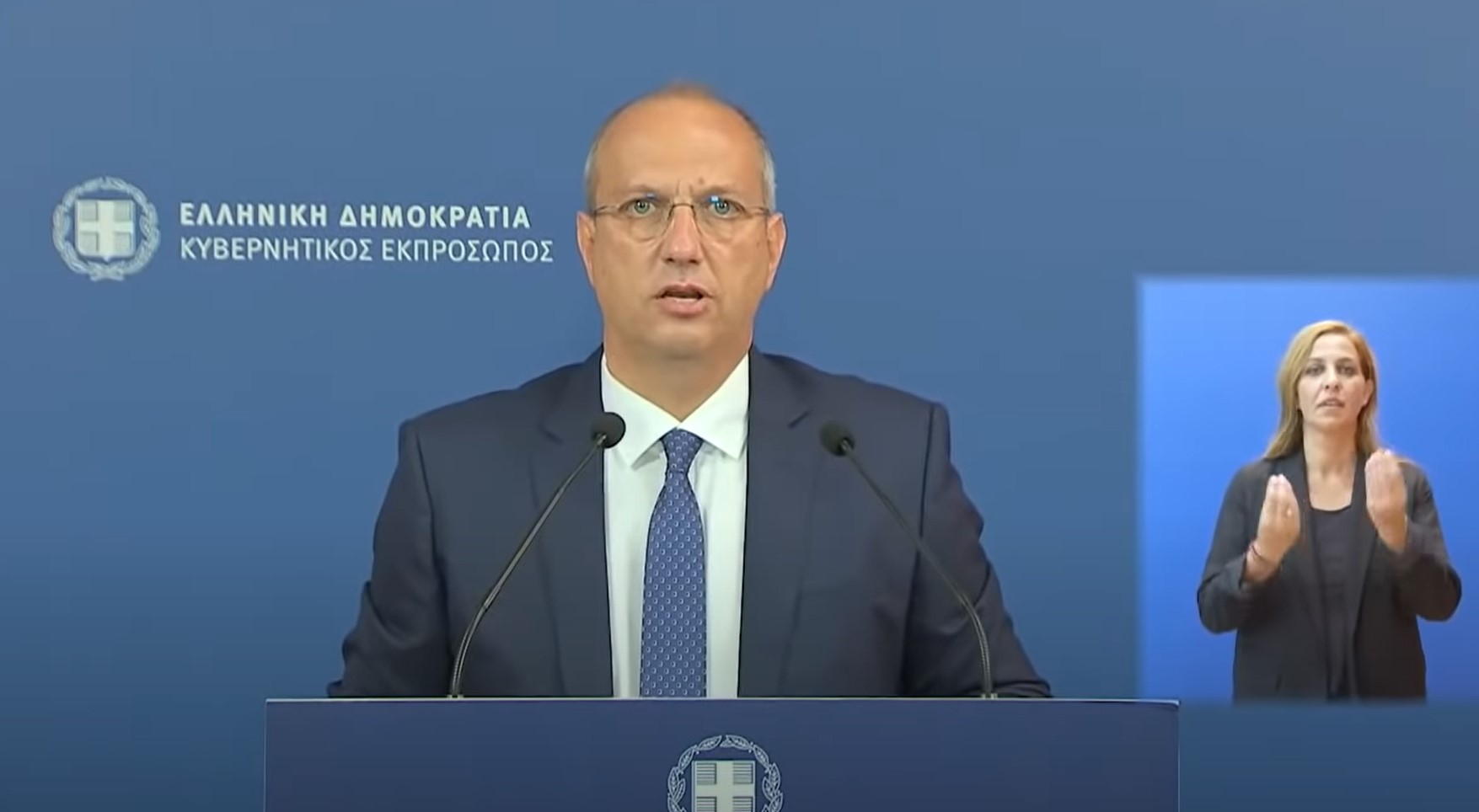
«Greek society is reeling from the crises caused by the ongoing war in Ukraine, and as long as the chaotic turmoil in international affairs continues, our goal is to maintain stability and security amid this chaotic environment,’ emphasized government spokesperson Yiannis Oikonomou as he began his briefing to political editors.
He stated that the government is taking economic and institutional measures because it knows that the consequences affect every citizen, and is striving to support everyone according to their needs, «with composure and seriousness as our allies.».
He emphasized that measures are being taken by making use of every available tool, new opportunities are being created, and there is optimism that «we will succeed in overcoming this crisis as well.’ All we need to do is stay focused on the goal and remain united. Unity and complementarity are the way out of problems during critical periods.».
He emphasized that the Russian invasion of Ukraine is causing serious economic and social repercussions across the globe, and particularly in Europe. «Inflation has already climbed to a decade-high, rising prices are eroding household incomes, and growth rates are under intense pressure,» he noted.
He added, however, that the government is taking action at both the national and European levels to mitigate the impact of the crisis, which is hitting the most vulnerable the hardest, and provided a detailed account of the measures taken at the national level from September to the present, with more than 4 billion euros allocated (1.2 billion of which in April).
«Measures to support the primary sector—farmers and ranchers—are a priority, as we must simultaneously ensure our security and be prepared to face the food supply consequences of prolonged unrest,» he emphasized.
He spoke about securing the necessary resources to provide timely support to society and referred to the Ministry of Finance’s submission on Friday of an amendment for a supplementary budget of 2.6 billion euros.
But also because the «Greece 2.0 Recovery Plan» has been launched and is being implemented with a strong social focus.
«On Friday, our country—the third in a row among the 27 EU member states—received its first payment from the Recovery and Resilience Facility, amounting to 3.6 billion euros,» he added.
He referred to the prime minister’s remarks that recovery must always go hand in hand with social cohesion and spoke of a goal that constitutes a key pillar of the Recovery Plan.
He then referred to the “I Save” program as well as initiatives with a strong social focus, such as the Personal Assistant for People with Disabilities and training programs for 80,000 unemployed people, among others.
Mr. Oikonomou said that, at the same time, efforts to combat profiteering are being stepped up on all fronts, and he referred to the inventory platform that has been put into operation. He emphasized that, based on the initial data available to us, it appears that «there is food sufficiency and self-sufficiency in food and agricultural products in the country at all levels of processing.» He explained that the rise—and in some cases the sharp spike—in prices is not due to shortages but primarily to energy costs.
He spoke about the imposition of fines in cases where violations were found following inspections and noted that the publication of business data will begin immediately after the necessary provision is passed by Parliament.
He emphasized that the prime minister’s efforts to achieve a European solution to a problem that is global—and certainly pan-European—are continuing. He also noted that it is essential for measures to be taken at the next summit to strengthen the productive fabric of our nations and support European citizens; otherwise, the blow to European economies and Europeansocieties will be severe, and our continent will once again find itself facing the Lernaean Hydra of populism. If Europe does not move quickly in this direction, our country will implement additional measures at the national level, Mr. Oikonomou emphasized.
In closing his introductory remarks, the government spokesperson referred to the draft bill that will be put up for public consultation immediately to simplify the licensing process for new renewable energy projects and made special mention the progress that has been made in the renewable energy sector in our country over the past two years.
Specifically, Mr. Oikonomou stated in his opening remarks:
Unity and complementarity are the way out of problems during critical periods
«Greek society is suffering from the crises caused by the ongoing war in Ukraine. And as long as this chaotic turmoil in international affairs continues, our goal is to maintain stability and security amid such chaos. We are aware of the problems, which leave no one in our country untouched. And we are constantly taking measures—both economic and institutional—to help everyone according to their needs. With composure, seriousness, and a constant effort to stand by our citizens as our allies—making use of every available tool, every available resource, and at the same time constantly creating new opportunities, we will succeed in overcoming this crisis as well. All we need to do is remain focused on the goal and stand united. Unity and complementarity are the way out of problems during critical periods.
It is well known that the Russian invasion of Ukraine is having serious economic and social repercussions across the globe, and particularly in Europe. Inflation has already climbed to a decade-high, rising prices are eroding household incomes, and growth rates are under intense pressure. The problem is extremely serious, affecting society as a whole, but hitting the most vulnerable the hardest. That is why the Government is taking action at both the national and European levels to limit the impact of the crisis.
At the national level, from September through today, we have allocated more than 4 billion euros, of which 1.2 billion euros were allocated this month, in April. These funds are intended for:
-The increased electricity and natural gas subsidies.
-A subsidy of 15 leptes per liter on the price of diesel fuel.
-A gasoline subsidy of 22 leptes per liter on the mainland and 28 leptes on our islands.
-The one-time subsidy of 200 euros for taxi drivers.
-The provision of emergency aid in the amount of 200 euros to 900,000 low-income pensioners, uninsured seniors, and people with disabilities.
-The payment of a double installment to 250,000 recipients of the Minimum Guaranteed Income.
-The payment of one and a half additional child benefit installments to child benefit recipients.
-Supporting the agricultural community through a series of measures, such as:
-The suspension, once again this year, of the business tax for farmers subject to the standard VAT regime, as well as for coastal fishermen.
-The refund of the excise tax on agricultural diesel for the entire year of 2022.
-The 80% subsidy under the electricity rate adjustment clause.
-A reduction in the VAT rate on animal feed and fertilizers to 6%.
-»Further support for livestock farmers, based on 2021 revenue, which will exceed 45 million euros.”.
Priority is given to measures to support the primary sector
Mr. Oikonomou even emphasized that «Measures aimed at supporting the primary sector, farmers, and ranchers are a priority, as we must simultaneously ensure our security and readiness to face the food supply consequences of prolonged unrest. To provide timely and effective support to society, we are securing the necessary resources to maximize that support.
Are you aware that an amendment from the Ministry of Finance for a supplementary budget of 2.6 billion euros was submitted on Friday? Appropriations in the Regular Budget are increased by 2 billion, and appropriations in the co-financed portion of the Public Investment Budget are increased by 600 million.
It should also be noted that the implementation of the National Recovery Plan «Greece 2.0» has begun and is proceeding with a strong social focus. On Friday, our country received—the third in a row among the EU’s «27»—its first payment from the Recovery and Resilience Facility, amounting to 3.6 billion euros. And for the government—as Prime Minister Kyriakos Mitsotakis emphasized during a videoconference he held on this occasion with European Commission Executive Vice President Valdis Dombrovskis—development must always go hand in hand with social cohesion. Every euro that enters the country must improve the quality of life and the income of society. And this goal is a key pillar of the Recovery Plan.
-It is noteworthy that the «Exoikonomo,» which is so important at a time when electricity bills are rising, is already in effect, and the «Exoikonomo» program for small and medium-sized businesses will soon be implemented as well.
It should also be noted that initiatives with a strong social focus have already been launched, such as:
-Personal Assistants for People with Disabilities: The call for applications has been issued, and starting April 14, people with disabilities can begin applying to select a personal assistant.
-The new-generation training programs for 80,000 unemployed individuals: These programs are already underway, and a call has already been issued to training providers to register in the relevant registry.
-The subsidized employment program for unemployed individuals over the age of 45, which takes effect immediately.a
-»The major prevention program, with this initiative on breast cancer as its first step.”.
He added: «At the same time, efforts to combat profiteering are intensifying on all fronts. We have made it clear that, in order to protect our society—which is under attack and facing hardship—we will not allow anyone to engage in profiteering or exploitative practices. We will be relentless, and inspections will be ongoing.
That is why the platform for tracking inventory has already been implemented, so that all necessary measures can be taken to ensure an adequate supply of goods and to prevent any excuses for price increases. In fact, preliminary data indicate that there is food sufficiency and self-sufficiency in food and agricultural supplies throughout the country, at all stages of processing, while the rise—and, in some cases, the sharp spike—in prices is not due to available quantities, but primarily to energy costs.
Market inspections are intensifying, and in recent days new fines totaling approximately 120,000 euros have been imposed on large retail chains found to be selling at a higher gross profit margin than what the law—which we enacted—allows. As for the public disclosure of the names of businesses on which administrative fines are imposed for profiteering, this will begin immediately after the necessary provision is passed by Parliament.
»We call on everyone—especially the most influential market players—to demonstrate the responsibility toward Greek society and consumers that the circumstances demand.".
An effort to find European solutions to a problem that is global and certainly pan-European
The government spokesperson noted that «At the same time, Prime Minister Kyriakos Mitsotakis and the relevant ministers are continuing their efforts at the European level to find European solutions to a problem that is global and certainly pan-European in scope. The consequences of the war do not stop at the borders of the two countries, nor can they be addressed in the usual way.”.
The proposals put forward by the Prime Minister in his letter to the President of the European Commission—and reiterated at the most recent European Council— as well as the detailed proposals put forward by the ministers at the respective Councils of Ministers.
As he himself has pointed out on numerous occasions, both publicly and in his meetings with EU officials, the sharp rise in international energy prices and the resulting resurgence of inflationary pressures make the development of a common European energy strategy a critical priority.
No national budget—as the prime minister emphasized—in any European country can bear the burden caused by the «explosion» in the energy market, which is fueled and sustained by the flames of war in Ukraine. That is why it is absolutely essential that measures be taken at the next Summit to strengthen the productive base of our nations, as well as all European citizens, who are under siege from rising international prices. Otherwise, the blow to European economies—and to European societies—will be severe, and our continent will once again find itself facing the Lernaean Hydra of populism.
We have a political and historical duty to prevent the economic crisis from becoming a political one. Strengthening our institutions requires strengthening people’s livelihoods and quality of life. The historical experience of the 20th century has taught us a great deal, and we have no right to fail to study it carefully in order to avoid mistakes and setbacks.
The government, however—as the prime minister announced in Delphi—is not going to sit idly by. If Europe does not move forward—and certainly not quickly enough—in taking measures to address the crisis, Greece will make decisions regarding additional national interventions. Because Greece has extensive—albeit bitter—experience with crises, and we will not allow ourselves to be sucked into another cycle of decline like the one from which we emerged with great difficulty.».
Simplifying the Process for New Renewable Energy Projects
In closing, Mr. Oikonomou emphasized that: «A draft bill has been prepared and will be put out for public consultation immediately to simplify the process for new renewable energy projects; among other things, it provides for a reduction in the total licensing time to 14 months from the current five years and the creation of an institutional framework for electricity storage projects. A legislative framework for the development of offshore wind farms is also being prepared.
It is worth noting here the significant progress that has been made in the renewable energy sector in our country over the past two years:
In just two years—2020 and 2021—HEDNO issued 8,500 final connection decisions for renewable energy projects with a total capacity of 3.3 GW. This achievement represents a more than threefold increase in the average annual capacity of projects approved compared to 2019. Specifically, this represents a threefold increase for 2020 and a fourfold increase for 2021, since the capacity for 2019 was 450 MW, while for 2020 it is 1.4 GW and for 2021, 2.0 GW.
In terms of connecting renewable energy plants to the distribution grid, HEDNO has managed over the past two years to increase the installed renewable energy capacity on the grid by 1.26 GW compared to the 0.24 GW connected in 2019, and it is certain that even more renewable energy sources will be connected in 2022.
We have a plan, we have the knowledge, and we have the determination. »We are navigating an extremely difficult environment, but we are prepared and level-headed, and through concrete actions we are striving to mitigate the impact of the crisis on people’s lives.”.