Odessa was created on the site of an ancient Greek colony, after the end of the 2nd Russo-Turkish War and the Treaty of Iasi.
Catherine of Russia «saw» its great geostrategic position and the advantages of the region as a bridge of communication between the West and the East and a port on the Black Sea for the development of trade.
The name Greek in Odessa was synonymous with the name merchant
Greeks from the Turkish-occupied regions, from Epirus, Macedonia, the islands quickly arrived in Odessa. Initially their numbers were small, not exceeding 10% of the total population, but soon they developed a rich professional and social activity.
Important information about the Greeks in Odessa was provided to APE-MPA by the Association of Graduates of the Zosimaia School of Ioannina, «ZOSIMADES», the product of many years of historical research, information which is included in the book «Hellenism in Russia and its contribution to the Nation - The contribution of the Epirus merchants, workers and teachers of the Nation».
Greek immigrants were engaged in various professions, such as bakeries, restaurants, tanneries, tannery, spinning mills, weaving mills, stock exchange, banks. They had also opened barbershops and cafes, which became places for discussions and news broadcasts.
From the very first moment they were engaged in trade, the Greeks of Odessa devised ways of dealing with various problems and followed successful methods of promoting their products in the East and the West. They quickly emerged as major traders at the international level. Subsequently, the merchants became ship owners and created an admirable Greek merchant fleet.
The Greek community has seen rapid development. Great trading houses were established. According to official statistics, in 1835, of the 57 large commercial enterprises that existed in Odessa, 20 were Greek.
The Holy Church of the Holy Trinity, the church of the Friends
The first concern of the Greeks of Odessa was to build the Orthodox Greek Church. The construction began in 1795 and was completed in 1807, with the financial contribution of Greek merchants, while the Tsarist court offered rich gifts for the interior decoration of the church.
The church of the Holy Trinity in Odessa was the only Orthodox church that was given sanctity because it was the church where the members of the Society of Friends worshipped, which is why it was called the «Church of the Friends».
For 50 years, from 1821 to 1871, the Holy Trinity hosted the skeleton of Patriarch Gregory V, after his hanging by the Turks in Constantinople. The Patriarch's funeral by order of Tsar Alexander was a magnificent one, and was held on June 17, 1821, with great participation of the people in the fortress of the city. Mourning flags were hoisted on the warships and the eulogy was delivered by the well-known scholar cleric, eminent orator and theologian, Constantine Economos of Economon, who had arrived in Odessa from Constantinople, where he was serving as a preacher in the Patriarchate.
Prominent Greeks of Odessa, such as the national benefactor Gregorios Maraslis and the merchant Theodoros Rodokanakis, were buried in the precinct of the church of the Holy Trinity.
Greek Education in Odessa
The Greeks of Odessa showed the same concern as the church for the establishment of a school, which resulted in the city becoming a hotbed of Greek education with great educational institutions.
The wealthy merchants of Odessa at times provided considerable sums of money for the establishment of organized schools so that the young people could acquire the knowledge to promote the activities of the Community, but at the same time, to have a substantial education to prepare the Nation for the struggle for independence.
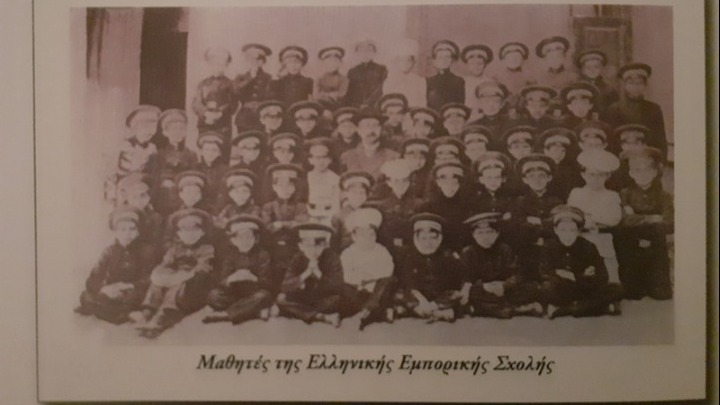
In September 1817, the Greek Commercial School was officially inaugurated, which from the very first moment of its operation, presented the image of a national Greek Educational Institution, with a broad educational programme, and was a milestone in the history of the Modern Greek Enlightenment. The educational work of the School was enhanced by the operation of its own printing press, as students became familiar with books and reading.
The School was staffed with teachers who had a broad education, worked with great effort and exemplary diligence, with the basic aim of enlightening the genus. Among those who distinguished themselves by their teaching and zeal was George Gennadios. A Russian writer, who visited the School in 1819, mentions among other things about George Gennadius: «...he transformed the school seat into Demosthenes» Pnyx, uttering passionate philippics against the barbarians who were drowning the Greek homeland, and moved to tears the hearts of his listeners...".
The Greek Commercial School of Odessa operated for 100 years until 1917
The Greek Community in Odessa found that there was a lack of a Virgin School. The idea matured with the establishment of the Greek Benevolent Community, whose board of directors included Gregorios Maraslis and Theodoros Rodokanakis. After deliberations and the securing of permits for the establishment of the School, its operation began in 1872, in the house of Mavrokordatos. Shortly afterwards, the merchant Rodokanakis secured financial assistance and the School was built in the precinct of the Holy Trinity Church. By a unanimous decision of the members of the Community, it was named the Rhodokanakio School.
The management of the School was entrusted for two years to the journalist and writer, Callirroe Parren. When the girls of the Parthenagogue were graduated, they were awarded diplomas which the Greek State recognized as equivalent to those of the Gymnasiums operating in Athens.