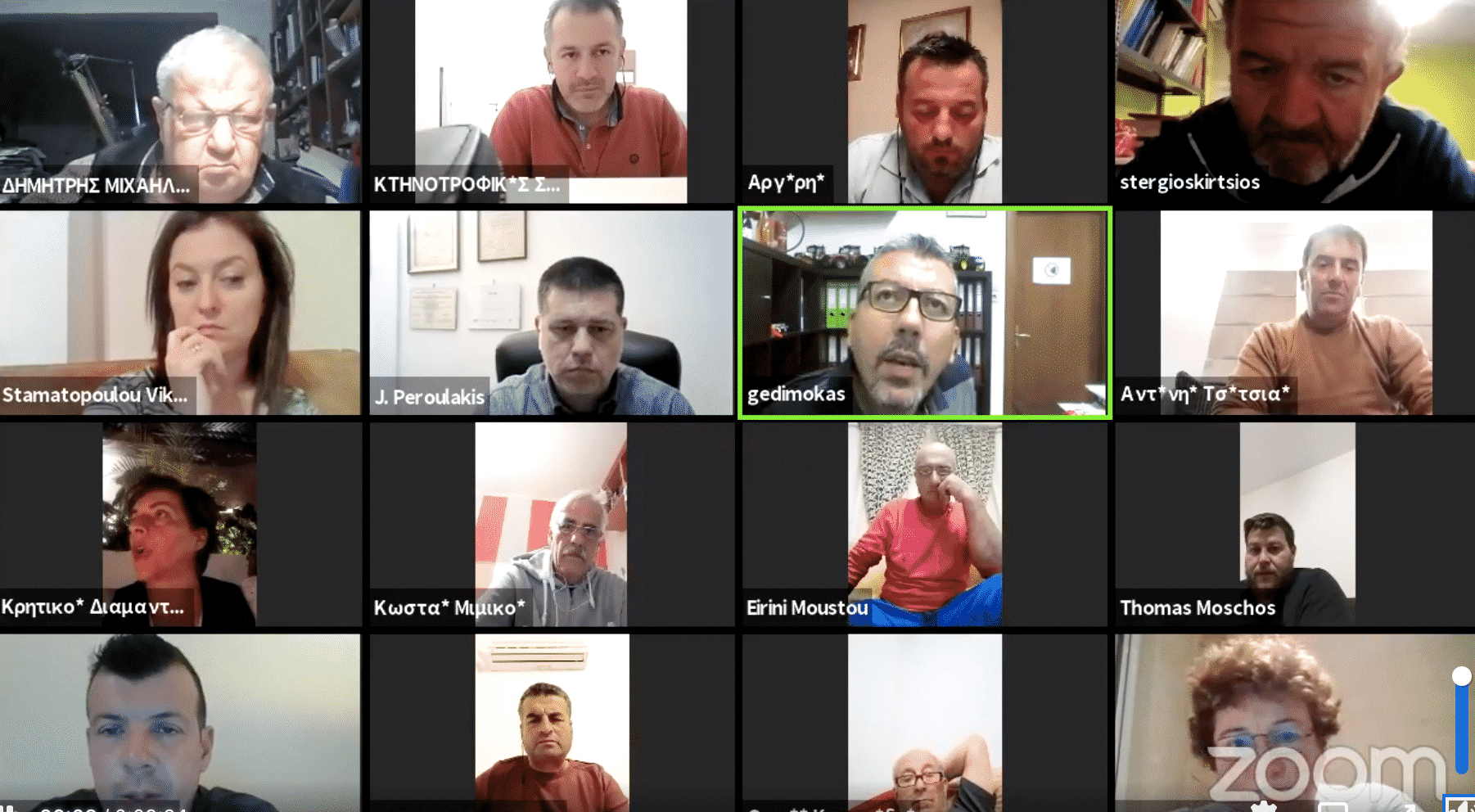
An open public online discussion was held on 26/10/2021, on the initiative of the «COLLECTIVE WORKING GROUP OF LIVESTOCK FARMERS» and with the support of the Livestock Association of Attica Region, with the aim of discussing the effort to make farmers understand the Joint Ministerial Decision 1217/264725 (Government Gazette B 4585/5-10-2021) «Allocation of pasture land to farmers in the country».
The debate started at 21.00 with too many questions and ended, with everyone tired & indignant, at 23.30 with too many more questions.
Participants in the debate were: Kostas Akritidis, Panagiotis Giaglaras, Nikos Dimopoulos, Eva Thomopoulou, Despina Karatosidou, Thomas Karpidis, Magda Kontogianni (host), Diamanto Kritiko, Giannis Kyriakoudis, Stergios Kirtos, Kostas Mimikos, Dimitris Michaelides, Thomas Moschos, Argyris Bairaktaris (moderator), Irini Mustou, Zafiris Nastoulis, Theodoros Spanos, Victoria Stamatopoulou, Maria Styliadou, Stratos Tsikourakis, Antonis Tsitsias & Ioannis Hatzi-Georgiou, with «translators»: Mr. George Dimoka, Mr. Thanasis Kountria & Mr. Yannis Peroulakis.
The discussion is on facebook at the Livestock Association of Attica Region at
https://www.facebook.com/618390278198909/videos/178452751126250
The most important thing that was understood by all is that the open public online debate on the Wednesday, 3 Nov 2021, on 21.00 again with the much-discussed EIS on pasture land and also the much-discussed Stock ... in the hope that Greek citizen-herders will understand what others write for them without them and «wrap whole lives and local economies in a piece of paper» ....
Some of what one might perhaps conclude are:
- The EIS seems to try to cover up the inability of the control authorities to check «strange» records leading to subsidies.
- The EIS imposes unacceptable retroactive regulations that destroy the financial programming of projects already declared and executed.
- In all of Greece all the goats and sheep from 10.000.000 decreased in one year to 9.500.000, and in the same period in one region (Crete! ...) the goats and sheep from 2.800.000 increased to 6.200.000, which were subsidized.
- Such extensive «weird» diversification can perhaps only happen with the synergy of many (elected, civil servants, officials of institutions, veterinarians, breeders, etc.) ...
- The regulations made by the EIS essentially regulate the subsidies of the new CAP 2022-2027 and the potential injustices are multiplied by 7-8 times making them critical for the viability of the livestock farms they «regulate»
- New farmers will enter with only 1/3 of the rights they would have received last year (disastrous! ...)
- The «chaos» in subsidies and the attempt to understand how they are calculated (gains-losses) is compounded by the fact that from 2021 we have «new rights» for everyone, the mechanism of which was not easy to understand for an ordinary citizen.
- There is a large deficit of adequate information for citizens-farmers
- The promotion of the services of the FSS is often done through commercial practices that create inaccurate and misleading impressions and conceal or suppress information crucial to the farmer's decision.
- The texts of OPEKEPE's «regulations» (laws, circulars, KYA etc.) are complex and use «wooden» language, which in the judgment of any intelligent citizen is not justified and simply end up making it difficult for farmers to understand them (or maybe that is their purpose...).
- «By »playing" with grazing densities, bribery procedures are subsidised and healthy competition in production is destroyed.
- The regulation of young productive animals is a step in the right direction.
- Grazing studies are an unacceptable burden for farmers.
- The inability of the public administration to deliver forest maps is holding hostage mainly livestock farmers and even farmers.
- The Ministry of Environment & Energy (Zoning etc.) has come out with specifications for almost everything (parks, roads, warehouses, houses, bio-refineries, recreation etc.), but does not ensure stable land use for livestock business planning, Livestock Parks, City farm etc.
- Even a new land-use plan for RES is being adopted by the Ministry of Environment with the participation of social actors so that wind turbines are not «sown» on high mountains and small islands, but NOTHING is done for livestock land use (energypress.gr, 27/10/2021).
- Farmers do not seem to be involved in the issues that concern them and the legislative regulations are made in the absence of the farmers and, as far as we felt, to the detriment of farmers and livestock farming and consequently to the detriment of the national economy.
- It is tragic that the officials who carry out the checks «impose» authoritatively the signature of the checks by the farmers, without the farmers receiving at that moment the result of the check. It is totally undignified and shows a complete lack of respect for the citizen to «hijack» his signature and only communicate the results after unauthorised actions have been created.
- It is too bad business that you do your business planning in May 2021, you declare your options, and the framework is set retroactively in Oct 2021. REQUIRED.
- The problem is that subsidies cannot be legalised with pasture elsewhere and animals elsewhere, nor can there be pasture without grazing animals.
Mr. Argyris Bairaktaris (moderator) due to the great interest, he asked Mr. G. Demokas, Th. Kountria & G. Peroulakis and anyone else who can help in understanding the «wooden» language of the EIS on pasture and the regulations on WASTE, to participate in the open public online discussion on Wednesday, 3 Nov 2021, on 21.00.
Ms Magda Kontogianni, 6932094231, will be the host and informed about how those who want to join the discussion can do so at https://us02web.zoom.us/j/88436560398?pwd=UXl1Wm82dzUwdEVHaDJzNHFoT0VvZz09 or just to see and ask questions on facebook to the ATTICA REGIONAL CATTLE COLLECTORIES.
For the record, Dimitris Michaelides, 6998282382, AgroNea.