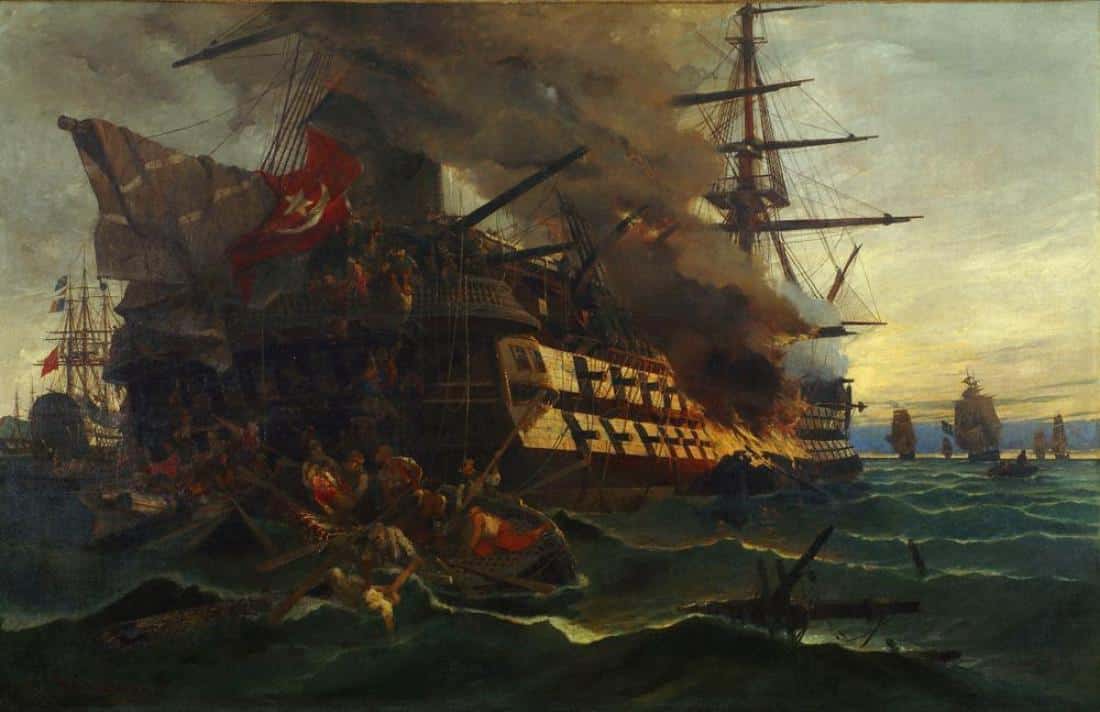
The Burning of the Turkish Flagship by Konstantinos Kanaris in Chios (June 7, 1822), was one of the most significant naval achievements of the Greek Revolution.
The preparation
Following the destruction of Chios (March 30, 1822), the Greek navy sought revenge by attacking the Turkish fleet. To this end, a large fleet of 64 ships was assembled (29 Hydra-class ships under Andreas Miaoulis, who was recognized as the fleet commander, 19 ships from Spetses under Anastasios Androutsos and Andreas Hatzianargyros, and 16 fishing boats). The Greek ships gathered at Psara in late April, and they were looking for an opportunity to take action.
The time chosen was the major Muslim holiday of Ramadan, which began on May 10. Initially, there were attempts at attacks, but they failed, as did the attempt to set fire to the Turkish flagship on May 18.
Meanwhile, the crews began to show signs of insubordination due to delays in the payment of their wages, and disagreements arose between the admirals from Hydra and Spetses. The Spetsiot admirals Androutsos and Hatzianargyrou deemed it prudent to withdraw from the joint effort so as not to cause a rift in the Greek camp, and on May 31, theyset sail for their island.
The Arson
On the same day, the people of Psara decided to attack the Turkish fleet with fire ships, because they had received information that the Egyptian fleet was in Crete. The decision was applauded by the Meow, as well as the other two Hydra admirals, Lazaros Lalechos and Ioannis Voulgaris. Two fire ships, one on each side, were tasked with carrying out the operation.
So, the next day, June 1, the two fireboats—a fishing boat captained by Konstantinos Kanaris and a Hydra ship captained by Andreas Pipino, set out in search of the Turkish fleet. The two fire ships were escorting four brigs (two fishing boats captained by Nikolaos Giannitsis and Georgios Koutsoukos, and two Hydra-style boats captained by Ioannis Zakas and Antonios Rafalias), which were to rescue the crews after the ships were set ablaze.
Taking every precaution, the two fire ships approached the Turkish fleet, which was anchored off Chios, and waited for the right moment to strike. They chose the night of June 6–7, 1822. It was a moonless night, and the officers had gathered on the brightly lit flagship of the Turkish fleet to celebrate the end of Ramadan. Although they were aware of the destructive power of the Greek fire ships, they do not appear to have taken any special precautions.
The Hydra fire ship under Pipino slipped unnoticed toward the vice-admiral’s flagship of the Turkish fleet, a two-masted vessel commanded by Bekir Bey. It attempted to dock, but was swept away by the wind and drifted away. Pipinos’s attempt failed, but Kanaris managed to moor his fire ship to the Turkish flagship. The skillful maneuvers of the experienced helmsman Ioannis Theofilopoulos also played a significant role.
Almost immediately, the wooden hull of the majestic ship burst into flames and began to burn like a firework. Kara Ali rushed to abandon ship and boarded a lifeboat, but a piece of the ship’s burning mainmast struck him in the head and fatally wounded him. Almost all of the 2,000 men on board the flagship were lost.
The 32 men who made up the crews of the two fire ships, taking advantage of the confusion that ensued, reached the Greek ships waiting for them offshore safely. Their return to Psara was triumphant, and, accompanied by a crowd, they made their way to the church of Saint Nicholas, where they offered a prayer of thanksgiving for their salvation.
The Consequences
Bekir Bey, who took command of the fleet after Kara Ali’s death, did not dare to attack Psara or Samos, but, in a panic, he abandoned Chios and fled to the Hellespont. On the contrary, when the Turks of Chios learned of this tragic event, they completed the annihilation of the island by destroying the mastic-producing villages.
Kanaris’s feat gave courage to the Greek rebels and deeply moved European public opinion. Engravings depicting Kanaris holding a torch were circulated throughout Europe, and the proceeds from their sales were sent to Greece to support the struggle.
To honor the crews of the two fire ships, the Ministry of the Navy proposed to the Executive (government) that they be decorated and granted plots of land. The Parliament approved the proposal, but it was never implemented.