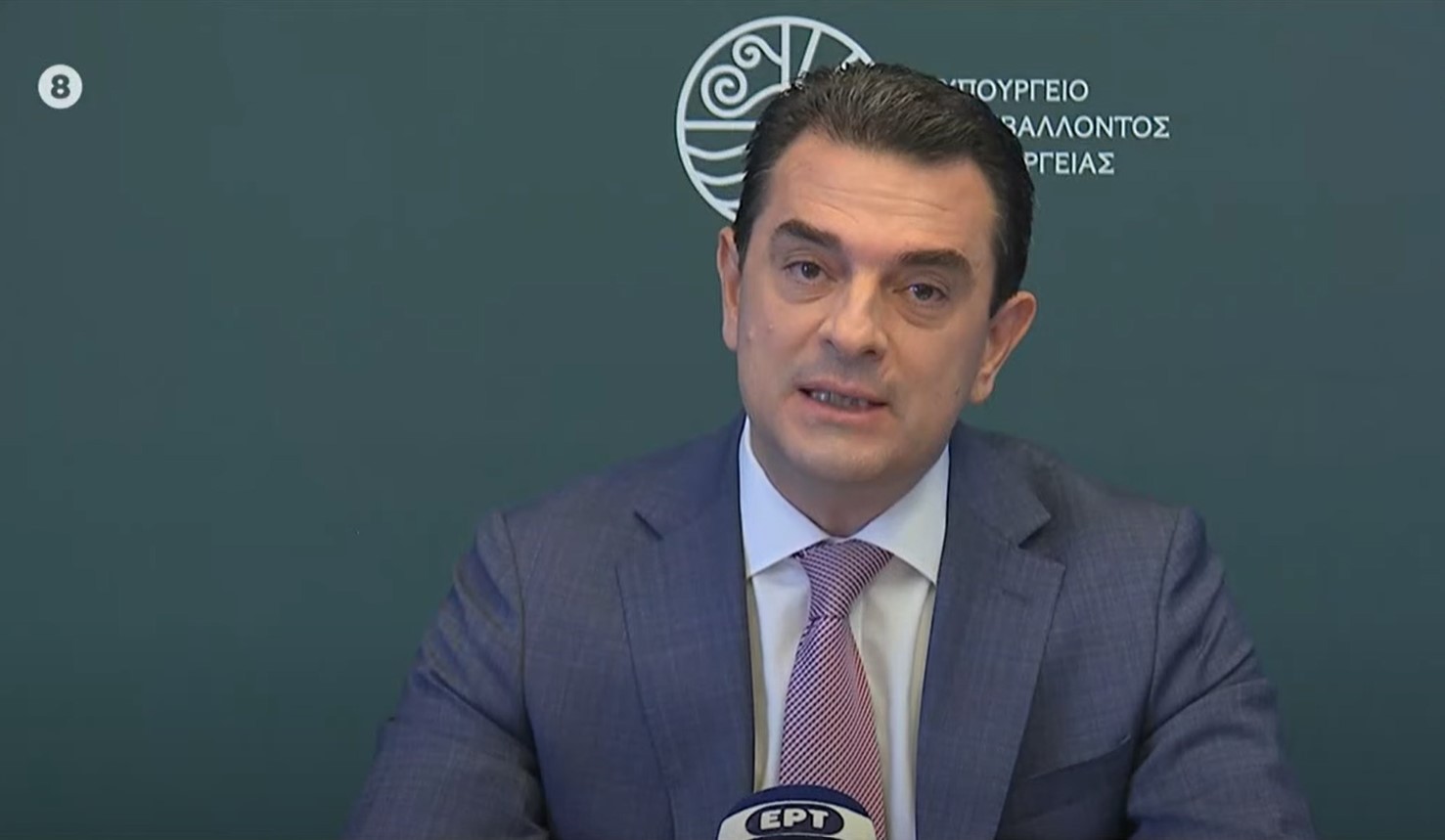
«In 2022 alone, we have saved over half a billion euros because the increase in energy production from Renewable Energy Sources (RES) has allowed us to import less natural gas compared to previous years.».
This was pointed out by Minister of Environment and Energy Kostas Skrekas, in light of the upcoming tenders for new Renewable Energy Sources (RES) decided by the ministry, as well as the upgrade of the targets for RES participation in the energy mix by 2030.
«An unwavering goal of our government, the minister emphasizes, remains the Green Transition, which we are implementing despite the unprecedented difficulties caused by the economic war that Russia has declared on Europe—and, consequently, on Greece. We have already quadrupled our renewable energy capacity over the past three years, with a twofold result: First, to drive a shift in the energy production mix in favor of the environment, and second, to achieve significant savings for citizens. We believe in this policy, which leads to the country’s energy self-sufficiency; we are implementing it, and we will continue to do so with determination.».
The Ministry of Environment and Energy is launching a series of tenders for renewable energy sources with a total capacity of 3,800 megawatts, with the aim—among other things— – to accelerate the transition away from fossil fuels, particularly Russian natural gas.
The first tender for 1,000 megawatts will take place in September, followed by a second tender later this year for 600 megawatts. Mr. Skrekas’s decision, which established the specifications for the first tender, also sets the timeline for the implementation of subsequent tender procedures, which is as follows:
-In 2022, tenders will be held for 1,700 megawatts of wind and solar power plants, as well as 200 megawatts of wind and solar power plants combined with energy storage.
-Tenders for 1,400 megawatts are scheduled for 2023.
-Another 500 megawatts in 2024.
These units represent a portion of the investments needed to achieve the 2030 targets in the first phase and the ultimate goal of climate neutrality by 2050, as additional units are expected to be added outside of tenders. The targets, as recently outlined by Mr. Skrekas and soon to be reflected in the new energy plan, are: to increase the share of renewable energy sources in the electricity mix from 42% in 2021 (which was the share of wind, solar, hydroelectric, etc. RES) to 50% in 2022, 62% in 2026, and over 70% in 2030. By that year, according to the plan, renewable energy plants with a capacity of 24 gigawatts will be in operation, along with an additional 2.5 gigawatts of offshore wind power and 5 gigawatts of energy storage capacity.
As representatives of the renewable energy sector point out, the key to achieving these goals, in addition to streamlining licensing procedures through regulations such as those recently passed by Parliament, is upgrading the grids so that accommodate more power plants and increase the capacity to absorb “green” energy.
The tenders authorized by the Ministry of Environment and Energy and implemented by the Regulatory Authority for Energy (RAE) are conducted using the lowest sale price of “green” energy to the grid as the evaluation criterion. The tender notice sets the starting prices (which are the maximum prices); for the September tender, these are set at 54 euros/MWh and for wind power plants at 63 euros/MWh. The starting prices are higher than in the previous tender held in May 2021 (which was 53.86 euros/MWh), due to the intervening crisis, the shortage of raw materials that led to an increase in the construction costs of renewable energy projects, and, above all, the rise in interest rates. However, the average price in the 2021 auction came in below 40 euros per megawatt-hour (the minimum price fell to 32.97 euros), and it is reasonable to expect that competition will drive prices down in the September auction as well. It is worth noting that, by comparison, electricity prices on the Greek Power Exchange have recently ranged between 250 and 350 euros per megawatt-hour, which means that the increased market share of renewable energy sources is driving prices down.
Mr. Voutsadakis