Ceratonia siliqua L.
Keratea the sled
Carob
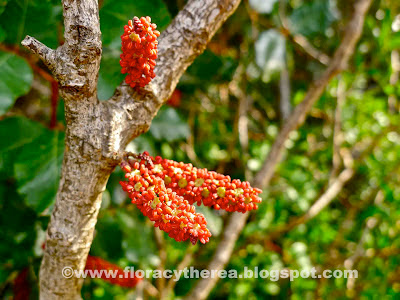
An evergreen, hard-leaved tree that can reach up to 20 m in height. It grows wild throughout the Mediterranean basin, the Middle East, and Western Asia as far as Iran. The tree blooms in the fall, and the male flowers have a characteristic strong, seed-like odor.
It has been cultivated for thousands of years and serves human needs on many levels as a valuable forest species, since it is particularly resistant to heat, drought, and poor, barren soils—stabilizing and enriching them—as an ornamental plant, adorning the landscape with dense, deep-green foliage, and as a source of byproducts widely used in industry. Carob wood is used to make utilitarian or decorative items (furniture, barrels, wood carvings, etc.). Its leaves and bark are used in leather tanning and as an excellent natural dye.
Its nutritious fruits have been used from ancient times to the present day for animal feed. During difficult times for humanity—such as wars and famines—carob pods were ground into flour, thus saving populations from starvation. Ground carob pods are used to make a high-quality coffee substitute—suitable for those following homeopathic treatment—as well as a chocolate substitute, carob syrup*, and more. Several scholars believe that the “locusts” mentioned in the Gospels as the food of St. John the Baptist were actually carobs; the tree is called a “locust tree” in English, and the carobs are called “locusts.” Another common name for the tree in English, “St. John’s bread,” leads to the same conclusions.
Wild trees bear fruit relatively slowly (12–15 years), while cultivated (grafted) trees can bear fruit in as little as 5 years. The fruit takes a full year to ripen and is harvested in late summer, depending on the region. Fresh loquats are eaten raw, while when they ripen and turn a dark brown color, they strongly resemble chocolate and are a pleasure to chew.
On Kythira, as throughout the Mediterranean, the holm oak is a characteristic feature of the local flora. Several centuries-old trees have survived on the island, such as the ancient cork oak outside Potamos, near the soccer field.
In this wooden-roofed house, the memories of locals and those living abroad come to life as relatives and friends bid farewell or welcomed their loved ones when they left or returned from distant journeys to Alexandria,Alexandria, Australia, and America in the 19th and 20th centuries. |