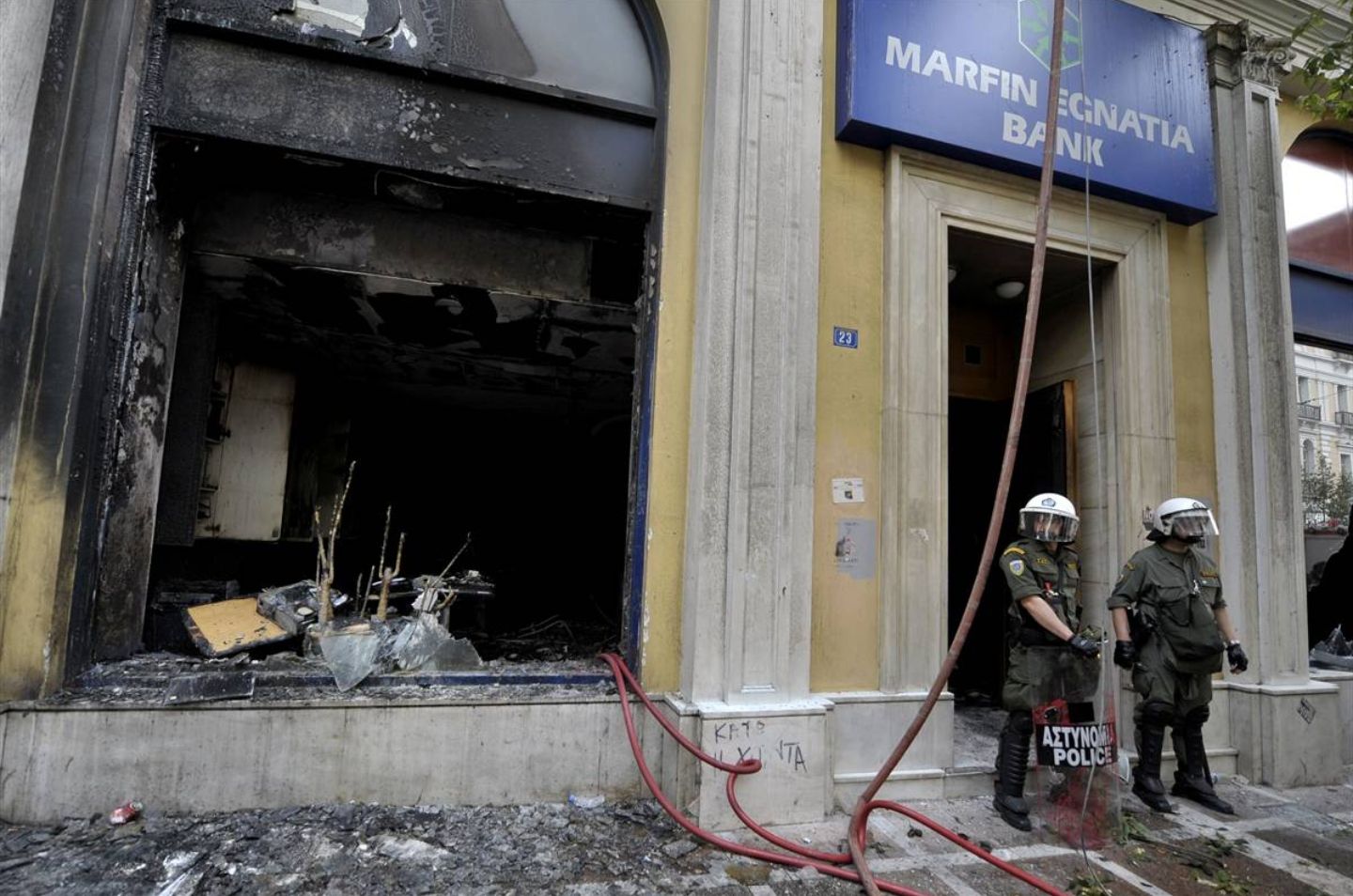
The Supreme Court ruled that the bank, which had leased its neoclassical building on Stadiou Street, had not taken the necessary security measures
In a «bombshell» ruling, the Supreme Court has, for the first time, held Marfin Bank itself liable, 14 years after the tragedy in which three people—including a pregnant woman—lost their lives while trapped inside its burning branch in central Athens.
More specifically, as revealed by the dikastiko.gr, the Supreme Court sets aside the previous decision of the Court of Appeals and remands the case for a new trial to the Athens Single-Judge Court of Appeals, noting, in fact, that the case must be heard with a new lineup.
«Upon accepting the relevant appeal, it overturned Decision No. 5541/2020 of the Athens Single-Judge Court of Appeals, acknowledging the liability of MARFIN Bank, the lessee at the time and those arising from individual torts committed by members of its Board of Directors, for failing to take safety measures to prevent the disaster »of the MARFIN branch located in the neoclassical building at 23 Stadiou Street, as a result of a fire that broke out during a march and rally on May 5, 2010" as stated in the decision published by Athens attorney Konstantinos Sakellariadis, who represented the property owner.
As stated in the Supreme Court’s decision, «the Court of Appeals Based on the assumptions set forth above, it deprived the contested decision of a legal basis, in that it held that insufficient, vague, and contradictory justifications, with regard to the crucial issue of the tort liability of the first respondent—the lessee bank—and the members of its board of directors (the second, third, fourth, and fifth respondents), regarding the omissions attributed to them, which render appellate review impossible, regarding the substantive law provisions of Articles 914, 330, 300, 297, and 298 of the Civil Code, which it erroneously failed to apply and thereby indirectly violated.’.
According to the Supreme Court, in its decision, the Court of Appeals «in particular, 1) held that the first defendant, the tenant, bore no fault for the total destruction of the leased property, without making any assumptions regarding the adoption and implementation of the necessary safety measures, 2) provided insufficient reasoning if the alleged omissions on the part of the lessee bank and the members of its board of directors, as organs of the legal entity, [a) Failure to install reinforced “vandal-proof” glass panes on the storefront of the ground-floor store, which can withstand multiple impacts from heavy objects or security rollers, b) lack of a second emergency exit toward a common area, c) lack of a water supply network for firefighting or a flexible hose permanently connected to a water supply, (d) lack of a fire safety study], ω...and also to close the aforementioned store whether from the start of business hours on the day of the demonstration (May 5, 2010) or before the start of the march, whether or not they contributed to the occurrence of the aforementioned result, given the existence of a causal connection, 3) it provided contradictory reasoning regarding its ruling on the automatic termination of the lease (on May 5, 2010), whereas according to its previous findings, the lease had been extended until June 30, 2012; and 4) it provided insufficient reasoning regarding its ruling that the lessee bank had no obligation to compensate for damage to the leased property and the reduction in its market value.».
As noted, «in the case at hand, which concerned workspaces that were already in use prior to January 1, 1995, there was the requirement that emergency exits “not be locked,” “so that they can be used without obstruction at any time.”. This obligation was also incorporated into Article 10, paragraph 6, of the Bank’s “Safety Manual for Staff, Customers, and Property,” which was in effect at the time of the incident. Furthermore, according to Article 12, paragraph 2, of Fire Regulation 3/1981, a water-supply fire protection system must be installed in public gathering areas of categories B and C (with a capacity of 201 people or more, i.e., not Category A, as in this case) and, furthermore, (a) in public assembly halls regardless of category, provided they are located on a floor of a building exceeding 20 meters in height, and (b) in rooms on any floor where access via flexible hoses, supplied with water from outside the building, is difficult. Again, however, this requirement (as well as the alternative requirement to install a 15-meter-long flexible hose,1 with a nozzle, the other end of which must be permanently attached to a faucet in the internal plumbing system installed for this purpose, Article 12, paragraph 3 of Fire Regulation 3/1981) are exempted those who operate public assembly halls with a capacity of fewer than 50 people, in which the provision of at least two portable dry-powder fire extinguishers is considered sufficient (Article 12, paragraph 1, subparagraph d of Fire Regulation 3/1981). Finally, according to Article 14 of Fire Regulation 3/1981, managers and operators of public assembly halls, as defined by the Fire Safety Regulation, are required to organize and train their staff on an ongoing basis in matters of fire protection, firefighting, evacuation of premises, etc.’
And the Supreme Court concludes: «For these reasons, it sets aside the final judgment No. 5541/2020 of the Athens Single-Judge Court of Appeals, in all other respects. It remands the case for further proceedings to the Single-Judge Court of Appeals of Athens, which will be constituted »by a judge other than the one who issued the decision being appealed.".
As a reminder, the tragic incident occurred on May 5, 2010. The 2013 bank executives They were convicted of the negligent homicide of three employees and of causing bodily injury to 21 other employees and for multiple failures to comply with fire safety measures and staff training requirements. The perpetrators have not yet been identified.
The families of the victims, after MARFIN executives were found guilty of a misdemeanor, they filed a claim against the bank seeking damages. However, while the Court of Appeals had awarded compensation totaling 2.24 million euros to the families of the victims and the 24 employees of the branch, The Supreme Court overturned the decision, remanding it to the Court of Appeals, as it ruled the compensation amounts are excessiveas awarded.
The following had also intervened regarding the payment of compensation to the relatives: Kyriakos Mitsotakis in 2020. However, the Ministry of Citizen Protection referred the case regarding compensation for the Marfin victims to the State Legal Council, claiming that «there is a legal issue, »regarding the payment method.".