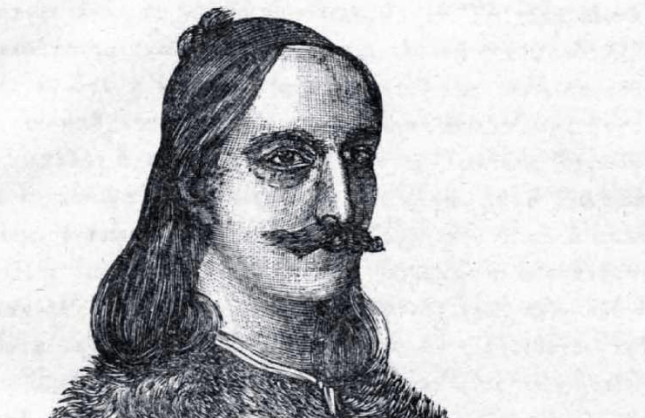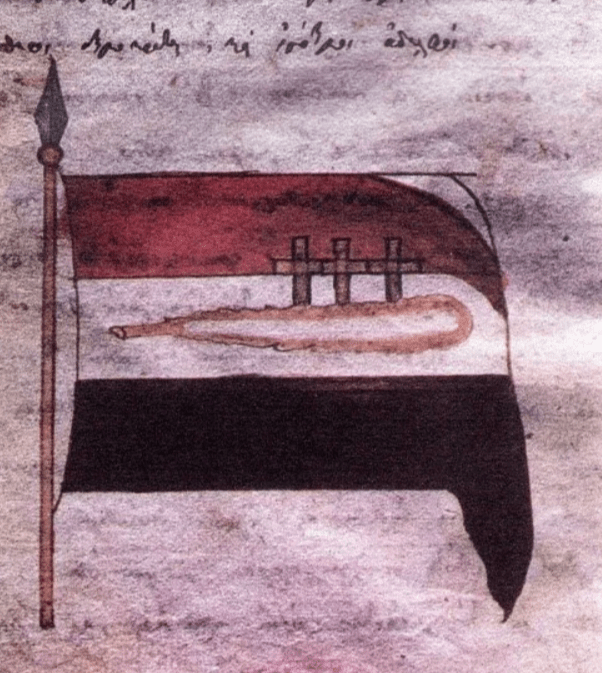
In 1797, the revolutionary Rigas Velestinlis, in his Constitution—which is also the first constitution of the Greek people—entitled «New Political Administration,» describes the flag of his democratic state with a vivid reference to its symbolism.
Specifically, the Annex to its Constitution states that its flag is tricolor, «red on top, white in the middle, and black on the bottom,» while also providing interpretive explanations of the colors and the meanings they convey. It explains that red signifies «the self-determination of the Greek people»—that is, their right to decide their own course and their freedom. White signifies the just cause of the enslaved people’s revolution against tyranny. And black signifies the enslaved people’s resolve to fight and die for their freedom, «death for our Fatherland and our Freedom,» which was expressed in the emblematic words “Freedom” and “Death.” Two words that have since stirred the hearts of the Greeks and inspired the warriors, the revolutionaries of 1821: “We will either be free or we will die.”.
Rigas thus expressed on his flag and in his Manifesto the Greeks’ unwavering determination to fight for freedom until death. With these proclamations, he rejected all the conciliatory attitudes of certain prominent scholars who sought to postpone the revolution of the enslaved people until some future date. Furthermore, he expressed his determination—which he succeeded in conveying through his anthem (verses 7–10) to the enslaved Greeks, proclaiming that freedom is the greatest good, above even life itself, and recalling the forty years of his life during which he composed the “Thourios”:
«Better an hour of freedom
after forty years of slavery and imprisonment.
At the same time, he compares the torments of slavery—which the Greeks endured for so many years—to being burned at the stake: The massacre of children, the killings, the beheadings, the impalings, the forced conversions to Islam, the heavy taxes, the arbitrary abuses—and that is why he cries out:
What good is it to live if you are in bondage?;
’Think about how they’re roasting you in the fire all the time.».
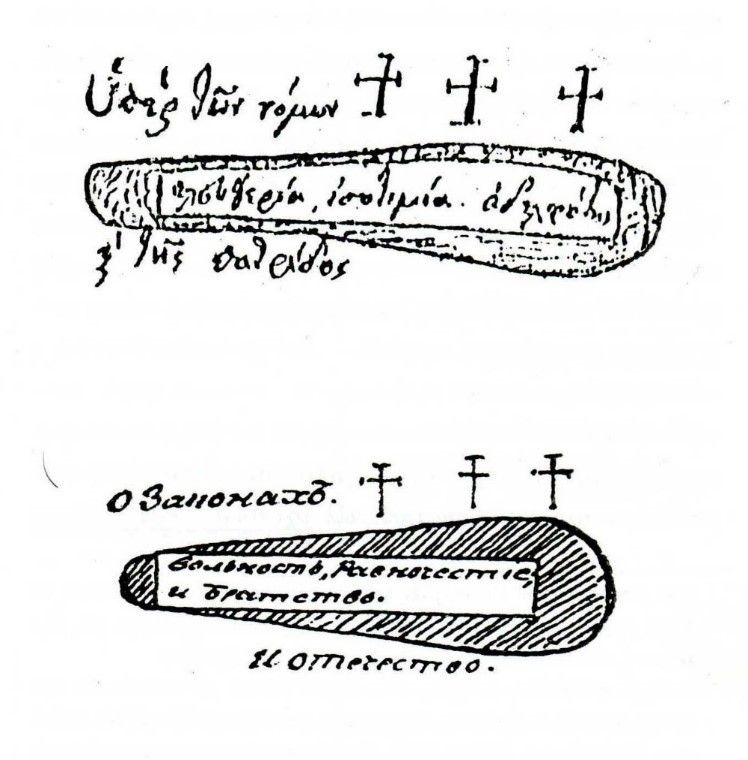
Furthermore, Rigas added the national emblem to his flag: «Hercules» club with three crosses on top.’ In this way, his Constitution aligns with the symbols that Rigas included on the maps of his democratic state. In the title of the Map depicting Hercules fighting the Amazon, in the depiction of the sleeping lion in the Epigraph of Constantinople, and in the maps of the Parisian Principalities of Wallachia and Moldavia.
It should be noted that Rigas did not adopt as a national emblem the Phrygian cap that had become established in revolutionary France; from there, he did, however, adopt the Jacobin Constitution of 1793 and translated it, adding several new elements of his own. He wanted his national emblem to incorporate Greek elements. The Phrygian cap referred to Asia, the source of the barbarian conquerors—the Persians in antiquity and now the Ottomans.
Regarding the significance of Rigas’s flag, it is worth noting that the tricolor flag was raised by Alexander Ypsilantis in Iasi on February 22, 1821, and was blessed by Metropolitan Iof Athens, Benjamin, at the Monastery of the Three Hierarchs. However, instead of the mace, it featured the phoenix rising from the ashes on one side and the Cross on the other. In Dragatsani, the Sacred Company sacrificed itself under this tricolor flag, which Demetrios Ypsilantis used during his journey to Greece. In a color lithograph by L. Dupré (1825), the fighter Nikolaos Mitropoulos is depicted holding a tricolor flag similar to Ypsilantis’s.
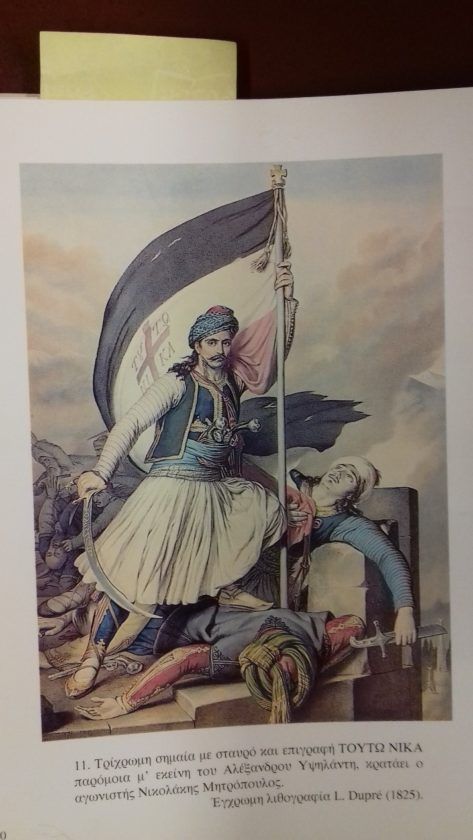
The Rebel in L. Dupré's Color Lithograph (1825)
In fact, Nikolaos Ypsilantis, Alexander’s brother, included Rigas’s explanations regarding the three colors of their flag in the revolutionaries« »Military Laws«: »White signifies the innocence of our just cause against the tyrants; black, our death for the sake of our homeland and freedom; and red, the self-determination of the Greek people.”.
We presented the flag of the revolutionary Rigas, with its emblematic symbols, which embodies his definitive decision to lead the revolution of the enslaved Greeks through his two-word declaration: “Freedom or Death.” This pioneering flag of Rigas, with its revolutionary symbolism, the State Committee for the Commemoration of the 1821 Anniversary neglected to include on the commemorative coins depicting the evolution of the Greek flag.
Dr. Dimitrios Karamperopoulos
(Published in the newspaper «TA NEA,» November 30, 2020, p. 49)