The suburbs of Smyrna, especially in the 19th and 20th centuries, were an integral part of its economic and social life. The rapid growth of Smyrna from the 19th century onwards is also evident from its expansion. Until the early 19th century, the city extended to the Fasoula area. In 1840, Kokkinovafion Street (Kokkinia Boyatzidika) – the city's central district in the 20th century – was full of marshes, with a few houses where the dyers lived. In the 1920s, the city's boundaries reached north to Daragatsi and beyond Punta, east to the bridge over the Meli River, and east to Dermen Tepe.
Starting from the northern coast of the Gulf of Smyrna, we come across Skala Mainemenis, the small port that connected Mainemenis with Smyrna. A few kilometers from Skala was Mainemeni, with about 5,300 Greeks and a total population of 12,500. Its market was a hub for products from the 45 villages in the area. On the northwestern slopes of Mount Sipylos was Tsili, and further east was Kordelio (Peraia), one of the most populous suburbs of Smyrna with a population of 30,000 in the years before the Catastrophe. Kordelio took its name from the neighbouring monastery of Kordoleontos of Sipylos and was also known by its Turkish name, Karsiyaka. Until 1874, there were only a few farmhouses in the area, but it grew rapidly. Transportation to Smyrna was by rail and small steamboats. The railway passed through the stations of Chalkas Vounar and Agia Triada before reaching Kordelio in 28 minutes (a distance of 11 kilometers). Kordelio was divided into four districts: Allambai, Kordelio, Papa Skala, and Tomazou, while further east, Petrota and Agia Triada could be described as suburbs of Kordelio. There were four Greek schools (a six-grade urban school for boys and girls, the school of Agios Ioannis, and the Antoniadis school). Kordelio was a place of recreation and leisure for the people of Smyrna. The cafes «Venizelos,» «Venus,» and «Ethnikis Amynis.» Olympia, To Skra, and Michel, the Ali Riza and Gounari pastry shops were the most famous, as was the Olympia Hotel. The Greeks had founded the Agathangelos brotherhood.
Between Kordelio and Smyrna were the coastal towns of Bairakli (Vari), Neo Mersini, and inland Bournovas and Paleo Mersini (where Panagia Myrtidiotissa is located). Bournovas (a corruption of the Byzantine Prinovaris) was 8 km from Smyrna and was located on the slopes of Sipylos. In 1853, there were 700 Greek families, which grew to 20,000 by 1882. In 1920, Kontogiannis recorded a population of 15,000 inhabitants, two-thirds of whom were Greek. Bournovas was divided into three districts (Chavouza, Stathmos, and Agora). The V. Papadakis community school for boys had been operating since 1856. The social life of the residents centered around the English Club and the five coffee shops (Voutzali, Efstathopoulou, Lampaditou, Prodromou, and Tzanni).
The Greek villages of Kouklouzas, Bouvarasi, and Narlioi belonged to the municipality of Vournova. Kouklouzas, an hour from Smyrna, had a purely Greek population of 5,000 inhabitants with a municipal school and 118 students. Bouvarasi, known as Kefalovryso among scholars (on the slopes of Mount Olympus), had a population of 1,200, about half of whom were Greek. However, another source mentions a population of 3,000, including 2,500 Greeks. Narlioi («village of roses»), half an hour from Vournova, had a population of 500 inhabitants, of whom 350 were Greek, or 700 according to another source. The Turkish villages of Siklari (3,000 inhabitants), Naldouki and Kavakia Deres also belonged to the administration of Vournova.
Near Smyrna (north) were the baths of Artemis (Chalka Bouna), where a statue of the goddess was found and where, according to tradition, a bronze ring prevented the waters of the spring from escaping and flooding Smyrna. In 1897, a French company used the water from this spring to supply the city.
Voutzas, northeast of Smyrna, with 10,000 inhabitants (almost all Greeks), was connected to Smyrna by railway. The Greek community maintained a six-year boys« and girls» school with 560 students and had founded the religious brotherhood "Holy Apostles." Voutzas (or Bouzas) was a resort for the English (with a club and a racecourse), but also for the people of Smyrna, who went on excursions to Tepez, Karagats, Kagkio, Paradisos, and the aqueduct, where Lord Byron carved his name. The valley of Agia Anna, on the road to Voutzas, was known for the pilgrimage of the same name on the slopes of Pago.
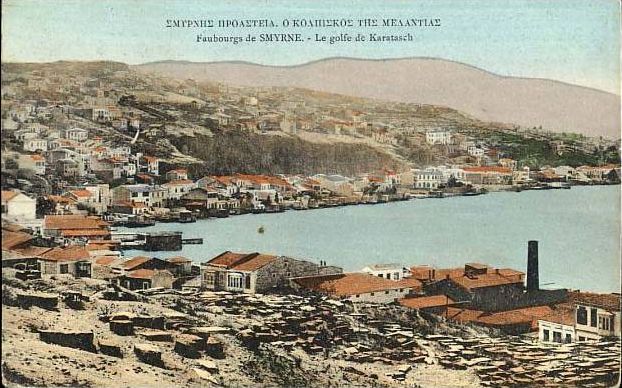
To the southeast of Smyrna, we find the suburbs of Melantia (Karatas), Sfaktiria (Shalhane), Kallithea (Karantina), Gkiostepe (Enopi), Kokargiali (Resadie, Myrakti), Lintzia, Baltsova, Tsifliki Agios Georgios, and Narli Dere (at the foot of Mount Dyo Adelphia). Karatas had three schools (a Greek boys« and girls» school, an Armenian school, and a French-Israeli school) and the «Pelops» nautical and gymnastics club. Karantina had a Greek community school and a private school (owned by H. Papaemmanouil), a Greek-French school (owned by Nikolopoulos), a military hospital, and the «Miramar» club on the waterfront. In Giostepe, there was a Greek boys' and girls' school, a French school, and an international school. Shalahane (Sfaktiria) was known to the people of Smyrna for its famous "elevator," a 35-meter-high lift that led to the heights of the area, where the Church of the Assumption of the Virgin Mary was located. In Salachane, there was a Greek co-ed school, an Israeli school, and D. Tahintzis' sesame oil and tahini factory. Seidiki (Sevdiki, Imerion Erasinon), 15 kilometers to the south, was connected to Smyrna by rail. It had a population of 8,000, of whom only a few were Turkish. There were 150 students in the five-year boys' school, 120 students in the five-year girls' school, and 240 children in the nursery school.
Other suburbs of Smyrna were Daragatsi, Tepetziki, Hatzilaris, the Three Wells, and further away (to the south and southwest) Jimovani with 1,500 Greek residents, Malka with 700 Greeks, and Develikioi with 500 Greeks. Hatzilaris, half an hour from Smyrna, had 1,000 inhabitants, many of whom worked at the Antonopoulos and Samios oil mill. There were many factories in Daragatsi: six steam-powered flour mills, nine carriage factories, three tanneries, and three ice factories. Tepetziki was five minutes away from the bridge over the Meli River. Three hundred Greeks lived in Tria Pigadia.
1. Karatas/Meladia on a postcard
(‘Asia Minor’ Issue 19 July/August/September 2009)
Bibliography:
- Greek Guide (1920), Asian Greece
- Chr. Solomonidis, «Education in Smyrna» (1962)
- P. Mechtidis, «Coast of Asia Minor – Greek Memories» (2006)
Petros St. Mechtidis, Archaeologist - Art Conservator, Museum of Byzantine Culture