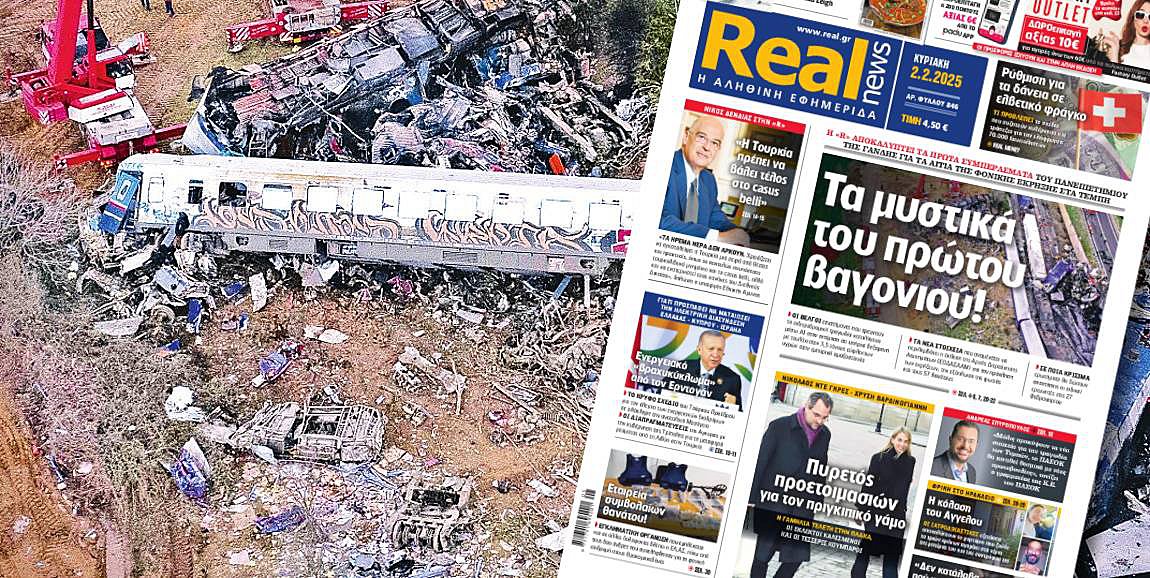
Belgian scientists investigating the train tragedy have concluded, based on AI analysis, that there was a tank containing at least 3.5 metric tons of flammable liquids on the freight train. The new findings are expected to be included in the report by the Accident Investigation Authority (EODASAA) regarding the cause of the explosions, the spread of the fire, and the 57 deaths. What critical questions will the expert investigators answer on February 27?.
Scientists at the University of Ghent have made precise assessments of the causes of the fire that broke out following the train collision in Tempi, who have been tasked with investigating the railway tragedy. According to information from Realnews, the Belgian experts have reached conclusions not only regarding the type of substances that caused the explosion, but also regarding their weight, the dimensions of the tank that carried them, and the location on the train where they were positioned!
A team of academic researchers at the Department of Structural Engineering at the University of Ghent has been investigating the accident for about a year, following a request from the Hellenic Organization Greek Organization for the Investigation of Aviation and Railway Accidents and Transport Safety (EODASAA). Using the equipment in their specialized laboratory, as well as the innovative artificial intelligence-based analysis system they have developed, the Belgian scientists are reported to have reached the following conclusions:
– The first car of the freight train, which was following the train’s two locomotives, was carrying a shipment of unreported volatile hydrocarbons.
– These flammable substances were transported in a tank measuring one by two and a half meters (1 m × 2.5 m).
– The weight of the volatile hydrocarbons that the commercial train is estimated to have been carrying was between 3.5 and 4 metric tons.
– The explosions lasted about 8 seconds after the collision, and the «mushroom cloud» they created reached a height of 80 meters.
– The flammable substances most likely refer to xylene and toluene, which are also used to adulterate fuel.
The same reports state that this information, which is being made public for the first time by the «R», are expected to be put in writing and sent to Athens within the next few days.
The surveys
Commissioning the relevant research to the University of Ghent was one of the first steps taken by EODASAM when it officially and practically began operations in February 2024. For its research, the team of Belgian academics had at its disposal samples from the site of the tragedy, as well as from the wrecked trains. In addition, all available videos and images of the explosions caused by the train collision and the ensuing fire were thoroughly analyzed in the university’s laboratories. Using artificial intelligence systems, the experts are able to determine exactly what caused an explosion in a given area. In fact, to reach a scientifically sound conclusion, they also took into account factors such as weather conditions, humidity levels, and the strength of the winds prevailing in Tempi on the evening of the 28thof February 2023, when the collision occurred.
Thus, the conclusions regarding the transport of at least 3.5 metric tons of flammable liquids in the first railcar were drawn from the exact location of the explosions, the size of the «fireball» that was created, and the way the fire spread. At the same time, other factors were investigated, such as the fact that the «fireball» appeared to change color, which indicates the type of substances that were burning at that moment.
German Institute
The findings of the University of Ghent, along with a number of other conclusions, will be included in the EODASAM report, which will be officially presented on February 27, one day before the two-year anniversary of the tragedy. Among other things, the Accident Investigation Authority has commissioned yet another study by foreign scientists, which may shed light on how the fire spread. This investigation concerns the behavior of the train seats and is being conducted by a specialized institute in Germany.
In accordance with the applicable regulations, companies responsible for train sets must carry out specific maintenance procedures on the seats at regular intervals to ensure they are fire-resistant. The German institute’s investigation will determine whether this maintenance was performed or whether the seats contributed to the spread of the fire.
Three collisions
Another scientific conclusion to be included in the EODASAAM report concerns the collision between the two trains. According to reports, one of the most notable findings is that the two trains collided not once, but a total of three times. This has been determined through an examination of the wrecked trains as well as available video footage. After the initial, first collision, the trains veered sharply, and two more separate collisions occurred between them. Thus, with the presentation of all these scientific findings, the five-member EODASAAM council will attempt, for the first time, to provide a valid answer to the central—and perhaps unanswered—question surrounding the tragedy.
This concerns the fact that the fire—which, according to the Fire Department, has been described as «unexpected and abnormal»—caused so many deaths, despite the violent collision between the trains. Furthermore, reports indicate that the EODASAAM report will include a series of tragic shortcomings and failures that occurred in the management of the scene of the tragedy, in the hours immediately following the collision. The main reason for these failures was the fact that the Traffic Police were responsible for managing the crash site! This happened because, although the creation of EODASAM was provided for by a Presidential Decree signed way back in 2007, this Authority was established and has been operating for only a year. Thus, instead of having the investigation handled by officials with extensive experience in investigating such accidents, it was taken over by officers from the local Traffic Police…
Fire-related data in the hands of families
The Committee of Independent Family Experts (EDAPO) regarding the railway accident in Tempi. Following a thorough scientific investigation, the experts appointed by the victims’ relatives have concluded that the commercial train was carrying an illegal cargo of flammable hydrocarbons weighing approximately 3.5 metric tons!
As stated in the Realnews A well-informed source stated, «For scientists and those with the appropriate expertise, the presence of flammable material, which led to the massive fireball following the collision, is considered indisputable.» In fact, analyses showed that the illegal material was loaded onto the first car of the commercial train, behind the second locomotive.
There, where Hellenic Train, in a recent announcement, stated that there were wide iron sheet metal products (sheet metal). EDAPO’s expert scientists studied, frame by frame, the progression of the fire and the explosions, the fluctuations in its intensity, the shape and color the fire took on, as well as the height—approximately 80 meters—that the fire mushroom reached. «All of this, in the hands of experts, constitutes critical and scientifically indisputable evidence leading to the conclusion that flammable hydrocarbons were present,» the same source emphasizes. If the evidence is verified, then it should be taken for granted that the charges against Hellenic Train executives will be upgraded. «The parent company is liable in any case. Beyond that, an investigation into smuggling must be launched. So the courts will be required to get involved in the smuggling investigation, and that’s where everything will start to be looked into… »Who sent the shipment, who received it, on whose behalf the transport took place, and so on,” notes a legal source.
Silicone oils
The fact that the silicone oils present on the trains were not responsible for the explosion is also confirmed by yet another report from a technical consultant hired by the victims« relatives. The expert report by Markos Chrysos, a chemical engineer at Aristotle University of Thessaloniki, states that, on the contrary, silicone oils are used for safety reasons, as they are heat-resistant. »It must be emphasized that, despite the proper sampling procedure, which was carried out correctly, reservations remain regarding the quality of the samples. The samples, taken from the three transformers of the engines, were exposed to the elements for a long period of time (approximately 19 months),” the new expert report emphasizes.
«Durable»
«It should also be noted that silicone oils were developed for use in high-voltage transformers to prevent fires and other related issues. Silicone oils are resistant to high temperatures and electrical discharges and are generally designed to mitigate safety issues that previously existed with the use of conventional oils. Based on the results of the tests and experiments conducted at the two laboratories of the General Chemical State Laboratory, I can responsibly state that it is not possible for silicone oils to create a fireball. It should also be noted that, based on our visual observations, there was no degradation of the samples due to poor maintenance (replacement of the samples in accordance with their service life) and/or due to thermal degradation following exposure to high temperatures (fire),» notes the expert, who also refers to hydrocarbons.
«In any case, silicone oils could be highly flammable if flammable hydrocarbons were present; however, as the experiments conducted have shown, the presence of these volatile hydrocarbons is virtually zero and in no way affects the basic properties of the silicone oil.… In any case, however, it should be emphasized that the experimental data cannot support the claim that the formation of fireballs, fire jets, and, more generally, the fire behavior observed in the video footage, were caused by the silicone oil found inside the machine transformers. We easily reach this conclusion due to the low presence of volatile hydrocarbons, the high flash point, and the quantities of silicone oil found in the form of pooled liquids—as evidenced by photographic evidence—at the accident site…».
In the final stretch before the trial
The defendants' statements, which so far number more than 40, are set to conclude at the end of February
The countdown has begun until the moment when those responsible for the Tembi tragedy, which claimed 57 lives, will take the stand. The investigation by Special Investigating Judge Sotiris Bakaimis appears to be entering its final stages, as the defendants« testimonies are expected to be completed by the end of February. So far, the number of defendants exceeds 40. Among them, in addition to the »fateful« stationmaster and his superior, are OSE executives, the 23 individuals involved in Contract 717, officials from the Ministry of Infrastructure and Transport and the Railway Regulatory Authority, as well as two high-ranking executives from Hellenic Train. One of the two is the company’s former CEO, Maurizio Capotorto, for whom yet another legal battle has just begun, as he has been summoned to provide explanations as a suspect in the criminal offense of making a false statement. The reason for his summons is the »testimony” he gave about a year ago before the Parliamentary Investigative Committee on Tempi. At the time, M. Kapotorto had managed to infuriate all the committee members, as he failed to provide substantive answers to any of the questions posed to him. In fact, when he was told that they would ask the prosecutor to investigate him for perjury, he refused to sign his testimony, claiming that he could not understand the interpreter.
The Critical Report
By the time the hearings scheduled so far are completed at the end of February, the investigator will also have in his possession the expert report from the National Technical University of Athens.
According to separate reports from the families’ consultants, between 5 and 30 people lost their lives in the fire. In a supplementary report by expert witness Vasilis Kokotsakis, submitted to the Public Prosecutor’s Office in January, 27 passengers were burned alive. However, it is noted that the publication of the list containing these 27 names provoked strong reactions from the relatives. In any case, based on the information available so far, the National Technical University of Athens (NTUA) expert, Professor Dimitris Karonis, appears to have concluded that such an explosion could not have been caused by silicone oil. The picture, of course, as legal circles note, could have been clearer if investigation protocols had been followed from the very beginning. Which, in this case, were likely ignored. For example, the scene of the accident was tampered with.
This hasty «clearing out» and «re-clearing out» of the site, according to the victims« relatives, was not »innocent.« A telling example is the statement made by their technical advisor, V. Kokotsakis, in the updated report he submitted to the investigating judge: »The tampering with the crime scene was not accidental, but deliberate, extremely rapid, and to a large extent entirely premeditated, since there was never any record or description of the materials and evidence that were transported.”.
This particular aspect of the case, which was initially separate and was subsequently linked to the main case file, was separated again a few days ago by D. Bakaimis in order to set a trial date immediately, as the charges brought against the four defendants are misdemeanors and there is a risk of the statute of limitations expiring. The final decision on whether or not to separate the cases rests with the Judicial Council, which will rule on the matter by resolution.
The determination
Therefore, provided that no further investigative actions are required and the special appellate judge’s investigation is completed in the coming weeks, the trial date may be set for the second half of 2025. This is because, according to recent amendments to the Penal Code, the case file from the investigating judge will be forwarded to a prosecutor, who will draft the charges and, with the consent of the president of the Court of Appeals, will refer the case to trial.
In other words, a resolution by the Judicial Council is not required; in this particular case, given the volume of the case file, it would take at least four to five months to issue such a resolution. It is also important to note that a courtroom has already been identified and prepared in Larissa for this trial involving numerous defendants. In other words, there will be no repeat of what happened with the Golden Dawn trial, when not a single hearing could be held for months as a suitable courtroom was being sought to accommodate the dozens of defendants, their attorneys, and the public. Specifically, according to information from the Realnews, the «Gaopolis» conference center at the University of Thessaly includes a courtroom for more than 50 defendants and 250 attorneys, a judges« chamber, a designated area for police officers, a lawyers» area, a press center, and an additional audience area where the trial can be viewed on screens (as was done during the “November 17” trial), given the high level of interest. In addition, new electrical and mechanical equipment, air conditioning, digital infrastructure networks, and control systems are in place.
Justice, Truth, and Action
How is the government expected to handle the political crisis and the shift in the agenda that followed Sunday’s mass rallies over the tragic accident in Tembi?
As the government grapples with a political crisis—one that is becoming increasingly dangerous—in the wake of last Sunday’s mass rallies, just a few weeks before the second anniversary of the deadly Tempi accident, the Maximos Mansion is called upon to focus its efforts over the next 30 days. Now, Kyriakos Mitsotakis knows that the political landscape has suddenly become fraught with variables and more unknowns, with the government no longer the sole determinant of the political agenda. The «halcyon days» —following the positive impact on society from the December economic measures—seem a distant memory for the government, as they have been replaced by threatening clouds gathering over the sky of Herod Atticus. The urgency of the situation was confirmed by the unscheduled interview the prime minister gave last Wednesday on Alpha, in an effort to align the government not only with judicial and other developments concerning the deadly train accident in Tempi, but also with the prevailing sentiment in Greek society.
The findings
It is clear that the sheer size and composition of last Sunday’s rallies took the Maximos Mansion by surprise to some extent. Recognizing that developments in the coming weeks may put even greater pressure on the governing majority, and in anticipation of the two reports— one from the National Technical University of Athens, expected within the next few days, and the corresponding one from EDOSAA, expected to be released around the end of the month, probably on February 27, the Prime Minister decided to reposition himself and his government regarding the main questions raised by the public and, by extension, by the opposition parties, emphasizing, however, in a firm tone that the government never sought to cover up the causes and circumstances of the unspeakable train tragedy.
A high-ranking government official points out in the Realnews that even a partial redefinition of the government’s defense strategy by Kyriakos Mitsotakis himself constitutes the first in a series of important steps in the crisis management strategy being devisedis being devised by the Maximos Mansion.
Dividing line
And while those unfamiliar with the latest developments may have been surprised by the change in strategy the prime minister implemented last Wednesday, those in his inner circle say the goal was to proactively manage any developments that might be negative for the government. «No one wants to be playing catch-up,» they point out. Also in the spotlight was Kyriakos Mitsotakis’s statement, made a few days after the tragedy, in March 2023, which exuded the certainty that the commercial train was not carrying flammable material. The partial retraction of that statement and the line the prime minister drew with Hellenic Train, stating that if the company’s assurances prove to be false, it will be held criminally and politically accountable, indicate the government’s intention to exert pressure to improve the services provided as well as to review the contract with the company itself, as the Minister of Infrastructure and Transport, Christos Staikouras, stated a few days ago during a television appearance.
Under these circumstances, the prime minister’s scheduled meeting with his Italian counterpart, Giorgia Meloni, in Rome on February 19, and the High-Level Cooperation Council that will take place there, take on added significance, as the Italian government holds a stake in the parent company.
A government official with inside knowledge also notes that a specific aim of the prime minister’s recent interview was to bring the prime minister and, by by extension, the government—with the public sentiment that was clearly reflected in last week’s rallies. As the same source explains, Kyriakos Mitsotakis wanted to include himself and, by by extension, the government, among the overwhelming majority of all those who demand that justice be served for the loss of 57 people on that fateful night in Tempi.
In fact, his remark—«I bow my head before Ms. Karystianou, who lost her child, and everyone in the government should do the same»— was intended to rein in the few within the government camp who had recently attempted to confront the victims’ relatives.
Answers
In any case, Kyriakos Mitsotakis’s main goal was to convince the public that the government is not plotting any way to cover anything up, nor is it acting behind the scenes to divert the investigation away from the potential liability of its own officials.
Hence, the prime minister left open the possibility that incorrect decisions were made on the ground in the first few hours after the accident, clarifying, however, that whatever happened did not involve malice, in response to allegations of a cover-up. He also reiterated that if the appellate investigating judge and the prosecutor «stumble upon» potential criminal involvement of political figures, the government majority will not stand in the way of establishing a preliminary investigation committee. An aide to the prime minister explains, however, that the government has always emphasized that it would not oppose the establishment of a preliminary investigation committee if the case file contains a substantiated description of a specific offense.
At the cabinet meeting
Kyriakos Mitsotakis also referred to the Tempi incident during Friday’s cabinet meeting, outlining the government’s position. «Today marks the end of a difficult week, marked by the tragedy in Tempi, as we are now in the final phase of the investigations into this immense national trauma. This is, after all, why I spoke openly and, above all, honestly about this issue the day before yesterday,’ said the prime minister, adding that »It is the judiciary that will judge and decide,« while the government remains ready at all times to present its positions both in Parliament and to the public.
Kyriakos Mitsotakis emphasized to the ministers that, given the current circumstances, there is only one task: «to step up our efforts and produce tangible results,» and called for more results from every ministry and from each minister individually. «You know, this isn’t the first time we’ve faced turbulence. We will overcome it, however, once again, guided by truth and action. What we need today, therefore, is a comprehensive call for vigilance and acceleration,» he emphasized, noting that «in the sixth year of our administration, the challenges are serious and citizens» expectations are justifiably higher.”.
The prime minister said that the government is essentially called upon to move faster than the pace of decline, but he also highlighted as a parallel responsibility «in times of rising populism, to defend the achievements of political stability.» At this point, he took a swipe at the opposition, saying that «it is one thing to seek the causes of a national tragedy and quite another to turn it into a “cheap” partisan tool.» «All those who believe that the entirely reasonable demand for truth and justice can be turned exclusively into an anti-government demand are making a very big mistake,» he emphasized, noting that the government’s response will be delivered on the ground through measures that will improve citizens’ daily lives.
Restructuring
Government officials believe, however, that the latest developments will mark a turning point, as the political “restart” the prime minister has been attempting since last Wednesday is now seen as likely to serve as the catalyst for the upcoming changes in the government’s composition. And while until last week the most likely scenario was a possible reshuffle toward the end of the first half of 2025, around the beginning of summer, the possibility that these changes—which were expected in any case—might take place earlier can no longer be ruled out.
Government officials now estimate that the end of February—a timeframe that coincides with the second anniversary of the tragedy— as well as the debate on the no-confidence motion that Nikos Androulakis announced in the past 24 hours he would table, may prove decisive in triggering changes to the government’s composition. In fact, developments surrounding the Tempi case may well influence any such changes, as officials such as the Deputy Minister of Civil Protection and Climate Crisis, Christos Triantopoulos, have de facto found themselves at the center of criticism.
Under these circumstances, however, it is also considered likely that the relevant ministry will be split up, with the simultaneous creation of a separate Ministry of Transportation—a proposal that has been raised again in the prime minister’s meetings, but until recently had been deferred until after the next parliamentary elections—in order to reinforce, even on a symbolic level, the message that the government is prioritizing the restructuring and modernization of the country’s transportation sector.
New Developments in Parliament
How is the parliamentary process to investigate the Tembi case expected to proceed?
Last Sunday’s mass rallies across Greece are also shifting the agenda in Parliament. The Tembi case, following the prime minister’s statement during his interview with Alpha TV that the New Democracy majority will not obstruct the investigation should the judiciary forward evidence against a political figure, is changing the dynamics in Parliament, though the opposition remains determined to exhaust all parliamentary means at its disposal to ensure the case is investigated.
As a first step—and pending any new information that may be provided by the judiciary—the findings of the National Technical University of Athens and the report of the Committee for the Investigation of Aviation andRailway Accidents regarding the causes of the fire that broke out immediately after the collision of the two trains.
Two opposition parties, SYRIZA and the KKE, have already submitted requests for a debate to be added to the agenda. The date of the debate among party leaders will be determined by the date the two reports are submitted, but given that, according to the Rules of Procedure of the Parliament, it must take place within thirty days of the submission of the requests, that is, no later than February 27.
The opposition has decided to step up its parliamentary initiatives, culminating in a motion of no confidence that has already been announced by the president of PASOK, Nikos Androulakis. However, given that submitting the motion requires at least 50 signatures—a number that no single parliamentary group possesses on its own—cooperation among the opposition parties will be necessary. It should be noted, however, that N. Androulakis, whose decision will be decisive for the submission of a motion for a preliminary inquiry, has pledged to take the initiative on the relevant motion as soon as new evidence emerges from the findings «proving that for the past two years, those in power have been deliberately deceiving the Greek people.» It is thus clear that the clarity of the findings’ content will also play a decisive role in how events unfold.
Beyond that, the president of the Freedom Movement, Zoi Konstantopoulou, is focusing her efforts on the Committee on Institutions and Transparency. There, gathering signatures from two-fifths of the members makes it mandatory for the majority to grant any request made by the opposition. Although Z. Konstantopoulou’s initial request to transfer the investigative committee’s file to the Committee on Institutions and Transparency was rejected by the Speaker of the House, Nikitas Kaklamanis, on the grounds that such a move would require an amendment to the Parliament’s Rules of Procedure, however, for the president of the Freedom Movement, the Committee on Institutions and Transparency is an arena where the opposition can set the course precisely because of the minority’s right to do so.
The opposition also has the weapon of a motion to establish a preliminary investigation committee at its disposal. According to the Constitution and the Rules of Procedure of the Parliament, such a motion must be directed against specific political figures and clearly describe the offenses for which prosecution against them is proposed.
Findings from the survey
The prime minister made it clear that the majority will not obstruct any investigation in Parliament, but only if the evidence to be submitted stems from the investigation being conducted by the appellate investigating judge in Larissa. Given that, to date, most of the evidence forwarded to Parliament relates to lawsuits filed by survivors or relatives of the victims, the majority’s reaction will be of immense interest should the proposal to establish a preliminary investigation committee not be based on evidence that has emerged from the judicial process. The order in which parliamentary tools are used is, however, an issue of particular concern to the opposition. There are many who believe that the process cannot begin with the most powerful parliamentary tool—the motion of no confidence—since, given that it is unlikely to succeed, there is a risk that the issue will be sidelined. Experienced parliamentarians argued that a pre-agenda debate among political leaders should take place first, followed by a motion to establish a preliminary investigation committee or a debate in the Committee on Institutions and Transparency; and then, depending on the stance taken by the majority, the weapon of amotion of no confidence against the government.