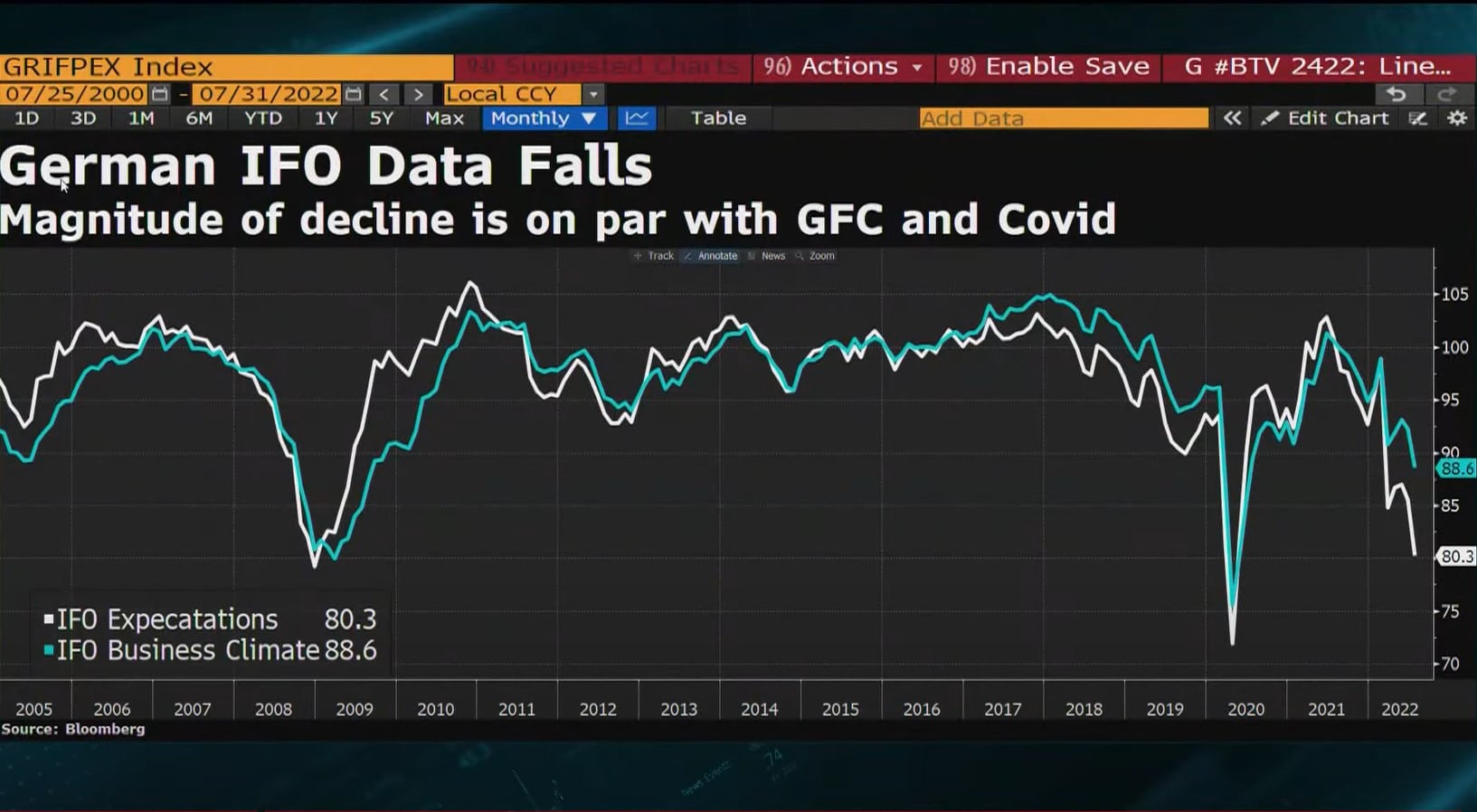
The German economy has been hit by a “perfect storm” caused by “high inflation, energy supply disruptions, and ongoing supply chain disruptions,” according to the Financial Times.
The media in Germany itself assesses the situation more harshly. Der Spiegel writes about the systemic collapse of the German economy as a tragedy in five acts.
Act One. Production halt
First of all, the shock of energy prices ’affects producers who are most dependent on electricity and natural gas: paper manufacturers, fertilizer producers, steel producers.
Alexander Becker, CEO of Germany's largest steel producer, Georgsmarienhütte Unternehmensgruppe (GMH), is in despair: “We really don't know what to do anymore. We are in a state of shock.”.
GMH has 21 subsidiaries across the country, six thousand employees, its own steelworks and steel mills, and an annual energy requirement of one terawatt. That is more than the consumption of three hundred thousand households.
Last year, the company paid €120 million for electricity and natural gas. Even if prices remain at their current level, next year the cost will skyrocket to €1.2 billion, which is 10 times higher! “Then we will go bankrupt immediately,” says Becker.
GMH's rival, Arcelor Mittal, has lost all hope of survival. The company recently announced that it will close two production plants in Hamburg and Bremen due to “excessive increases in energy prices.”.
Germany's largest fertilizer producer, SKW Stickstoffwerke Piesteritz, has completely halted production. Even chemical giant BASF has reduced its ammonia production.
“As the economic outlook continues to deteriorate, construction projects are being postponed, cars are being replaced less frequently, and old washing machines are being repaired instead of replaced,” writes Spiegel.
“The worst is yet to come,” says Klaus-Dieter Maubach, head of energy giant Uniper (one of the financiers of Nord Stream 2), warning that high natural gas prices will place a “heavy” burden on German industry.
Jasmin Fahimi, head of the German Trade Union Confederation (DGB), warned in an interview with Spiegel that a “domino effect” (Dominoeffekt) would hit German industry, leading to the deindustrialization of Germany: “It will be a disaster.”.
Act Two. The price trap
The Volkswagen Group is facing a crisis in demand. “High energy prices and the looming recession are making people reluctant to buy new cars,” says Ferdinand Dudenhöffer, director of the Automotive Research Center of the automotive industry.
According to expert estimates, demand for higher-priced German cars has fallen sharply. The German Association of the Automotive Industry (VDA) has revised its forecast for the German market from three percent growth to minus six percent. “Our economic model is being called into question,” warned VDA President Hildegard Müller.
Production cuts in key sectors and bankruptcies trigger a chain reaction. The deeper the automotive and chemical industries slide into crisis, the less they invest in their development.
Even in growth sectors such as construction, which accounts for more than six percent of Germany's GDP, the mood is changing: in June, new orders fell by 11.2% compared to the same period last year. More and more companies are canceling new projects due to the explosive increase in construction costs. Residential construction is particularly affected. Large institutional investors, such as insurance companies and pension funds, are no longer buying real estate due to the sharp rise in interest rates. Private demand for their own four walls has also collapsed, “in some places even to zero.”.
Act Three. The Consumer Crisis
Germans have now started saving not only for major projects, such as building a new house, but also for everyday life. Many families have drastically reduced their supermarket purchases. In electronics stores, fashion chains, and furniture retailers, sales are down across the board. “People are just scared,” says the owner of a large furniture chain. "I would like to reduce the number of discounts and markdowns, just to wait out the crisis. But then no one else will come.".
Even financially sound retailers will not be able to hold out for more than a few weeks. The Galeria Karstadt Kaufhof (GKK) chain, with 130 stores, went bankrupt, received a state subsidy of €700 million, but fears a “frozen winter.”.
The energy costs of German stores have increased tenfold in recent months, and customer numbers have fallen significantly. Analysts at consulting firm Cima published the Germany Study Inner City report, which predicts a “net loss of visitors” of around 20% across all age groups.
“Private consumption is likely to fail as an economic driver in Germany during the year,” warned experts at the Institute for Economic Research.
Act Four. Wave of insolvency
In August, the number of bankruptcies among small and medium-sized enterprises rose by a quarter compared to the previous year. Steffen Müller from the Institute for Economic Research predicts a further increase in bankruptcies in October (by a third more than in 2021). Weak companies are now “forced to exit the market.”.
While the “pandemic” mainly affected the service sector, the current crisis is hitting Germany's industrial core. According to Müller, 40 percent of all bankruptcies of large companies are in the industrial sector.
The federal government is trying to prevent a wave of bankruptcies, but to no avail. The economic aid packages provided by the government cannot change the situation.
“We cannot overcome the energy crisis with rescue packages,” warns Stefan Coutts, vice president of the Institute for World Economics (IfW) in Kiel. Germany, he says, needs a “strategic realignment” of its energy policy.
Coots suggests we bet on fossil fuels and nuclear energy, but the government continues to cling to green energy with unreliable wind turbines and solar panels.
The IfW expects Germany's GDP to shrink by 0.71% next year. “We have been forced to revise our forecasts downwards by four percentage points,” says Cootes. ”Instead of the expected economic recovery, Germany will experience a huge recession.".
Act Five. Failure of the labor market
The fear of job losses is returning to Germany, something that has not happened for decades.
“The recession and the labor shortage are happening at the same time, which is an unusual situation,” says Enzo Weber of the Nuremberg Institute for Employment Research (IAB). ”There are currently two million job vacancies, and people are still desperately needed in almost all sectors.".
According to Ifo, the shortage of skilled workers in Germany has reached an all-time high. In July, labor shortages affected 49.71% of companies in the country. “More and more companies are being forced to reduce their activities because they simply cannot find enough workers,” says Stefan Sauer, a labor market expert.
In the service sector, 54.21% of businesses are affected by labor shortages. In the construction sector, 64.1%. In the insurance sector, 62.41% of companies.
In the manufacturing sector, 44.51% of companies reported shortages of skilled workers. These include companies in the food processing, metallurgy, and IT industries, as well as approximately 40% of retail and wholesale trade.
The labor shortage in Germany is similar to the situation in almost all Western countries, especially the US. An artificially created “pandemic” has quarantined millions of workers who have received generous social welfare packages and are in no hurry to return to work for much lower wages.
Germany is “turning from the anchor of European economic stability into the sick child of Europe,” notes Nordkyrier, citing analysts at US investment bank Morgan Stanley, who have predicted an economic crisis in the eurozone, which they forecast will begin in October 2022. “Germany will drag the whole of Europe into recession,” warns Focus magazine.