What happened to the Acropolis and how it was transformed from a Mycenaean fortress to a sanctuary in the 8th century BC? Why 30 years after the Persians, did the Athenian state choose to create the great edifices that stand majestically to this day? What was the goal of Pericles' building program? Why did the great general choose Phidias and other great builders to carry it out? What does the sculptural decoration of the monuments of the Holy Rock symbolize?;
Few people could respond with appetite, clarity and humour to the barrage of questions asked by an erudite little visitor to the rock and the Acropolis Museum - even if they are the questions of a little ‘paper’ hero. One of them is certainly Panos Valavanis, archaeologist, professor of classical archaeology at the University of Athens, author also of books aimed at children, such as «The History of the Acropolis. Where people met the gods», which has just been published by Kapon Publications.
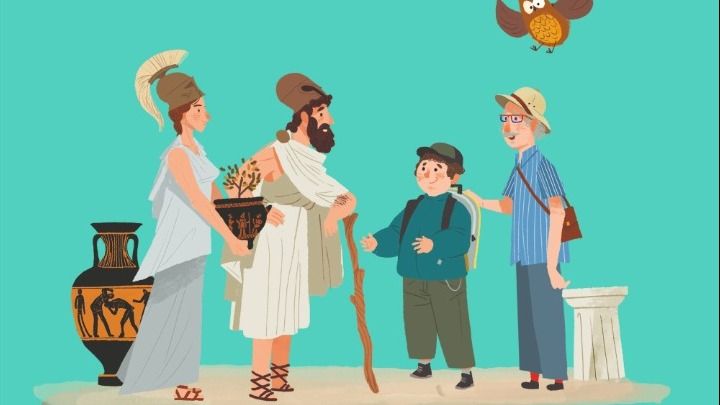
«The book came about as a continuation of the great guide ‘Acropolis through its Museum’, which was published in 2015 also by Capon Publications. The idea was to come out with something ‘lighter’, which could be read comfortably by the wider public, but also by students. So we changed the format and instead of a continuous narrative - as was the first guide book - dialogue was chosen. This is the one element that differentiates it. The second is the illustrations, done by Costas Theocharis. Thus we have a completely new book, which through a lighter approach informs about all the serious issues concerning the history of the Acropolis», Panos Valavanis tells APE-MPE about the book which, like the rest of the children's series of Capon Publications, is addressed to young curious readers, but also to older «children».
It all starts with a visit to the Museum and the Acropolis rock by a student, whose repeated questions may drive the accompanying archaeologist crazy, but are nevertheless the occasion for them - and the readers - to discover the secrets hidden in the monuments. I wonder what inspires the archaeological writer who has spent decades on the Acropolis (and beyond)? «For years I have been writing books for schoolchildren. ‘The Hill of Hidden Secrets’ was the first one, which after 25 years is still being published - in fact it is now in its 12th edition! Since then I've been trying to put myself in the children's shoes. Seeing them in museums, where, due to our profession, we were regularly and for a long time, I found that some serious books were missing, which could be comprehensible and captivating for the young visitors», P. Valavanis answers to the question of APE-MPA. He continues:
«Often existing books are limited to a descriptive approach to things. Here we are trying to explain why all these things are happening on the Acropolis - what happened and from a fortress that was originally a fortress then became a sanctuary, why the Athenian state decides to create these great edifices, what was the goal of Pericles' building program, why did he choose these particular creators and these particular architectural forms? And more importantly, why is this sculptural decoration chosen for the pediments, the metopes and the frieze? What do the Athenians want to show, for example, with the conflict between Athena and Poseidon on the western pediment of the Parthenon? What does the olive tree that is offered to them as a gift mean?;
»Behind all this there is a whole rationale that from the past, but especially in recent years, research has placed it in the context of the political aspirations of the Athenian state or of Pericles himself, for the confrontation with Sparta and the claim of Panhellenic hegemony. In the book we try to explain the causes and reasons for these choices and to give the general public an understanding of them in a readable and enjoyable way. For too often we all get carried away in ‘the cloud of the magnificent grandeur of these monuments’, thinking that the ancients had nothing to do but create great works to be remembered in history. No. The ancients did not know that they would be remembered in history and that we would be studying them 2,500 years later. The ancients, not just the Athenians, but all Greeks, chose specific forms in their artistic expression because they wanted to serve immediate goals and solve current issues. The timeliness of the criteria in these choices was something very important,» he told AP-MPA.
Despite the ‘weight’ of the meanings, the book is understandable and pleasant -a fact that is due to the illustrations and the elegant edition, but also to the fact that the author created it with great pleasure. «Here I would like to pay special attention to the choice of the illustrator Kostas Theocharis, whom neither the publishers nor I knew personally. We saw his work and understood that he was an artist who could deliver serious things in a lighter way. In the end he enjoyed it and I think the final result justifies his choice as illustrator for our book,» he underlines about the co-creator of the publication which opens up the ... appetite for more knowledge.
«If we have achieved that, then the book has achieved its goal. More generally, the job of education and all teachers is not to tell all. It is to whet children's appetites, to make them look further and to give them the ‘tools’, not the technical ones - these children know them better than we do - but mainly the way of thinking. How, that is, through phenomena, ancient remains, architectural and sculptural forms, we will go back to the past to find out why, to see what it was that led people to make certain choices», stresses the interlocutor of APE-MPA, who also referred to his new «book» for children and adults, which is expected to be published soon.
«Two years ago we got a dog, an excellent dog, and on this occasion I saw that there is no book in Greek literature about dogs in antiquity. With the publications Proti Mili and the illustrator Hara Marantidou, who also has two dogs - we had made it a condition that in order to illustrate it one must have a dog!- we are now in the final phase of publishing a book about dogs in antiquity with their beautiful stories and pictures», he informed us about the new illustrated edition, which did not come about as easily as the «History of the Acropolis». «I read a lot going into the new subject, I studied in depth to clarify things, to see exactly what would go into the book, what themes would be developed, what images would be chosen. It can be said that we know the Acropolis-although the Acropolis is never learned! But about dogs in antiquity I didn't have much knowledge. In the end it is a creation that has filled me with joy. Because when we ‘dive’ into a new subject, it is always something revealing, a new aspect of the world opens up before us,» the professor concluded to APE-MPA.
Eleni Markou