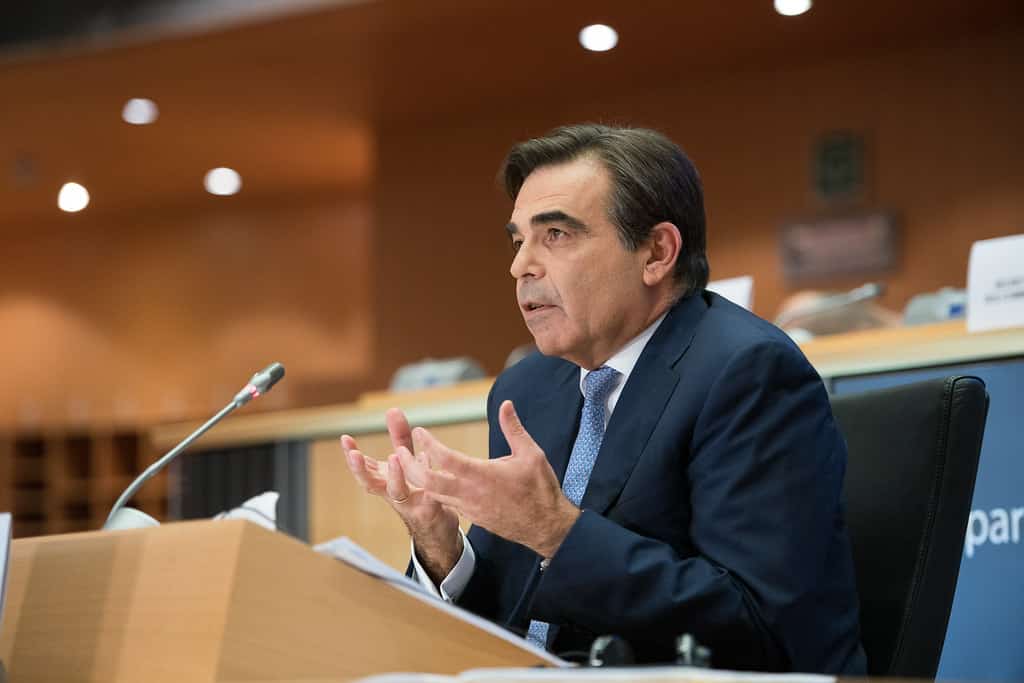
The need to maintain a strong and truly common Common Agricultural Policy (CAP) after 2028, with adequate resources and a clear European focus, was highlighted by Margaritis Schinas, Minister of Rural Development and Food, during his remarks at the European Union’s Council of Ministers of Agriculture and Fisheries, held in Luxembourg.
The meeting focused on the future of the CAP, the state of European markets, and the future of the Common Fisheries Policy. The Greek minister emphasized that the decisions to be made at the European level will determine the nature of agricultural production for decades to come, with the primary objective being to preserve the unified and Community-based nature of the CAP.
As he pointed out, the crucial question is whether the policy that has been a cornerstone of European integration for more than 60 years will truly remain a common policy or will gradually be transformed into a set of national policies with limited Europeansupport.
Greece has come out in favor of greater simplification, flexibility, and better adaptation to national specificities, with the minister clarifying, however, that these changes must not lead to a weakening of the common European framework.
«Greater flexibility cannot mean less Europe,» Mr. Schinas pointed out, emphasizing that increased subsidiarity must be accompanied by a strong common core with shared goals, basic rules, uniform enforcement authorities, and accountability.
He placed particular emphasis on the financing of the next CAP, noting that the European Union cannot demand greater resilience, more investment, and higher ambitions with fewer available resources. He stressed that the new policy must support both farm income and investments that will strengthen the competitiveness of the European agri-food sector, while underscoring the need for continuity, predictability, and the avoidance of funding gaps during the transition to the new framework.
At the same time, he emphasized the need for generational renewal, noting that the sustainability of European agriculture will depend not only on the institutional framework but also on the ability to attract young people to rural areas.
Referring to market conditions, Mr. Schinas noted that, despite the overall resilience shown by European markets, producers continue to face intense pressures due to extreme weather events, animal diseases, rising input costs, and geopolitical uncertainty.
In this context, it welcomed the European Commission’s proposals regarding the fertilizer market, which aim to provide immediate support to producers in the face of rising costs driven by international conditions.
In presenting an overview of the Greek agri-food sector, he noted that feta cheese maintains a strong presence in international markets, citrus fruits continue to post strong export performance, and Greek wine is showing remarkable resilience, despite the difficulties facing the European wine sector as a whole.
At the same time, he highlighted the challenges facing specific sectors, such as rice and livestock farming, which are burdened by rising energy costs, the prices of animal feed and transportation, as well as by animal diseases affecting many European countries.
In the field of fisheries, Greece maintained that the objectives of the Common Fisheries Policy remain relevant, but that the tools need to be adapted to the actual conditions faced by fishermen and national administrations.
The minister emphasized the need to simplify procedures and reduce administrative burdens, noting that policy evaluation cannot be based solely on biological indicators, but must also take into account the social and economic dimensions of sustainability.
He made special mention of small-scale coastal fishing, which he described as being of strategic importance to Greece because of its contribution to the sustainability of coastal and island communities.
At the same time, he emphasized that the sustainable management of the Mediterranean’s shared resources requires strong regional cooperation and a shared commitment from all countries involved.
Mr. Schinas also raised the issue of a level playing field, pointing out that it is neither sustainable nor fair for European fishermen to bear the full burden of restrictions and management obligations, when the same stocks are being fished by fleets from third countries that do not apply equivalent standards.
Finally, he reiterated Greece’s steadfast commitment to the goals of the MedFish4Ever Declaration and to joint European efforts for sustainable fisheries and aquaculture in the Mediterranean, highlighting the country’s active role in protecting marine ecosystems and biodiversity.