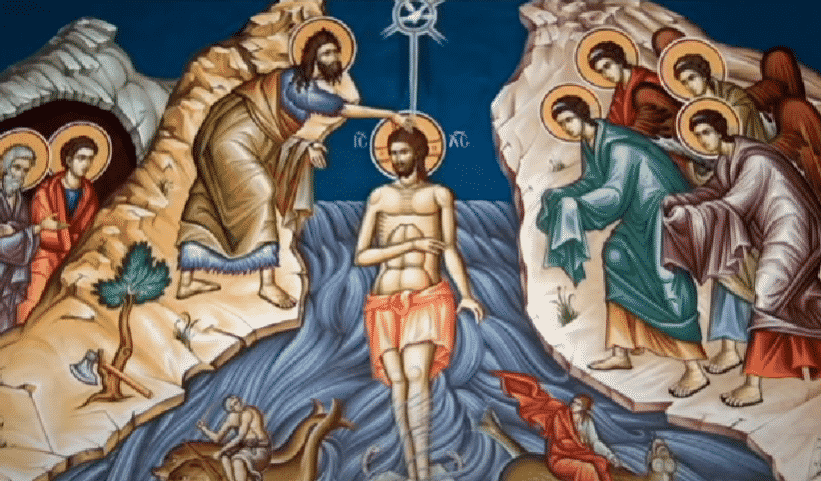
Epiphany or Lights. One of the great feasts of the Greek Orthodox calendar. Joyful, triumphant and hopeful, they close the Twelve Days, which «opened» on Christmas Eve.
In the early Christian years the feast «covered» Christmas and New Year together.
Throughout the three days of the Lights (Holy Week, Epiphany, St. John's Day), an underlying worship of water is also celebrated. Waters are everywhere considered holy. No longer is there any superstitious fear of the nights and the elves of winter.
During Epiphany the Trinity of God, the Holy Trinity, was revealed. They are also called «Lights», because during the first Christian years, on the eve of Epiphany, the followers of the new religion were baptized. The search for purification from man is reflected even in the ancient religions.
The three-day event begins with the church service on the morning of the eve of Epiphany. In the Holy Churches the sequence of the «Great Hours» is chanted and then the «Great Consecration» takes place, which on this day is performed inside the church.. The faithful, after receiving holy water and the antiphon, will return to their homes. There, the housewives will prepare the fasting food for lunch and the children will pour into their homes to sing the carols of Epiphany:
«Today the lights and the lighting,
the joy is great and the sanctification.
Down to the river Jordan,
Our Lady of the Assumption.
He carries an instrument, holds a candle,
and St. John begs.
St. John the master and baptist,
baptized me a child of God.
Go up to heaven,
to pick up a wheel and a bedpan.».
The customs of the day end late in the evening and at midnight it is believed that the heavens open. At that time, tradition says, whoever wishes for something with all his heart, it will come true.
The day of Epiphany begins with the church service of the faithful. In the churches, as on the previous day, the sequence of the «Great Hours» is chanted.». Afterwards, the Priest and the faithful will leave the temple and head to the place where the «diving of the cross». This point is a harbour, a river, a well, a reservoir or simply a platform in the churchyard on which, in a special vessel, the ceremony will take place. The bells are signalled joyfully and the priest, throwing the cross into the water, chants the «Thy baptized in Jordan, O Lord».
White doves are released and fly in the sky, while, where this is possible, the «dutihadas» fall into the water to catch the cross. The custom is called «catching the cross» and the one who finds and catches the cross first is considered lucky and blessed.
The weekend ends on 7 January with the celebration of Saint John the Baptist, as he had the privilege of baptizing Jesus Christ.. The Holy Forerunner was the Artichoke that announced the coming of the Day of the Lord. The Orthros that preceded the rising of the Sun of righteousness.