Let's repeat it once more in light of the discussion that has opened up about
the lighting at the port Kapsali: The legitimacy and appropriateness of a
Public lighting is not a subjective issue. («I like it» – «I don't like it")
like»), it does not concern art and aesthetics, it is not a matter of
referendum and – of course – is completely independent of whether it is
lighting that is pleasing to the residents of a municipality.
It is a specialized scientific issue that is legally regulated on the basis of
Decision No. D13/b/oik.16522 of the Ministry of Environment, Physical Planning and Public Works (Government Gazette B’ 1792, 3.12.2004) and not on the basis of
the aesthetic views of institutions, citizens, and other democratic
forces... The above Ministerial Decision incorporates the – mandatory for all
EU – lighting standard EN 12464-2 of 2003, entitled «Light and lighting.
Lighting of workplaces. Outdoor workplaces», which sets out the specifications
which must be met by the installed outdoor lighting system.
But what is the situation at the port of Kapsali (and elsewhere) in relation to
legislated standards?;
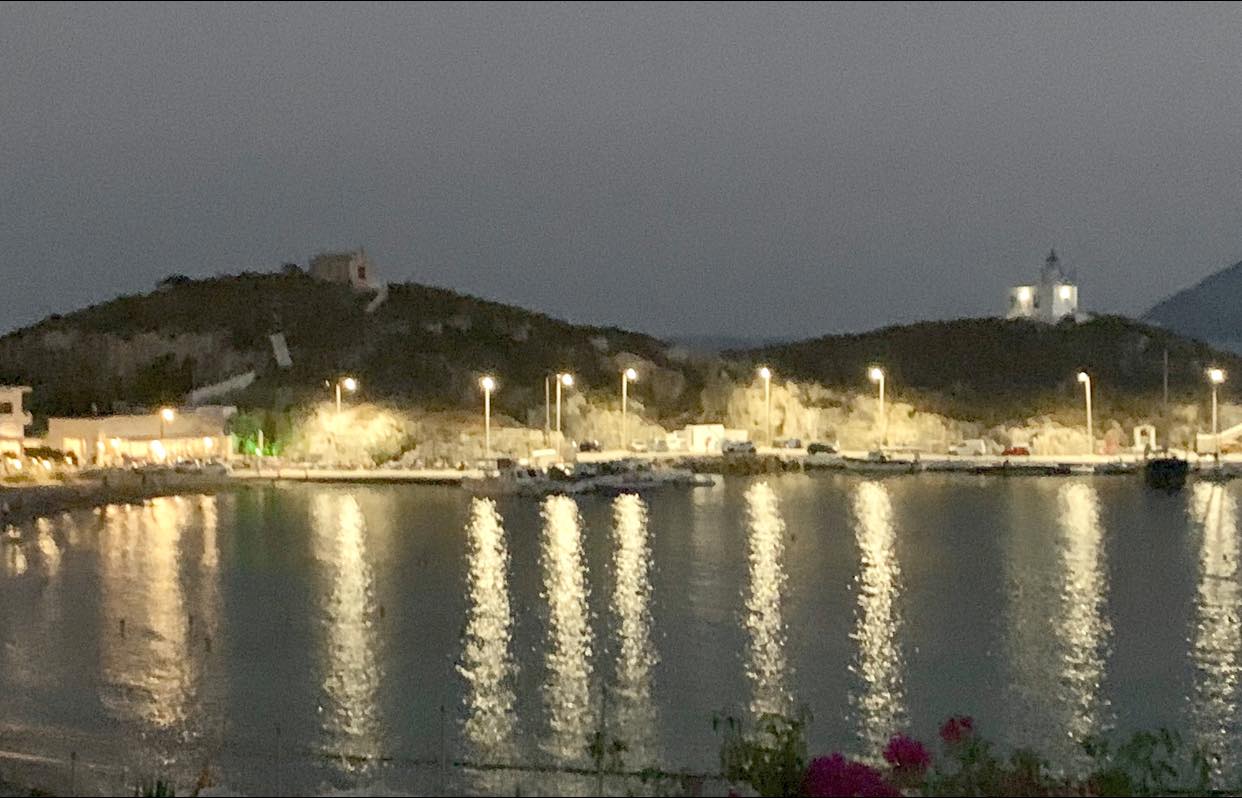
Based on specific measurements we took on June 17 along the entire length of the
pier in Kapsali, the light intensity was recorded at many points above
from 400 Lux, the surrounding rocky slopes were illuminated at a great height with
intensities ranging from 250 to 400 Lux (while the rock should not be illuminated at all)
and the boats – too – were bathed in the abundant Lux of the aggressive lighting.
Let us now examine what is stipulated in the applicable legislation, which –
systematically anymore – is not applied, as is also the case with
street lighting of the coastal front in Kapsali, which ended up being
beach lighting – habitat of the loggerhead turtle(!), lighting of the
sea (!!) and sidewalk lighting with national road specifications (!!!), such as
we have demonstrated in our previous article.
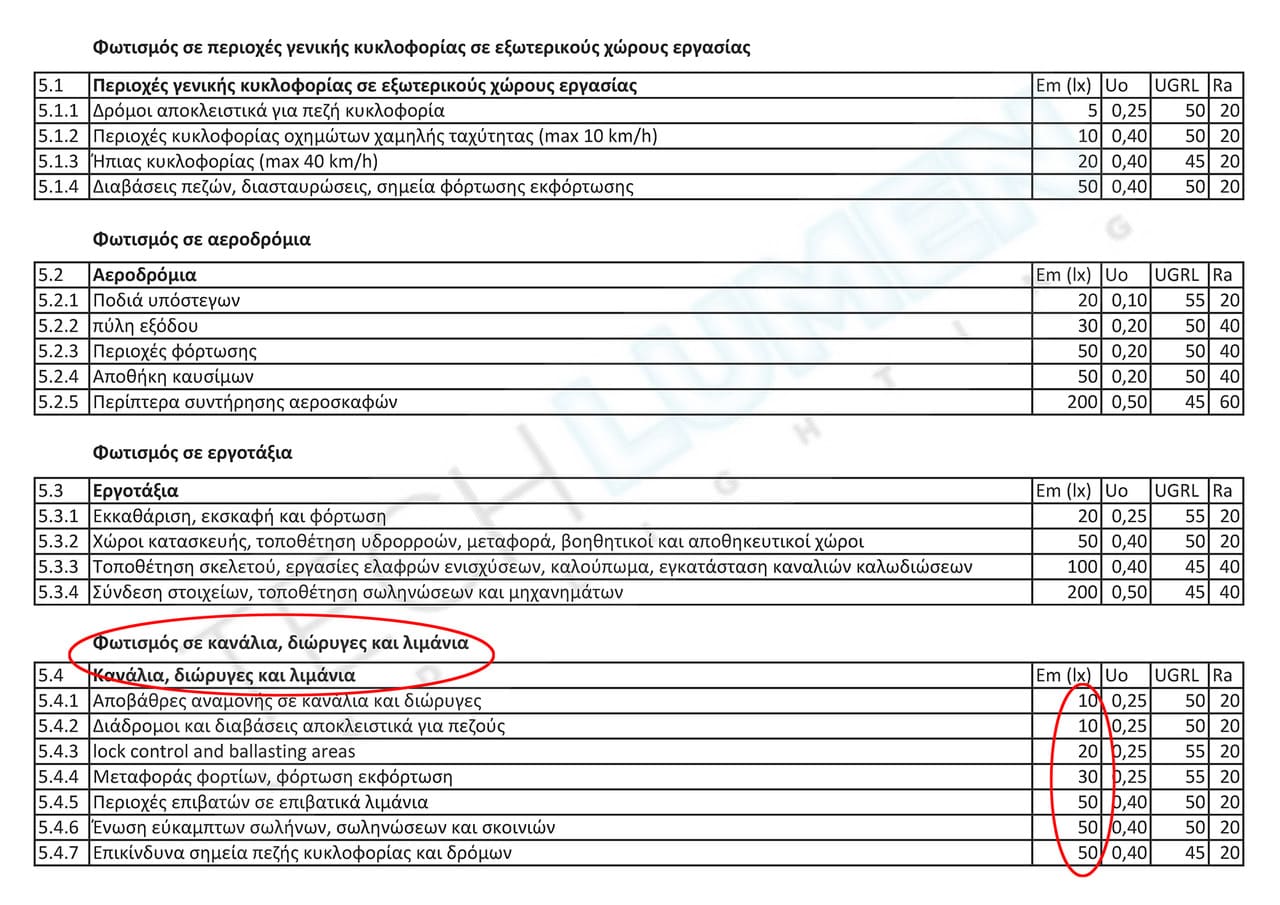
In this case, then, for lighting levels in large ports (e.g., Piraeus,
Lavrio, etc.), the EN 12464-2 standard stipulates lighting levels
30 to 50 Lux for intensive and specialized activities that may
are carried out in ports central to the country (cargo transport, loading, loading
unloading, passenger areas in passenger ports, mooring of vessels, etc.).
To understand the extent of the diversion of lighting from the
statutory requirements and common sense, we note indicatively
that even in the most demanding tasks involving activities in
construction sites (installation of wiring channels, connection of elements, installation of
piping and machinery) the lighting levels are between 100 and
200 lux.
Anyone who claims that safety considerations require an increase in the average level
of lighting by 500 - 800 % from the maximum provided (for central
ports) in the relevant tables of the standard, it would be useful to explain
what are these reasons for imposing such unthinkable lighting levels in
a port like that of Capsali. Does the extreme crime, the
container loading and unloading, the welding of ships, the use of
machinery and heavy vehicles; Even in these cases (or in
any other extreme conditions) there is no (worldwide) standard
approaching the 420 Lux that we measured in many parts of the
Port.
Let us now see what should apply to the port of Kapsali based on
(always) the legislated standards that were (once again) ignored.
Capsali, as we all know, is not a conventional port, but functions as a
fishing shelter, since it includes the activities provided for
by the legislation on the category of fishing shelters. On this basis, the
common to all, the failure of lighting is of unimaginable magnitude.
Here is an extract from the relevant technical description of the application study
for the electrical installations of the Fishing Refuge of Nea Koutalis in
Lemnos: «For electric lighting, arm-type luminaires will be installed with
a 70W metal halide lamp, of the «pyramid» type, cut-off type,
according to the instructions of the supervisory authority .... The luminaires shall ensure a level
lighting of approximately 17 Lux at the pier and jetty». It is of course noted that
here 17 Lux is an illumination intensity in accordance with the legislated
specifications and result (very simply) from the application of the tables of the
EN 12464-2 legislative standard.
Such an absolutely wrong treatment of a public lighting project with
intensities of ten (10) to twenty (20) times the applicable statutory intensities
could be explained only in the case of the complete absence
any lighting study by a qualified lighting designer in a
coupled with complete ignorance and violation of the existing legislative
specifications from all the stakeholders (including those
including the services of the Ministry of Culture and the
Region). A practice which, it seems, is faithfully followed (by all) in
corresponding projects for the installation or upgrading of public lighting on our island.
We will not develop in this article the serious questions of legality where
the lighting works in Capsali (complete diversion of the lighting system in the
existing situation from the statutory lighting requirements for the
coastal frontage, lack of the required approval from the Council
Architecture) as well as the critical issues of light pollution, public
health and disturbance of aquatic and terrestrial life, the most obvious issues
indirect damage (within the meaning of archaeological legislation) to a number of
nearby monuments and listed buildings, as well as issues of immediate
damage to the (declared) «landscape of exceptional natural beauty.».
Moreover, the general issue for every small place like Kythira is not the
recording – by specialist scientists – of legal irregularities and destructive
technical projects, but also raising awareness among the interested public and
citizens for repeated bad practices, with multiple and
long-term consequences that degrade the natural and cultural environment
environment. Without collective vigilance, without social and democratic control
those practices, the bodies and persons representing them will
continue to act in the same way, they will continue their harmful work
in the name of «development,» and some, instead of remaining silent, will
continue to write publicly for an audience that is eager to
be persuaded by «arguments» that support the inconceivable.
Orestes Charos
Visual Artist – Educator
MSc in Lighting and Multimedia«