In collective memory, the elections of 29 October 1961 were recorded as the elections of violence and fraud or, according to others, the elections in which the trees voted. In fact, everything that happened before, during and after these elections was the beginning of an “anomaly” in the functioning of the constitution which eventually led to a complete coup d'état, i.e. the coup of the Colonels on 21 April 1967.
In 20th century Greece, anyway, the historical time was never more dense than in the first seven years of the 1960s, as the political crisis reached its peak, the popular factor rushed to the fore and reaction, domestic and foreign, played its part so that Greece would “stay away from the glare of communism”, at a time when the Cold War was at its height.
The political climate: Anger against the Karamanlis government
But what exactly happened in the 1961 elections and why do they constitute a break in historical time? Let us first examine how the political climate had been shaped after the 1958 elections, which brought EDA into the position of the Official Opposition, and after the Zurich and London agreements (1959) for the resolution of the Cyprus problem.
The electoral explosion of the EDA, which, with 24%, shocked everyone, inside and outside Greece, caused an alarm in all the poles of power. First of all, the Americans were particularly alarmed to see that in their satellite country in the Eastern Mediterranean, a political faction that did not agree with their plans for the wider region was gaining considerable ground. But they were equally alarmed, both in the Palace and in the Army, in which there had long been processes and internal movements by ’concerned“ officers, both high-ranking and non-ranking.
With the Zurich and London agreements on the Cyprus problem, which promoted the solution of an independent state with a Greek Cypriot president and a Turkish Cypriot vice-president, Prime Minister Constantinos Karamanlis saw his popularity decline. The agreements, by which any plans for the union of Cyprus with Greece were definitively abandoned, were interpreted by public opinion as a national retreat, a fact that the Greek Prime Minister himself understood.
As we read in Alexis Papachelas“ book, ”The Rape of Greek Democracy“ (Estia Publications), ”Karamanlis made no secret of his discomfort with the concessions he was forced to make on the Cyprus problem“ when he was talking to American officials. In fact, in his contact with U.S. President Eisenhower's envoy, George Maggie, he said that ”he could have gone down in Greek history as a great man who supported the desire of all Greeks for union and now he is called a traitor.".
Under these political circumstances, Karamanlis had a difficult time in Parliament in 1959 and 1960 with the opposition (Left and Centre) being particularly critical of him. Nevertheless, the leader of the EPP has always enjoyed the confidence of the American factor. The then American ambassador in Athens, Ellis Briggs, had developed close relations with the Serraean politician and they often exchanged views privately. As Alexis Papachelas writes, Briggs informed Washington after a lunch with Karamanlis that “we left with the impression that we have a tough, self-sufficient, confident politician and leader who is honest with us and deserves our support”.
When the new electoral law was passed in June 1961 (enhanced proportional representation), Karamanlis did not think twice. In September of the same year he resigned, and as a result elections were called for 29 October 1961. The Palace undertook the appointment of a caretaker government, a process that proved key to what happened before and during the elections. At the same time, the paramilitary groups in the army were taking up battle positions.
The intrigue of the Palace
The person initially chosen to lead the caretaker government (which would be in power for about 40 days) was the retired general, Thrasybulos Tsakalotos, known for his actions mainly during the Civil War years. But the Palace, as the historian Tasos Vournas writes in his book “History of Modern Greece”, Volume V (Pataki editions), wanted a man of its absolute confidence in the caretaker cabinet and specifically in the position of Minister of Defence. This was the retired general, Charalambos Potamianos, who undertook to convey the palace's wish to the candidate for caretaker Prime Minister himself.
The Tsakalotos-Potamianos dialogue, as transcribed by Solon Gregoriadis and recorded in the book by Tasos Vournas, is indicative of the way in which the palace wished to influence things.
Tsakalotos: With me as Prime Minister, you don't become Minister of Defence.
Potamianos: But is it the King's wish?;
Tsakalotos: So be it.
To his credit, General Tsakalotos did not give in to the pressure. However, the Palace insisted and finally managed to get its own point of view across, even if it came close to blowing up the government's oath of office. As Tasos Vournas reports, shortly before the swearing-in procedure, General Balodimos, director of the Political Bureau of the Palace, visited Tsakalotos at his home. There the following dialogue took place:
Balodimos: I come on behalf of the King, who asks you to accept Potamiano as Minister of Defence.
Tsakalotos: This is not possible.
Balodimos: Then we'll head for Dovan.
Thus, all of a sudden, and at the will of the Palace, the former senior army officer, Konstantinos Dovas, became acting Prime Minister, with, of course, Charalambos Potamianos as Minister of Defence. The anomaly had only just begun.
The Pericles project: A secret coup d'état in a time of democracy
But by August 1961, when Konstantinos Karamanlis was still Prime Minister, the first chapters of the drama had already been written. This is because it was much later, in 1964, when George Papandreou's Centre Union was at the helm of the country, it was revealed that an “obscure committee”, which had been approved by the then Prime Minister, had undertaken the dirty work of “finding methods of persecuting Communism”.
The...method was none other than the infamous «project Pericles», which was signed by the then Chief of the General Staff, Vassilis Kardamakis. It was this very plan that was put into operation by the committee which consisted of the heads of the Armed Forces and the Police and a deeply anti-communist lieutenant colonel of the KYP, who went by the name of Georgios Papadopoulos. The subsequent dictator...

The plan had two clear objectives. For ERE to prevail and for Konstantinos Karamanlis to form an independent government and for EDA's share to be reduced, if possible, below 20%. Both objectives were achieved to the great satisfaction of the Palace, the Army and of course the Americans who were watching the situation closely. The elections, in any case, resulted in both a National Government and ...a National Opposition, since the newly formed Centre Union of George Papandreou came in second place. However, for the desired result to emerge, for reactionary circles, much had to be done.
Violence...
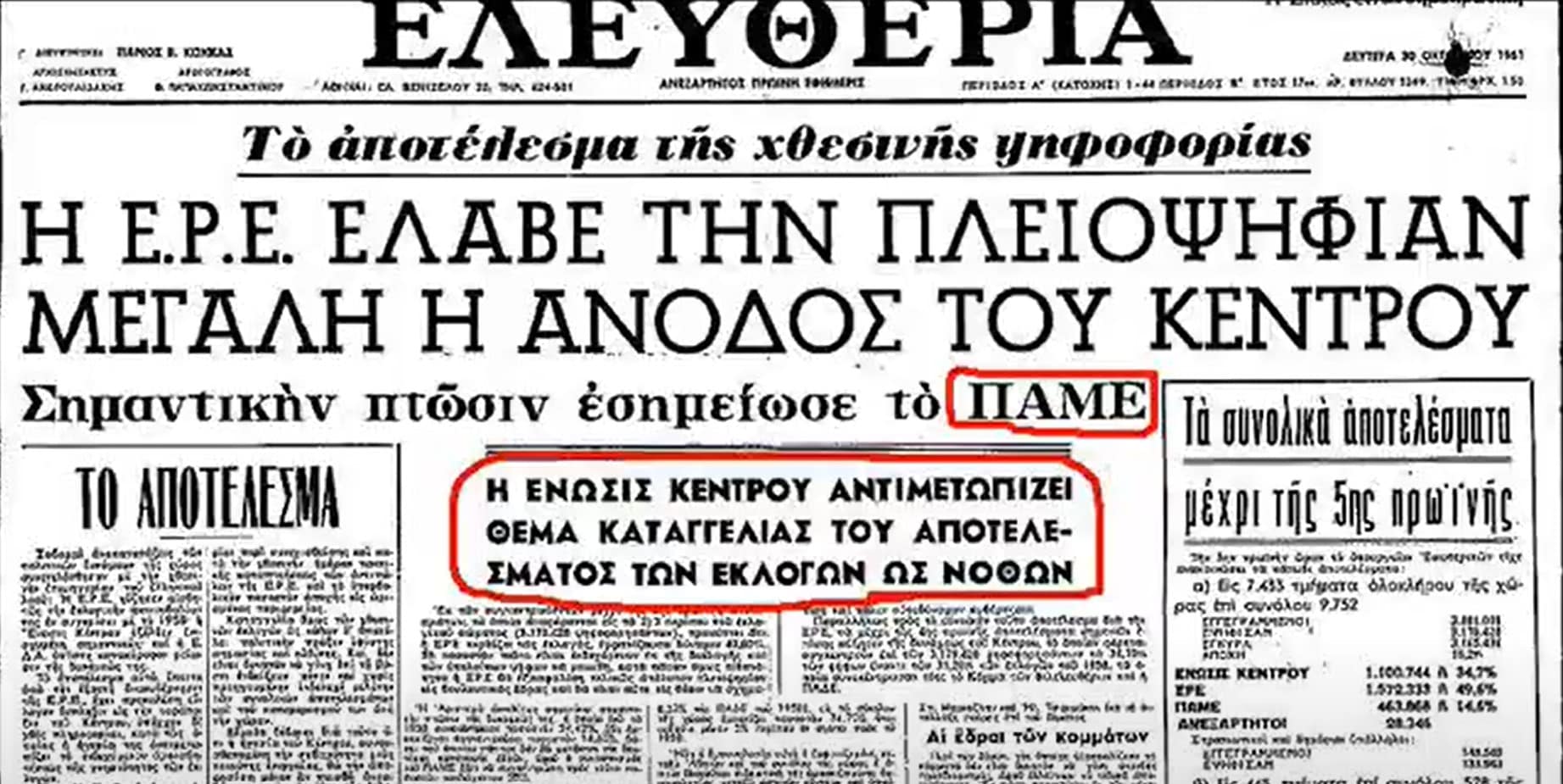
Tasos Vournas presents the events with a vivid description: “The attack of the state was terrible in order to achieve the intimidation of the Greek people and the falsification of the election result. Attacks, injuries, violation of citizens“ constitutional freedoms were reported from everywhere. Terror reigned throughout Greece. The left, narrowly united in the PA-ME electoral formation, bore the brunt of the attacks even in the capital itself. Thus, ERE emerged from the ballot box as the leading party with 50,77% and 176 seats. The Centre Union 33.69% and 100 seats, while the EDA was reduced to the ”normal“ limits of the ”extreme” left with 14.65% and 24 seats".
One could say that the balance of the system had been restored. Although hurt by the developments in the Cyprus problem (and not only), the EPP managed to improve its percentage by 9% compared to the 1958 elections. Exactly the same percentage of votes was lost by the EDA, which was mainly targeted by the attacks of the parastatal mechanisms.
...and fraud
However, even under the regime of violence it would have been very difficult for ERE to increase its percentages so dramatically (let us not forget that Constantine Karamanlis was serving his third term as Prime Minister). So, the election result had to be falsified in ways... typically Greek and parastatal. The revelations that came to light in the following months by the Opposition Press and what the Centre Union and the EDA recorded in the Black Books they published, are now a source of laughter, but at the time they certainly aroused the anger of democratic citizens.
The security forces became the protagonist of the fraud, as police officers voted more than once! On December 31, 1961, in a front-page story, Vima writes that “206 voted as residents of the house at 18 Rigillis, and 303 policemen voted in two parishes in Ampelokia and Zografou”. Military officers voted twice, since they had voter's books and their names were also on the voting lists.
In houses, which turned out to be dilapidated (in New Philadelphia and elsewhere), many voters were registered. Many of them were policemen, as happened with a house in Haidari, at 10 Koumoundourou Street, where 13 (!) policemen were registered as workers. They even registered voters on plots of land. The photographic lens of the time revealed that at 38 Sardea Street in Nea Philadelphia, where the voter had declared his permanent residence, there was nothing but a plot of land with two... trees.
Later, in 1963, as the journalist Victor Netas writes in the magazine “Historika” of the newspaper “Eleftherotypia”, retired Lieutenant General G. Petropoulos stated, during a trial, the following: “I was the right hand man of (i.e. Chief of the General Staff) Kardamakis and I am in a position to know the national crime committed in the elections” and “how 90% came out of the military departments in favour of EPE”. It was, of course, a stretch to believe that 9 out of 10 Greek soldiers voted right-wing because they wanted to.

The Centre Union, for its part, as the Official Opposition, raised the issue very high. Already, before the elections, it had warned that it would not tolerate the phenomena of fraud that would distort the will of the people and then, in January 1962, and after the investigation had confirmed what was offensive to the constitution had been done in the October elections, George Papandreou declared the Struggle of Unity, not recognising as legitimate the government formed by ERE.
The Old Man of Democracy was vindicated by his electoral victory in 1964 but his government proved short-lived as the Palace, under King Constantine, decided to complete in the summer of 1965 the anomaly that had begun in 1961. The royal “coup” led to apostasy, the deregulation of political life and finally to the military coup of 21 April 1967.

The “apology” of Karamanlis
It is a question mark to this day whether Constantine Karamanlis was aware of the extent of the violence and fraud of the 1961 elections. It is also questionable whether he knew the exact activities of the parastatal machine, which he had already approved in August 1961.
In the memos in the Karamanlis Archives, the Ethnarch denies everything, but admits that the involvement of the Minister of Defence, Charalambos Potamianos, was suspect. “And I call it suspicious because, as it turned out afterwards, his appointment to the Ministry of National Defence had to do with the foolish plans for the suppression of the Communists” power during the forthcoming elections, plans which were being drawn up by secret services without the knowledge of my government. Mr. Potamianos informed the leaders of the opposition of these plans and advised them to try to take advantage of them themselves.".
This is what Constantine Karamanlis wrote in the 5th volume of his archives, as Victor Netas reported in the “Historika” of “Eleftherotypia”. It is rather exaggerated to believe that Potamianos was placed from the Palace in the Service Government to work for the EDA and the Centre Union even though he disliked Karamanlis.
Below, the then Prime Minister takes a step forward: “I do not know whether, without my knowledge, either the government, by order of the King, or the army, took measures to curb communism. I do not entirely rule it out, given that after the 1958 elections, the swelling of the forces of the NRA caused national concern. However, even if such an attempt was made, firstly, it was done without my knowledge; secondly, it was not done to the detriment of the Centre Union but to the detriment and to the benefit of the EDA; and thirdly, it was practically impossible to influence the result of the election, since within the division secrecy and freedom of voting were guaranteed, as is evident from the minutes of the electoral offices of all the divisions in the country.’.
This approach of Karamanlis is very reminiscent of his famous phrase “who governs this country”, attributed to him in connection with the assassination of Grigoris Lambrakis in 1963. After all, did the Prime Minister of the country know or not about the actions of the parastatal apparatus from 1961 onwards? There is no certain answer. ‘However, he has the historical responsibility whether he knew it or not.
The Americans are the winners
In any case, however, the action of the paramilitaries served the plans of the Americans. As Alexis Papachelas writes in his book “The Rape of Greek Democracy”, the CIA had a clear picture of what was going on, since its information “tended to confirm that the army command had made every effort to secure many votes for Karamanlis, and that the Chief of the General Staff and associate of the Prime Minister for many years, General Kardamakis, had been involved in the election campaign”.
The American ambassador in Athens, Ellis Briggs, could not hide his satisfaction with the result of the elections of 29 October 1961 and in a telegram to the US Secretary of State, he said (according to Alexis Papachelas): “The only good news from the NATO camp for 1961 was the results of the Greek elections, which was such a strong slap in the face for the communists, it made their teeth chatter.”.
The slap, then, which made the teeth of the Greek communists move, was the main American target. In that sense, those who triumphed in the electoral arena were the Americans and their interests in the Eastern Mediterranean. Not so democratic, of course, but that was small print in the Cold War world.