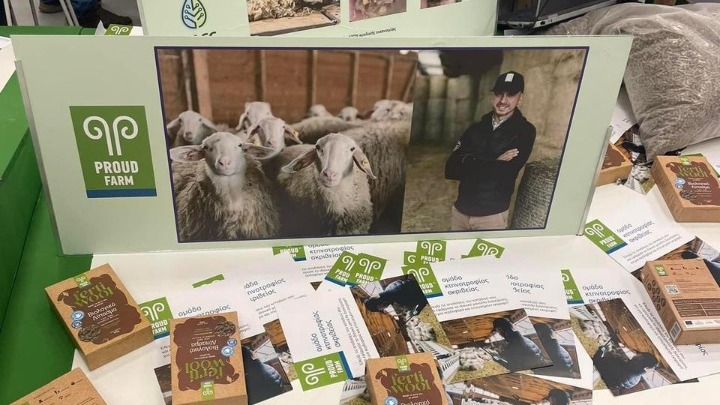
Organic fertilizer made exclusively from 100% sheep wool is being produced as a pilot for some time now by the «Proud Farm» group of producers from the Kozani area, in order to make alternative use of animal wool that is currently discarded. The idea arose some time ago to make use of something completely unused, and in this effort solutions were sought that could be viable on the market, such as creating from wool a kind of synthetic material for plasters and insulation in houses and buildings. From the analyses and research carried out, it was found that the best solution was to create a fertiliser from wool.
The team of «Proud Farm» contacted the Mediterranean Centre of Agri-Food Competence (MACC), one of the 11 Centres of Agri-Food Competence created in Greece, but also with wool experts from Germany and Austria, and so today an organic fertilizer is being produced from the wool of the animals of the producers of the team. The wool is first passed through a crushing machine that also applies pressure to it to give it the form of a small tablet, while cleaning and sterilisation processes are carried out to eliminate any microbes under specific conditions of temperature and pressure.
This process is currently being carried out in a social enterprise - a sheep wool processing unit created in Austria 50 years ago, while the aim of Proud Farm is, after the completion of the research and licensing procedures, to create a similar unit in the Kozani area. The European registration of the trademark of Fertiwool, Proud Farm's organic fertiliser produced from 100% sheep wool, has already been completed.
«Wool is something new that we have been experimenting with»
Nikos Koltsidas, a member of the «Proud Farm» group of producers, explains to APE-MPA that the producers of the group are basically engaged in the production of milk, which they distribute. Beyond that, he says, «wool is something new», with which they are experimenting. «It's untapped anyway. Because it is thrown away we went into the process of looking for alternative ways of utilising it and in our efforts we got to work with experts who guided us and that's how we came up with the fertiliser experimentally. We have made a quantity and that is now what we are pilot managing, first to do research and then to do the licensing procedures. So we had to first put out a pilot product, see the analyses, from there it had to start being tested experimentally in fields and finally complete the licensing process. Already, the product has come out in small packages and is currently intended for home use,» he says.
He clarifies that the main product for producers is milk, but notes that wool can act as a supporting product, as the producer can sell the wool, make some of his production costs or a small profit, or even use the fertiliser for his field. «First efforts are being made and new roads are being opened. Therefore, conditions for a circular economy are being created and the benefit can be many times greater than what is being shown now. In other words, it has to do with how this whole utilisation mechanism is ultimately shaped,» he adds.
Next objective, the use of sheep's back wool in the textile industry
The next goal for the producers of «Proud Farm» and the Mediterranean Agri-Food Competence Centre (MACC) is the use of sheep back wool in the textile industry. The manager at MACC Dr. Michael Katharakis tells APE-MPA that in the context of changing a habit in which sheep wool is discarded, the next step is to convince farmers that the wool from the back of the animals can also be used in the textile industry, as long as it is separated from the wool from the belly and those who shear the animals are trained on the possibilities of sorting.
«The animal lies down in the stall, so that the wool on its belly and ribs is stuck, like felt, and cannot be threaded. But the back wool, estimated at 30% of the total wool can be utilized in the textile industry. Anyway, there is a unit in Aigio which washes wool and from there the weaving can be done in Ioannina in a textile mill. In other words, there are such structures that we can use at this stage to produce yarn from wool,» Koltsidas said.
Moreover, Mr. Katharakis stresses that there is interest from major European companies to buy the wool, if it meets certain specifications.
Designs for the production of collagen from bone and skin with antimicrobial properties
The network development manager of the Mediterranean Agri-Food Competence Centre (MACC), George Manousakis, speaking to AP-MPA, notes that other ideas are also being considered, so that nothing is wasted and producers can use elements such as animal bones for the production of collagen and leather for the creation of materials with antimicrobial properties. Collagen, on the one hand, can be used in prosthetic medicine or in the production of face and body creams, while leather can be used in clinics and health care facilities after it has been properly treated, with the help of special nano-material coatings that break down microbes.
The above, as Mr Koltsidas notes, are currently being examined at an experimental level, in order to exploit anything that can add value to production. At the same time, innovation is already being put into practice with the «Proud Farm» business model, for the entry of young people into the sheep and goat sector at low cost and with limited business risk.
«In this spirit, the Farmers» Incubator created is essentially a facility where young farmers can be accommodated to take their first steps, with low risk, safety and a small investment. In other words, we reverse the process and instead of them investing in buildings, equipment, feed, animals and then producing - because the animals are housed in the facilities for three years - we leverage the subsidies they are eligible for (because to be eligible they have to have animals anyway) and then their transition to their own facilities is much smoother. Eventually, when they manage to go to their own facilities they will already be trained and will have a productive livestock," he adds.
P. Yultsi