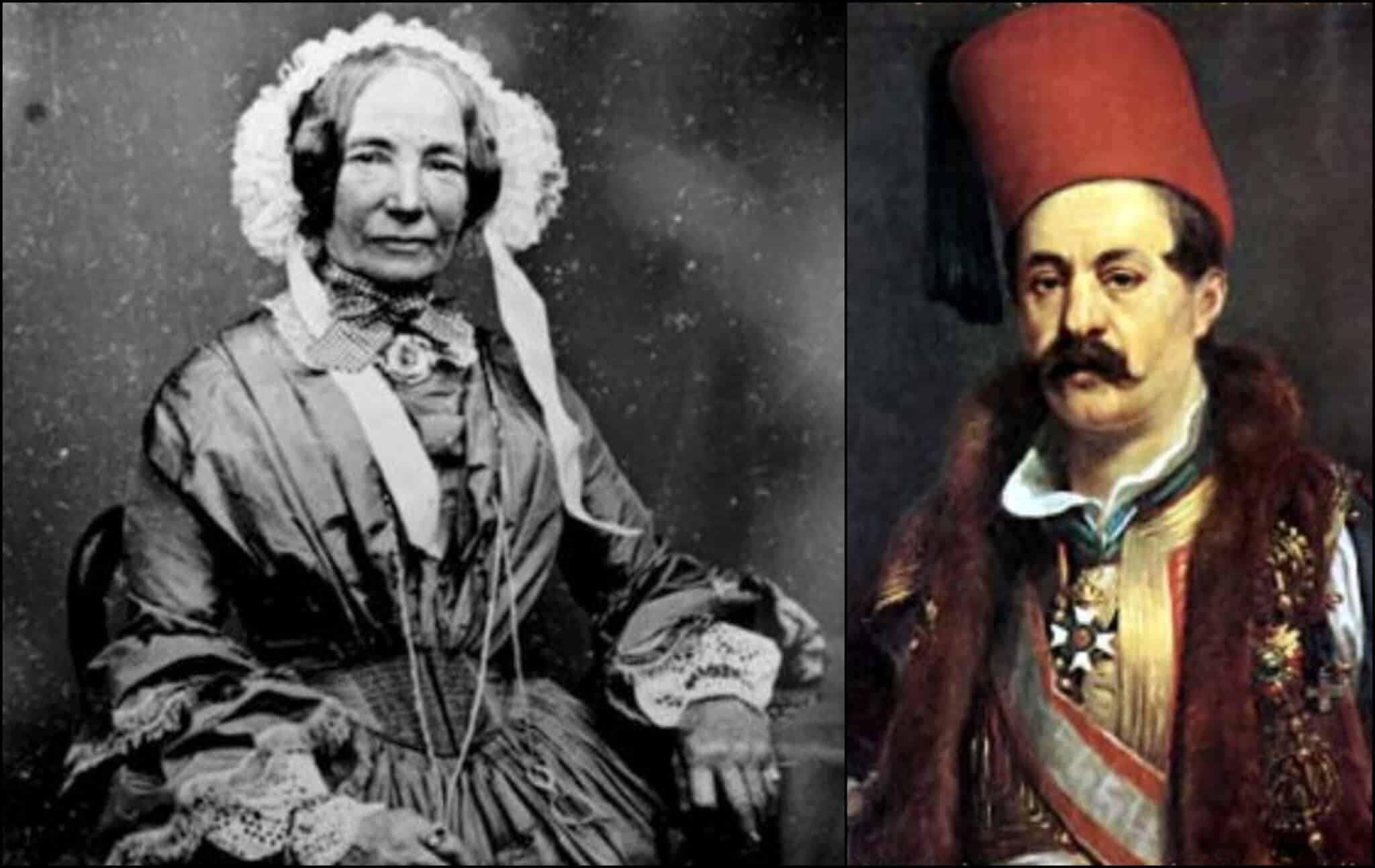
A 12-year-old girl whose son Ali Pasha, he wanted to marry Coletti, was the first Greek who settled in Australia and he lived until he was 98.
Specifically, after his studies in Italy, the John Kolettis was found in the Ioannina, where he practiced medicine and was the personal physician of Mukhtar, the son of Ali Pasha. Mukhtar liked him so much that he wanted to marry him to a twelve-year-old girl who was in his harem. Her Catherine or Russo Plessa. Daughter of the beautiful Basilica.
Three years later, and while Kolettis stubbornly refused the marriage, Catherine managed to escape from Ioannina as the relentless pursuit of the Gate against Ali Pasha had begun. She found herself on the islet Kalamos, in Ionian, where he met English philhellene James Kramer, whom she married. In 1830, the couple moved to Australia. Catherine Plessa became the first Greek woman to be a settler in the country.
Ekaterini Plessa is estimated to have been born in 1809. Her mother, Vasiliki, married George Plessas, a merchant from Serra, at the age of 14. She is said to have been very beautiful. One of the «Masters of the Nation» and Enlightener, Athanasios Psalidas, wrote about Vasiliki Plessa: «She was very beautiful, of medium stature, with a greasy, greasy, mavra slit eyes that breathed love and soon I would say a masterpiece of nature, she could captivate anyone with her charms’.
Among the men who besieged the beautiful peasant girl was Ali Pasha's son, Mukhtar, who fell in love with her at first sight and took her to his harem, with her daughter, Ekaterini and her son, Kostoula, who was probably his own child. At the same period, John Kolettis was serving as Mukhtar's personal physician and was quite often at court.
In 1821, when Catherine turned twelve, Mukhtar tried to marry Kolettis to the young Plesa, in order not to lose him from his side. According to another version, her mother, Vasiliki, sought her daughter's marriage to Kolettis in order to protect her from Mukhtar, who had begun to claim her. Kolettis never accepted this marriage. He tried various pretexts to avoid the engagement and later the marriage. Although they were engaged after the Pasha's pressure, the marriage never took place.
After the revolution, Kolettis was involved in the political organization of the rebellion and Catherine, after the death of Ali Pasha and his son Mukhtar, found herself in the Messolonghi, as she refused to stay with her father in Serres. There, she came into contact with Lord Byron and is said to have been one of the last people to see the great philhellene alive.
After the death of the Lord and the heroic exit of Messolonghi, Catherine found refuge on the Ionian island, Kalamos. It was there that she met her husband, James Henry Carter. The Irish officer, a veteran of the battle of Waterloo and commander of the British garrison on the island, had been sent to the area, with the outbreak of the Revolution in 1821. On 17 February 1827, he married Catherine Plessa. The newly married couple soon moved to Corfu, where their first child, Amelia, was born in 1828.
The following year, the family left for Ireland, where Carter continued his service in the army. Clearly suffering from his years of battlefield presence and wounds, he asked to retire. Ireland refused even though Carter was now forty years old, which at the time was quite old.
Three years later, in October 1835, Carter was sent with the 28th Regiment to the Sydney, escorting a group of about 300 convicts. This time he did not go alone. He took his wife and their three children. They stayed in Australia until the end of their lives. They had a total of eleven children. Ekaterini Plessa died at the age of 98, in 1907. Only two of her children were alive to mourn her.
Resting in the Waverley Cemetery, in the eastern suburbs of the city. Ekaterini Plessa - Carter is remembered as the first Greek settler in Australia, who was there of her own free will. Perhaps also thanks to the cosmopolitan Kolettis, who, inspired by the ideas of enlightenment, refused to forcibly marry a 12-year-old girl, although marriages after the age of 15 were common. Life expectancy in 1821 was 36 years. Catherine exceeded all expectations....
THE MUKHTAR TOWER
For the record, almost 20 kilometers east of Agrinio, in Municipality of Dugris, is the farm «Mukhtarina» with its Tower. The olive-clad slope on the north side of the Trichonis and the dense vegetation make the ruins of the Ottoman tower house a secret of the area. The place name Mukhtarina or Mahtarina is believed to have come from an Ottoman toparch or landowner named Mukhtar. Besides, «Mukhtar» in Turkish is a common name, and it also indicates a community office, a kind of commune chief. However, it is not known who this particular Mukhtar was or when he lived in the Aetolian Tower.
According to a local narrative, the tower belonged to the son of Ali Pasha Mukhtar, who supposedly lived there for a period of time. This version, accompanied by legends of hidden treasures and with a certain beautiful Helen who was forced to become Mukhtar's mistress. According to legend, when Mukhtar was killed, Helen discovered his treasure and gave it to the liberation struggle, while donated the Muktarina to the monastery of Proussos. According to another variant of the legend, the tower was donated to the monastery of Prousou by Mukhtar himself because he had made a vow to it.
In the brief narrative of the former President of the Community of Neromanas«Ali Pasha's son Mukhtar loved the lady Frosini, who was in his father's harem, and for this reason Ali drowned her in the lake of Ioannina. Mukhtar Ali's second son, after her drowning, settled in Dugri, in the Tower, which was probably prepared by Ali Pasha. With the Revolution, Mukhtar peacefully surrendered to Karaiskakis. In fact, it is legendary that Mukhtar went with Karaiskakis to the Monastery of Prusos and transferred the Farm and the Tower to the Monastery by a document (Kitapi)’. It is likely that some imaginative local took advantage of the name »Mukhtarina« and invented the story of Mukhtar the son of Ali Pasha.
According to another folk tradition, which was developed by the author F. Berikos, the Tower was built by Mukhtar. After the author refers to the drowning of Lady Frosyne in the lake of Ioannina, he continues: «Lady Frosini, whose name was Euphrosini Vassiliou, entered into a love affair with Mukhtar when he was 32 years old. His father, who never showed any favour towards him, banished him. Of course, Mukhtar left with a lot of money. Mukhtar passing by Dugri was so enchanted by the scenery that he decided to stay there. So Mukhtar built the Tower and practically ruled the province of Trichonis, from the peaks of Panitolikos to the lake. Read more: The legendary Venetian castle of Chalkida. The legendary legendary Hellenic castle of Halkidiki, the famous Hellenic castle of Thessaloniki, was heavily besieged by the Turks, but was demolished by the Greeks for 2.70 dirhams per cubic meter! The rubble was used to build the embankment on the waterfront One day, while passing through Paliokarya (Zakonina at that time), Mukhtar saw a beautiful girl, Eleni, reaping. Helen did not want to follow him, but neither could she resist the mighty Mukhtar. Helen followed Mukhtar, who revealed to her where his treasure was hidden. Helen had contacts with the captains, to whom she revealed the exact spot of the treasure. Eventually, the treasure ended up in the Monastery of Prousou. According to another local oral tradition, the tower was burnt down in Orlofika (1770) and its Turkish owner was killed at that time.