By Tonia A. Maniatea
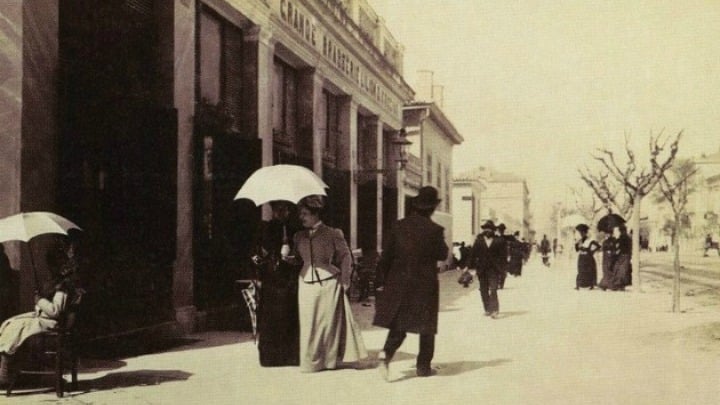
She is a mature, wise lady of nearly two centuries of age. She has endured much and seen even more. She carries on her shoulders the modern history of Athens. She is the street whose opening was approved in 1837 and more than a century later (1945) renamed «Eleftherios Venizelos». But its new name was not registered. Neither in the bourgeois consciousness nor in the collective memory. Respectful, you see, the weight of historical names, but the power of habit does not override it... So the first street of modern Athens, «Panepistimiou» was christened at its birth and «Panepistimiou» will remain. The course of the street is rich and charming. In its own evolution one can «read» the evolution of the whole city. And one can imagine that this historic street «stepped» on a «river», as the Heridanos was mockingly but almost officially called, there in the early 19th century, the stream that acted as a drainage system, carrying the droppings of the animals that grazed in Lycabettus (hence the later area of Kolonaki at that time was known as «goat farms») to the other stream, the Voidopnichti, in today's Stadiou Street. When it reached there, the network of the stinking river turned towards Omonia.
And it is here, chronologically, that the journey of the famous, today's busy Panepistimiou Street begins, which in 1883 was characterized as a «deserted, Sahara» street, unsuitable to accommodate an urban transport system!
But let's take the story from the beginning.
THE ALLEY WITH THE GAZELLES PASSES THE BATON TO THE UNIVERSITY
The year is 1836. The capital of the state has been moved from Nafplio to Athens, where the kingdom of the young Bavarian King Otto is to be established. The life of the city develops around the rock of the Acropolis. For the construction of the palace, the hill of Boubounistra (Syntagma Square) is chosen, where the urban fabric of a few thousand inhabitants ends. East of the place where the royal residence will be erected, there is a parliamentarian (boulevard), a small country promenade with gazebos on either side (on their... long country trips, the inhabitants often choose the «gazebo road»!), small scattered outbuildings and a few makeshift huts, which serve as animal shelters. But the future of the town looks bright. Athens should be transformed into a capital city worthy of its wild past. In the «heart» of the ancient Greek spirit, in the shadow of the Acropolis, and moreover next to the palace, neither stench nor animal grazing are to be understood. It is more than certain that with the settlement of the royal family in Bubunistra, the centre of the city will move. Hence, the prospects for the roads around the palace are great. The town planning has been undertaken by the architects Stamatis Kleanthis and Edvard Saubert, although an initial design (before the capital was moved from Nafplio) by the German architect Leo von Klentse has been done. The latter, «sees» the development of the parliament building as a primary need. A similar assessment is also expressed by the duo Cleanthi and Saumbert. In 1837, the road was approved. At this time there is no official naming of streets. Streets are usually commemorated by the names of important figures of the distant past and monuments of ancient times with which Athens is interspersed (Pheidios Street, Socrates Street, Acropolis Street, etc.), or identified by their characteristics («the street with the gazelles», «the street of the fountain», etc.). As for the exact locations of the houses, they are identified by the names of the householders. The more prominent the householder, the better known the street of his residence. The prospect for the deputation is to establish a university there, as a hive of fresh minds, bringing growth and life to the area. Almost immediately the excavation began, and two years later, in 1839, the university was founded, erasing the hitherto name of «the street with the gazelles» and giving its name to the new street. The road was opened with slow and difficult progress. The state must first deal with the issue of the stream that spreads the unbearable stench in the area and then «plow» the uneven ground, from the rocks and ditches. For too long University Street has been a construction site.
Shortly after 1840, Cleanthes and Schubert propose the transfer of the Metropolis from St. Irene of Aeolus to a church to be erected in a prominent place on the University, but the opposition of the religious world is strong. «It is too far from the urban fabric and will make it difficult for believers» the hierarchs protest. So the new Metropolis is decided to be built next to the surviving medieval church of Our Lady of Gorgoepikoos and St. Eleftherios, an area that is considered easier and safer to access for the Athenian faithful.
OPHTHALMOLOGY, AGIOS DINICIOS, ARSAKEIO, MEGARO SCHLIEMANN THE FIRST IMPOSING BUILDINGS
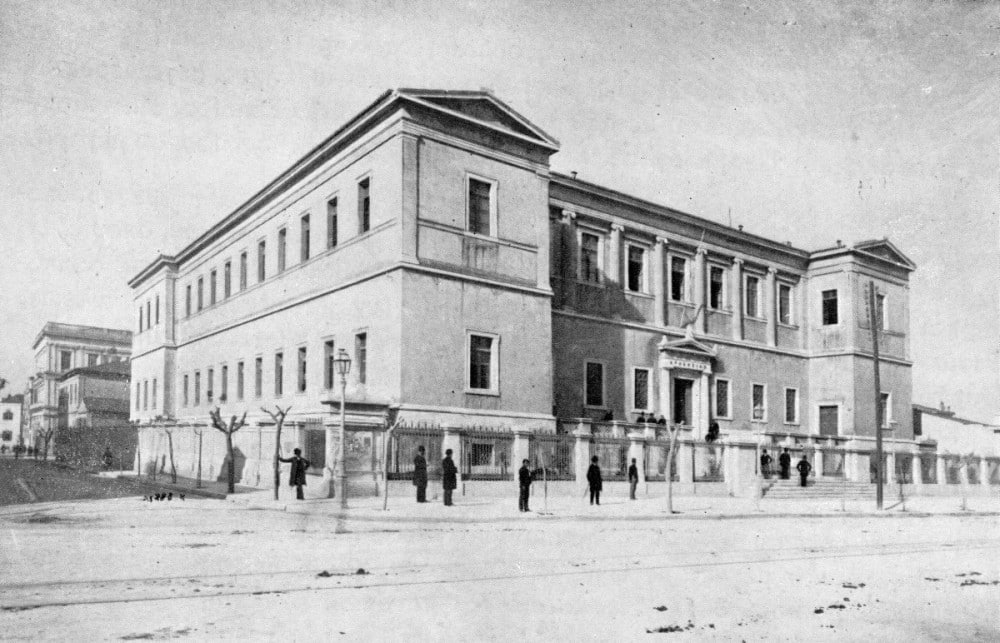
However, at the spot that the two developers intended for the Metropolis, it was decided to build the Ophthalmology Clinic, designed by the Danish Hans Christian Hansen, who also designed the University building. In Hansen's plans, this historical monument to the scientific activity of Greek ophthalmology is referred to as the «Ophthalmology Hospital». The Athenians of the time called it the «Ophthalmospace». It is, you see, a first-line medical care unit, as the dust and bugs of all kinds from the inadequate cleaning of the city have turned eye diseases into a routine affair for the population. Construction of the building, however, is proceeding at a slow pace. Athens is changing its appearance, Panepistimiou is «ploughed up» due to the management of the stream and the construction of various buildings. At this time, the Arsaki Mansion is also being built, on a plot of land at the corner of Menandrou (now Pezmazoglou), which belongs to the Monastery of Zoodochos Pigi and for the purchase of which Queen Amalia has intervened for the Phillepedagogical Society.
In fact, at the height of this plot of land, there is the only bridge that connects the two banks of the Voidopnichti. Spatially, the lower side of University is one stream bed, which receives the discordant material from the goat farms.
Time passes. The pace of construction of public buildings in Panepistimiou is that of... patience. Money is limited, evaporating and until a new financier is found, time is ticking away...
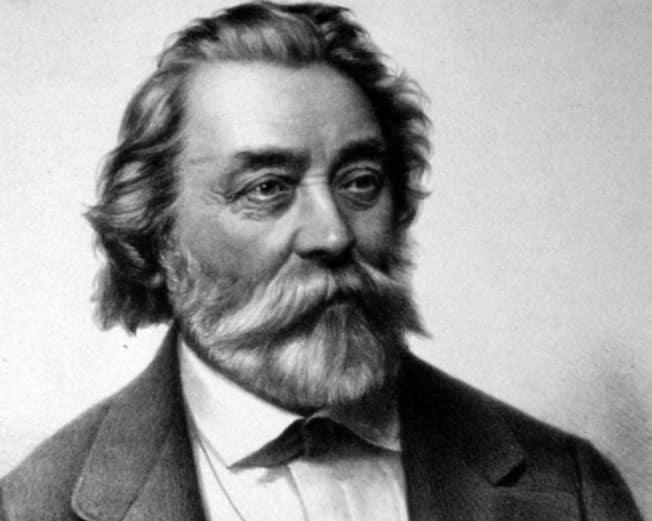
In the spring of 1850, Hans Christian Hansen, unable to keep up with the erratic pace of the construction of the public buildings he had been assigned, returned home, leaving room for action to his ambitious and talented younger brother, Theophilus. The building of the Ophthalmiatry, is undertaken to continue by the equally distinguished around Europe Lysander Kautantzoglou, with one modification.
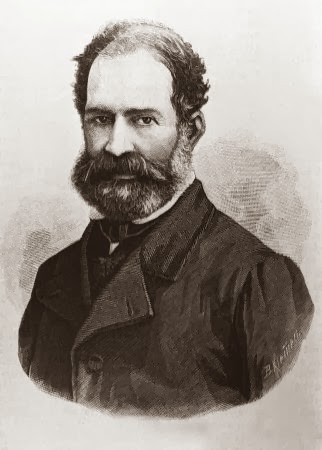
Hansen's ground floor building adds an upper floor. In 1854 the Ophthalmology Department is delivered in two levels. In 1869 a floor is added in 1869 to a design by Gerasimos Metaxas, and in 1881 a gallery and an outpatient clinic are added.
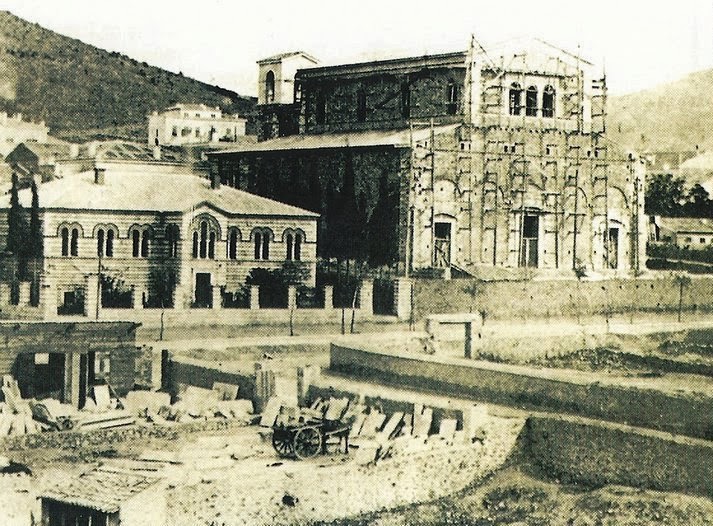
But apart from the construction of the Ophthalmology Clinic, Kautantzoglou has also been entrusted with the supervision of the construction of the adjacent church of St. Dionysios. The Catholic community, which has been strengthened by the coming of the king to Athena, has purchased a plot of land at the junction of Panepistimiou and Homer, where it plans to build its own cathedral. To defray the expenses involved it has even set up a committee - consisting of the ambassadors of France, Austria, and Bavaria, and the chaplain of Otto - which is authorized to raise money by means of fund-raising in the Catholic communities of America and Europe. The foundation stone of the church was laid in 1853 and construction began tentatively with Hansen's plans. But the money runs out. In the meantime, the Danish architect has left Greece, and the completion of this project is also taken over by Cautanjolgus. The building of St. Dionysius is done with... the Arab. When the money runs out, it stops and when new money is collected, it continues. One day the businessman of Lavreotiki, Ioannis Serpieris, puts his hand deep into his pocket and the church is finally completed. 32 years have passed since the year of its foundation! But in this three-decade period the entire Panepistimiou has changed its appearance. Already, since 1879, halfway down the street, the beautiful and imposing Schliemann Mansion (Ilium Melathron), built to the designs of the famous German architect Ernest Chiller to house his fellow archaeologist friend, has been dominating the street. Eight years ago, Schliemann unearthed ancient Troy and the treasure of Priam, and it is only five years since he excavated the Acropolis of Mycenae and uncovered tombs, vases and rare artifacts, great examples of Mycenaean civilization. In the meantime, Slimane has married a Greek woman and professes to be a lover of the Greek spirit. And he sealed his special bond with Greece by building his mansion in the newest neighborhood of Panepistimiou and commissioning the interior frescoes to the Slovenian painter Yuri Subic, whose fame already spreads across the length and breadth of the developed world. Next to the Slimane house, at the intersection with today's American Street, the economist and politician of Theo Diligiannis, Ioannis Zographos, chose to build his own residence. At the dawn of the 20th century, however, Zographos bought a large country estate in the eastern part of Athens and moved there, triggering an impressive residential development and eventually giving his name to the entire area. The house that Zographos left in Panepistimiou would house Eleftherios Venizelos for years and shortly before 1940 it would be demolished to be replaced by the imposing mansion that still stands today and which during the Occupation housed the Italian command post.
THE STADIUM WEDGE - AMAXILATES VS. HIPPODROME - «DESERT SAHARA» THE UNIVERSITY?;
As the years go by and Athens acquires the air of a capital city, gathering more and more population from abroad and within the country, the urban fabric stretches in all directions. Panepistimiou, having already acquired its first brilliant architectural buildings, attracts the interest of politicians, bankers and merchants. In fact, after 1862, when a generous grant of 50,000 drachmas from Michael Tositsa widened several smaller streets in the city centre and Panepistimiou, which had stopped at the University, extended as far as Patision Street, interested investors found an open field. Meanwhile, construction is also underway, next to the University, of the neoclassical mansion intended to house the Academy of Athens. The donation for the building's construction was made by diplomat and businessman Simon Sina in 1856, but the foundation stone was laid three years later. The design is by Theophilus Hansen. The building was delayed and with the death of the donor the work was interrupted for several years until the continuation of the project was taken over by his widow. This building will also be delivered almost 30 years later, but it will be the jewel in the Danish architect's professional crown. In the estimation of experts, «it is the most beautiful and harmonious neoclassical building in the world, which Hansen was inspired by the Athenian architecture of the 5th century, as reflected in the monuments of the Acropolis». The Academy, together with the University and the Vallianeio National Library, which was to be erected later (founded in 1888), will form the famous neoclassical trilogy of Athens, the brilliant jewel in the long history of both the street and the modern city.
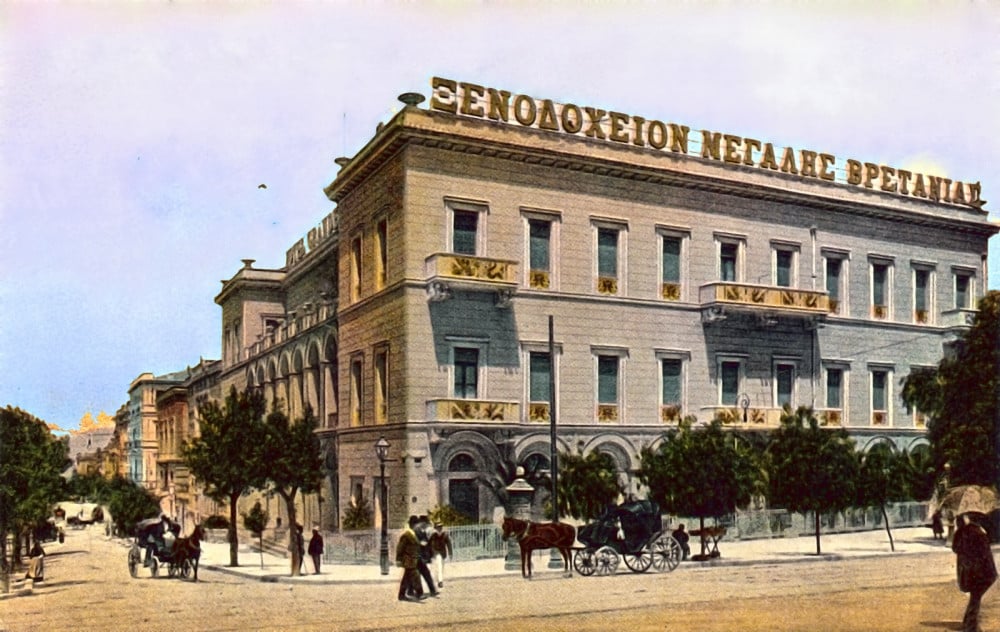
Among the creations - diamonds of Theophilos Hansen in the 19th century Panepistimiou Street is the Hotel of Great Britain, where the street meets Syntagma Square. In fact, the building was completed in 1874, but the hotel had been operating since 1866 at the intersection of the «acacia street» (Stadiou) and the present-day Karagiorgis Servias and was simply moved to its new location, where it is still located today.
As Panepistimiou is developed, a new residential horizon opens up. Residential buildings spring up on the «back» of the Academy, creating the settlement «Proastio» (the later Neapolis). The first developers go on the rampage... After the establishment of the University and the Academy and the completion of the Royal Palace, the area attracts the interest of students and family men, both because the city centre has now shifted and because acquiring a plot of land in the «Suburb» is (for the time being) a feasible proposition for the lower classes. Meanwhile, the stinking river from 1852, when Athens was called upon to manage a natural disaster that cut it in two, is now a thing of the past. A downpour destroyed the bridge at the site of the Arsakeio and put the area into new adventures and the state into new expenses... The stream was patched up and the Voidopnichtis was turned into Stadiou Street («christened» because it was planned to go all the way to the Panathenaic Stadium. It never did).
The point is that since then, since the second half of the 19th century, Athens has acquired another main artery, but mainly the first sewer, which passes under the new road. Stadiou opens up other horizons. «It breaks the monopoly of Panepistimiou and divides the interest of investors. Paved, seeded with acacia trees, without public works, ready for development and at least at first apparently cheaper, the new street surpasses Panepistimiou in attracting interest. It does not have the glamour of the trilogy, nor of the aristocratic residences of Schliemann or Zografou, but it eats up Panepistimiou at the... bend, because it has a sewerage system. Even walkers prefer it. And indeed, there towards the end of the 19th century, the creation of Stadiou not only divides investment interest, but also Athenian citizens. Chroniclers of the era testify that the first major confrontation between the... supporters of Stadiou and those of Panepistimiou was on the occasion of the creation of the first means of mass transportation, the hippocycle. This is a wagon which is usually pulled by three horses. It is a type of urban transport and was established by a special law in 1880. In fact, with the... genetic - it seems - appeal to grand planning, the local rulers of the time also promised a plan for a network of nine hippocycle lines in Athens and Piraeus. The right has been granted to the Belgian »Societe des Laminoirs«, which sets up a base in Omonia and launches the first route to Syntagma. But this means of transport is disrupting the work of the traditional coachmen, who, finding the municipality of Athens as their ally, launch dynamic mobilisations. Their main argument is that the condition of the roads through which the horse-drawn wagons pass has become unacceptable because the operating company does not meet maintenance forecasts. The coachmen demand that the vehicle be moved from Stadiou to Panepistimiou, as, they claim, this «it is wider, the traffic will be more comfortable and, in addition, horses and carriages will not be crowded on a road, which is already one of the main arteries of the city anyway».
The representatives of the company denounce first and foremost the municipality of Athens, calling «unheard of» the fact that «it adopts the positions of the amaxilates, which were contrary to the public interest». Secondly, they argue that in many cities the tracks of horse-drawn or even steam locomotives are laid in incomparably narrower streets, only five metres wide. On the contrary, in Stadium Street, which is twenty metres wide, a little less than nine metres have been set aside for carriage traffic. They add that in busy streets the lines should be multiplied and «not to move to “deserted, like the Sahara, streets”, such as the University, because no benefit would be gained for the public, and the construction of such lines would be of no value and use»!
The confrontation takes on dimensions. It gives juicy headlines in the press of the time with a series of publications, comparing the two apples of discord, Panepistimiou and Stadiou Streets, and from time to time they highlight the winner of one or the other. In the meantime, while horse-drawn carriages and carriage drivers make their way through Stadiou with obstacles and walkers crowd between the horses' hooves, Panepistimiou is being embellished with new imposing buildings. From the press's shackle do not escape the carriage drivers, who often cause accidents, turning Stadiou into a racing track... «...To put away the old customs of wanting one to overtake another.» the newspapers call the coachmen, attributing to this... bad habit of the carters the collisions of the carriages on the iron rails of the horse-drawn railway. In fact, people, trying not to lose customers, load, unload and carry out the on-demand services with greater haste... The controversy continues. Despite the rabid war of the coachmen, the horse-drawn railway remains on the Stadium line, raising the value of the land through the roof. A definitive end to the conflict is given with the inauguration of the steam carriage.
As fast as Stadiou is developing, Panepistimiou is taking its time. Its extension up to Patision opens up space for the creation of new neighborhoods, but peripheral to the street, where prices are affordable. For now, the upper side of Panepistimiou is dominated by the Cathedral of St. Dionysius, the Ophthalmic Hospital, the Athenian trilogy and the Schliemann and Zografou mansions. On the lower side, the Arsaki Mansion and next to it, at the intersection with today's Edouard Lo, the residence of Ioannis Serpieris. The businessman, having firmly financed the completion of Agios Dionysios, watching the development of the street with the erection of the first mansion houses, and foreseeing the value that he will very soon acquire, chooses to build his own house here. In 1887 he even took over the lighting of the town. The Serpieri Mansion, designed by Anastasios Theofilas, was completed in 1880. Later a floor will be added and an extension will be made. In the future, with Serpieri's departure, the building will house the Agricultural Bank. According to Dionysios Iliopoulos in his book «In Athens, once upon a time...», next to the Serpieris residence, in its tenure as the Agricultural Bank, there was a two-storey house from 1860 and even further down a house from 1840.
The country's fiscal bankruptcy in 1893 and its defeat in the Greek-Turkish war in 1897 halted the country's progress, but not for long.
In 1900, Panepistimiou remains a street with potential. Just like Greece. It «hosts» the magnificent buildings of the Athenian trilogy and a few other magnificent buildings of similar logic, but most of them were erected in the interwar period. The slow development of the street's development brings it to a relatively low rank in the paving. Under the mayoralty of Spyros Mercouri, Aeolou Street is given priority, where the commercial heart of the city beats and mobility is high. This is followed by Stadiou Street, Omonia Square, Athinas Street (also a commercial street) and finally Panepistimiou Street.
Despite its first use, Panepistimiou saw its own glory days from the 1920s onwards. A few buildings were created in the first gasp of the 20th century, but most of them were demolished and rebuilt after World War II.
The University followed the course of the city. Or did the city follow the course of the University? It is difficult to answer. What is certain is that it marched in creation and development, opened roads, guided, was written in bold letters on the first pages of the modern city, the modern country. The University. Where Panepanistimiou was born and will remain so.
PHOTO SOURCES
Photographic archive of the Benaki Museum
Society for Liberal Education