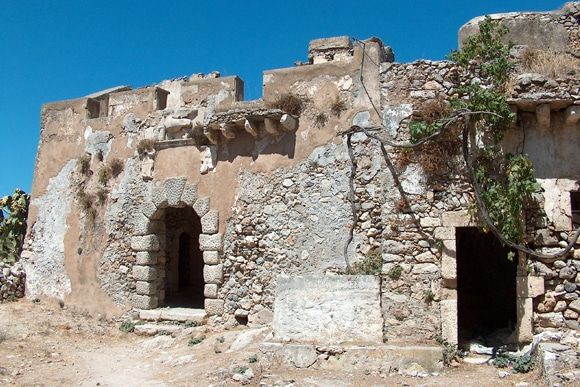
Driving towards Kato Chora of Kythera, one passes Aroniadika and at Dokana turns left towards the west coast of the island. There is plenty of vegetation here, considering the desolation that prevails in most of the island. The first village at three kilometres is Araioi, followed by Mylopotamos, an entire rural community built next to the ruins of a Venetian castle-city. The houses of today's Mylopotamos have a morphological homogeneity that gives colour to the modern settlement: something similar must have been true of the medieval town. Inside the castle the houses are built in groups of two-storey houses, due to the narrowness of the space. The two floors did not communicate internally, but were ascended to the upper floor via an external staircase that ended in a landing or balcony. The ground-floor rooms were auxiliary, just as in modern village houses, were covered with cylindrical domes and heated by a corner fireplace. Their main building features were the fours, the unhewn corner stones and the clay masonry, the «solar» balcony and the chimney. A relatively short walk along the ramparts offers a unique view of a sea claimed by all the leading powers of southern Europe in the fifty centuries of the island's history. You can barely trace the last seven centuries in the ruins of the Mylopotamos borgos.
There is no evidence, so far at least, of a Neolithic settlement similar to that of Linear A which C. Sakellarakis in Agios Georgios in Vouno, or similar to the Minoan findings (3000-1200 BC). Tsirigo must have been settled by Phoenicians and Cretan traders in the second half of the 9th century BC, while Bronze Age remains at Kastri (Paleopolis) date between 2500 and 1500 BC. The Mycenaeans followed, while the Argives used this new stronghold against the Spartans, who finally conquered it in 546 BC. Thereafter, the island of Kytheria Aphrodite (note 1) passed, successively, from the hands of the Lacedaemonians into the hands of the Athenians and the Tanapalians, until, in 21 BC, Octavian Augustus «endowed» it to the noble Gaius Julius Eurycles.
Who owned Mylopotamos
The only thing we can assume about the Mylopotamos area is that it must have had an unexplored sanctuary, or perhaps it was used as an observatory (villa) for naval excursions. The first four Christian centuries of the island remain obscure, and by 395 AD Kythera was part of the Eastern Roman State as a sparsely populated, barren region. In 530 AD they were subordinated, along with the rest of the Ionian Islands, to the administration of the Eparchy of Greece, with a Byzantine proconsul (note 2).
Quick historical review
The modern history of the island begins with the settlement of Agios Georgios and with testimonies of the passage here of Agios Theodoros and the martyrdom (athrosis) of Agia Elesa. Under the Emperor Constantine (641-668) the Diocese of Kythera came under the jurisdiction of the Pope. Under Leo III Issayrus and after the Iconoclasm (717-741), the diocese in question returned to the Patriarchate of Constantinople. From an anonymous chronicle of the 16th century we learn that, already at the beginning of the 12th century, the settlement of Paleochora (Agios Dimitrios) had been founded, the ruins of which are preserved today as the only trace of the Byzantine history of the island. At that time, the inhabitants chose someone to govern them, who in turn was accountable to the despot of Sparta or his counterpart in Monemvasia (note 3). The native population of nobles must have come from castles in Laconia until 1390-93, when the Venetian Senate subordinated Kythera to the regimen of Crete. The founders of Paleochora must have been Constantinopolitans who moved there dissatisfied with the heavy taxation of Michael Palaiologos.
Crusades
For the period of the Crusades, opinions are divided regarding the Venetian presence on the island. According to the above anonymous chronicle, followed by the historian Hopf, the first Venetian Castellano was Angelo Semitekolo in 1237. According to the historian Chrysa Maltesos, Kythera remained under Byzantine rule until 1238. In any case, in that year Nicolos Evdemogiannis gave them as a dowry to his daughter for her marriage to the son of the Venetian nobleman Markos Venieris. Antikythera (Cerigotto) was settled by the Viaros family in the first thirty years of the 13th century AD. When, after 1261, the Latins abandoned Constantinople, the Venerable Pavlos Notaras undertook the reconquest of the islands in 1275 on behalf of Michael II Palaiologos. The native population seems to have desired Byzantine rule, but the Venetians recaptured the place some thirty years later (note 4). And so the blue blood of the Veneri family took over the exploitation of the place once and for all, considering it part of the power granted to them by the Galinotati.
Venetians and other blue bloods, Albanian and other settlements
The Venetians sold Kythera for twenty-four «carats» (titmarii) and chose Crete for their residence, following an unabashedly philhellenic policy. There are sources that attest to the participation of Kythera in the Cretan revolt against Venice (1363-1365), as well as notarial deeds (note 5) that attest to the liberation from the Venetians of some parishioners in Crete and Kythera (note 6). Thus begins a period of successive settlements which directly concern the castle of Mylopotamos.
In 1316 Greeks, Serbs and Albanians arrived on the island. When, in 1363, the Cretans revolted against the Venetians, some members of the Venieris family were executed and families such as the Notarades, the Calligians, the Megaloconomos, the Patricians, the Stadians, the Konomos, the Monchenigos and the Orsini (or, alternatively, the Ducatarians) came to the fore. In the transitional period from 1374 to 1395 the Venetians managed to maintain only thirteen of the twenty-four villas on the island. It was a period of intense militarisation, aimed at strengthening the defence against pirates. With the fall of Constantinople, pirates began to ravage the southeastern coast of Laconia, Kythera and Antikythera, Elafonisos, northern Crete and the Cyclades. They were preceded by the Genoese (1405). The constant opposition of the Castellans in Kythira to the authority of the Duke of Crete led to the establishment of an administration by «Provveditori», who in turn would report to the General Provveditori and the latter to the Doge of Venice. The bloodiest raid was that of Hayredin Barbarossa, a Lesbian of Lesbian origin, a chief raider and ruler of West Africa, who destroyed the outer burghs of all southern Greece. Then the Kythiraean forts of Kapsali (near Chora of Kythira) and Agios Dimitrios were destroyed. With the loss of Monemvasia (1450), the fortress of Mylopotamos in the area of Kato Chora was reinforced with Venetian money. After 1545/47, the fortress gathered more than fifty military families of Cretan and Cypriot origin.
Returning from the sweatshops
The plundering of Barbarossa was followed by Venetian reinforcements, around 1453 (Fall), after repeated written requests (suppliche) of the Kythirians to the «Exotic Lady». In these documents, the plundering and persecution are described in the darkest colours: those inhabitants who returned from slavery, naked, impoverished and starving, asked for tax exemption and re-fortification of their town. After 1547, the predictor Bafo asked Theodore Lagos (who was then serving in the Mani army) to select forty to forty-five men refugees from Crete, so that he could colonize the fortress of Mylopotamos on a half-time basis, since «with these brave men the raiders will not dare to attack», as he wrote (note. 7). In fact, he even proposes a donation of land in the area outside of Bourgos, «so that they can pay the tax of the third». Already the Provost Alexander Contarini, in his report of 7 August 1540, acknowledging the «grandissima importanza» (note 8) of Kythera, had called for the fortification and manning of the castle «so that Kythera would not suffer the same fate as Monemvasia and Nafplio» (note 9).
The new homeland
Thus began the expansion of the Mylopotamos Bourgo at the foot of the castle and the creation of a suburb outside the walls. A distinction is often made, in legal texts, between the «Inside» and the «Outside Burgo» (Xoburgo), while in cases such as that of Capsali we can also speak of «settlements of the sea» (Burgo della marina) (note 10). This urban and social organisation in many castle towns is divided into districts (stones), each with its own leader, and it is possible that the same was true of Mylopotamos. The crowding of all these frightened, religious villagers into Exoburg is justified, if one considers the emergency manner in which the inhabitants had to rush inside the walls in case of a possible sea invasion. Indeed, families such as the Foscarini, the Giustiniani, the Ricardi and others ran commessaria («committee shares») of the lost Venetian chateaux throughout the territory of Kythera. Thus, in 1540, refugees from Monemvasia gathered at Mylopotamos, and even against the dissuasive advice of Bishop Mitrofanis «to avoid the dull, stony, stony and even thirsty» place, they came seeking shares of land to cultivate. Three years ago, Coronese refugees had passed through the island, but they fled, as did the persecuted people from Tenedos who fled to Chandaka, Crete, two centuries ago.
Xenolasia, already since the Renaissance
Kythera was chasing away the housewives. It has always been a place of exile, a military place, a natural fortress, among other things. In the island's archives kept in the fortress of Kapsali, the dating of the titles begins in 1563, the year that the -already bombed- fortress of Mylopotamos was reconstructed, or simply repaired. When Cyprus was lost, in 1570, and after the Battle of Nafpaktos (Lepanto, 1571), a peculiar condominium regime began in Kythera, with the Venetian Doges on the one hand and the Venerian family (some of whose members had also served as Doges) on the other. The first «Council of the Nobles» is mentioned in 1583, when, according to the census of Kastrofylakas, the inhabited towns of Kythera were Mitata, Kyperi, Kalamoutades, Viarades, Konyana, Kusounari, Platanos (today's Village of Kyra), Protika, Alikarigni, Arkarion and Mylopotamos (note 11). In the wider area of Kato Chora in 1583 there were «126 men, 113 children, 8 old men and 212 women» (note 12), which constituted one fifth of the total population of the island. The social stratification under the Venetian rule was very strict and strictly served the fiscal policy of Venice. In a representative town of this period, outside the fortress with its acropolis overlooking the sea, one could find a loggia (bodega) where the nobility gathered to hold their meetings, a granary (Fontego), a customs office (Duana), a sanitary hospital (Sanita) and probably a plague sanatorium (Lazaretto). Next came the private residences, connected by narrow streets, porches or galleries, much as in the Cyclades, for reasons of overcrowding and security.
Temples in the ruins of the 16th century
Walking around the ruins of the citadel of Mylopotamos (the fortress with the acropolis) of the 16th and 17th century AD, one encounters the ruins of a later School of the Anglo-Christian era. It is followed, in a prominent position, by the Venetian Lion of St Mark, on the lintel of the entrance tower to the fortress, a representation of the famous lion holding the Gospel, with the inscription «Pax tibi Marce Evangelista meus» and the year of construction of the castle. After passing by the private residences of the military, as well as several deserted, grassy streets, one will notice the abundance of temples and churches. In Mylopotamos there are Agios Ioannis Chrysostomos, Agios Ioannis the Baptist, Agios Athanasios, Panagia Mesosporitissa, Agios Kosmas and Damianos, the church of Sotiris, whose frescoes belong to the early Cretan school. The militaristic style of the masonry and town planning is characteristic. At that time, all security, by engineers and architects experienced in the art of fortification, was provided by the castles, since the ports of Kythera were not suitable to maintain a landed fleet. The south and south-west winds have always plagued the island. We do know, however, that in summer, the predominant season for pirate raids, in the clarity of the evening atmosphere that allows for visibility, vigilantes were placed at Cape Agios Georgios, lighting torches to alert the Venetian authorities in Kastelli, Crete, for immediate fleet reinforcements.
Reviving that era
Reconstructing an era is not a difficult task if one is sufficiently informed and has imagination. The surrounding countryside, with the river in Lower Chora, is clearly visible from the ramparts of the castle of this Venetian state. Beyond the ravine there were, in 1583, fourteen «casali», that is, hamlets inhabited by farmers, numbering 1443. Each «casa» was headed by a chief, with a very specific political and social position, who was also responsible for collecting taxes. The whole island was divided into four administrative districts, one of which was that of Milopotamos. In 1577 the number of Cypriots amounted to 2,405, with 792 combatants, and with 60 permanent Italian soldiers whose captain was an envoy of the Galinotate and had full control of the area.
After the fall of Chandax (1669) from the old world of the Venetian East, only Tinos, Kythera and the fortresses of Souda, Gramvousa and Spinalonga in Crete had survived in the Aegean. In 1645, after the conquest of Chania, Cretan residents settled in Kapsali and Agios Nikolaos of Kythera. The island fought on the side of Morosini against the Turks.
At the beginning of the 18th century (1715) Captain Pasha besieged Methoni and came to threaten Kapsali and Mylopotamos. The then Provost Sevastianos Marchelos, in his report «On the Destruction of Kythera» (note 13), gives a vivid description of the devastation and the slavers. In the church of Panagia Orphani, relics of victims of Turkish atrocities were found. However, after a brief Turkish occupation, the Treaty of Pasaurovic (21 July 1718) returned Kythera to Venetian rule.
Bad and good heritage
In 1770 the census mentions 1,059 Orthodox in Mylopotamos, a constant proportion of one sixth of the total population of Greek-speaking people on the island. The ruthless economic policies and the miserable handling of the Republic of Venice led the Kythirian pole to complete impoverishment in the early 18th century. The historian Chrysa Maltezou, studying the archives of the period 1724-1814 on the Venetian presence on the island, converges with the view that the roots of the intense localism that prevails there to this day can be traced back to partiality, bribery, the bribery of governors and clergymen, which were established as phenomena during the Venetian rule and were later consolidated during the French rule. Alongside corruption and exploitation, however, Kythera saw a flourishing of literature and the visual arts. As is the case on the Ionian islands, hagiographers were converted and their guilds undertook the illustration of the famous «arched halls with blind arches on the long sides», as Katie Tsihli Aroni writes (note. These craftsmen borrowed the iconographic elements from the West, and thus we have the phenomenon of Kytherians and Cretans painting the iconography of private worship in an elaborate manner. In Mylopotamos every nobleman or captain or captain used to have his family shrine. Defence was the chief concern of these eager soldiers, especially during the period when the Venetian republic was in decline, only to be finally crushed by Napoleon in 1797.
It was a turbulent time in general for every corner of the Mediterranean. In the effort to meet the ever-increasing needs for manpower to man the ships, for the siege works, a large part of the population was exhausted, slaughtered, and forced emigration gave impetus to a shift to agricultural work for those who remained. Ten years after the French Revolution, in 1799, the «Magnificent Councils» were established in Kythera, a kind of temporary Senate that elected an ambassador for the courts of Constantinople and St. Petersburg. Kythera passed from the hands of the French into the hands of the Russians and the Turks. On September 17, 1795, as the Kythirian priest Gregorios Logothetis mentions in his «Chronicles», «...Leonard Koryfis, a Venetian judge, came to Mylopotamos with a great parade and honour...» (note 15).
Libro d'Oro and separatist tendencies
Venice did not accept the devastation that its maritime empire had suffered at the hands of Napoleon's armies, and so the «State of the United Seven Islands» retained the privileged landed property of earlier times. It also retained control of the titles of nobility in the four «disctritas» (compartments) of the island, something like a «Golden Book», that is. Locals strongly oppose the reintroduction of this much hated system of social stratification and settlement of economic and judicial affairs. To the great dissatisfaction of the nobles, the villagers of the Kato Chora/Mylopotamos region set up their own social and political «jury», a council of primitives. As G. Logothetis: «With the opinion of the four birthers, the criterion was made here in Milopotamon in the houses of George Malanos, the antecry of Saint Sozontos, which agitates the rulers that we do not submit to them...» (note 16).
And, as if the social unrest was not enough, intense earthquakes seem to have struck the island at the turn of the century, and civil strife followed, not unrelated to the earthquake. In July 1800, the Kefalonian Count Eustathios Metaxas was appointed commander (bilingual). From the «fear of the armada» of the French, the icon of Myrtidiotissa was transferred to Agios Haralambos of Mylopotamos. A second French domination followed, in 1808, while in September of the following year two English frigates subdued the island, after a naval defeat of the English at Avlemonas. According to the chroniclers (Logothetis, Laspiotis, Varypatis), Kythera remained under English rule without interruption until its final union with the rest of Greece in 1870. An anonymous person who wrote in Venice «Thoughts on the Public Economy of the former Venetian islands of the Ionian Sea» gave data for a population of 9,000 inhabitants in 1808, while Mikelis gave 8,500 in 1814, of whom 150 were priests, 204 nobles, 422 elders, and also - based on their productive activities - 1,741 were bourgeois. In terms of the degree of ageing of the population, this demographic report speaks of 1,545 children and - always last in these phallocratic lists - 4,439 women.
Black darkness
One can imagine the darkness and superstition that plagued these populations if one reads the chronicles of the 19th century. In 1829 the census gave 1,900 inhabitants in Mylopotamos, out of a total of 11,200 inhabitants of Kythera. Since then the population of the island has never exceeded 14,500 inhabitants. At the dawn of the 20th century, mass migration to Australia began. However, the institution of demogerontia was not enough to eliminate the place's peculiarity. A forecaster by the name of Carlo Pasqualigo left us written decisions on the duties of the primate, but in these military quarters the memories of the Venetian occupation remained alive. The native populations were addicted to treating the peasants as if they were plebeians. The first land register attempted in Kythera reflected the social inequality, from which, moreover, the hatred between the «main villages» and the periphery stemmed. The agricultural and beekeeping countryside yielded little profit under the «third» tax regime, originally imposed by Venice. Nevertheless, the ’third’ tax was a particularly onerous tax for domestic farmers up to the time of the French Empire. Today, after considerable support for the Tsirigotes from the expatriate Greeks of Australia, Mylopotamos remains a pile of ruins - an ideal place for photography and watercolour photography. The sound of bombings and earthquakes has sunk in, along with its turbulent past. Our personal map of recording impressions is drawn on these ruins. But there remains a powerful sense of a city designed solely for defence, without the gentleness and ease of access that distinguishes lowland cities. Witness the desolation and the silence...
of Nikos Xenios
Notes