From the «Restart Tourism» and the stunted 2020 season with any then desperate efforts to recover Greek tourism, the last two summers were marked by the pandemic. Today, with the picture changing, the estimates for tourism performance seem at least optimistic: tourism groups are talking about a dynamic restart, while the government is announcing the apparent recovery of tourism with dithyrambic statements - all indications are that the slide of the previous lost seasons is a thing of the past, despite the energy crisis and the war in Ukraine. And yet, a cloud is clouding the bright prospects of the «heavy industry». Where are the workers lost?;
The anaemic mood of potential employees to enter the tourism industry this year has been evident since last year, with surveys estimating that 8 out of 10 employers were running out of staff. The phenomenon is not purely Greek. Southern European countries in particular were recording hundreds of thousands of job vacancies from the hotel industry in 2021, with Greece, Spain, Italy, Portugal and France totalling more than 700,000 «vacancies». There were thousands of us restaurant and tourist owners who voiced their grievances, either online or in tele-windows, saying more or less that it was all ’the fault of the allowances«, lamenting the supposedly »lazy young people who were stunted«.


This year the phenomenon has swelled and no one can attribute the problem of job vacancies to the pandemic or subsidy policy, making market analysts, employers and entire communities in the so-called tourist flagships scratch their heads - let alone the fact that youth unemployment in Greece is on the rise.
Is it the conditions of the domestic hotel and catering industry, intertwined with conditions of overtime, undeclared work and very low wages, or is it employers who overemphasize the lack of working hands in their attempt to further reduce the wage? The recent avalanche of complaints about working and living conditions are revealing, but they did not come as a bolt from the blue. From staying in cockroach-hole rooms or in containers and tents, to bathing in beach showers, to rent-fires and black labour, a large proportion of workers are well aware that the summer season often becomes an oasis of labour exploitation, with tips being the only hope of supplementing meagre earnings. And all this while it should be the smiling facade of «Greek hospitality». The Ministry of Labour may announce intensive inspections by the Labour Inspectorate in view of the tourist season, but it remains to be seen whether this is enough to «patch up» the chronic problems, while the government has limited itself to recommendations to employers.
The paradox of the Greek case could not be ignored by the foreign press. The German news agency DPA, in a report on forecasts that Greece will experience a record year in its performance in the summer season, asks why the tourism sector has stopped attracting some 50,000 workers when there are 600,000 unemployed in the country. Could it be seen as the Greek version of the «Great Quit» - the phenomenon that emerged in the US in the midst of a pandemic to express the mass withdrawal of workers from their jobs due to stress and overwork?;
The answer is not simple, but the debate has already been opened up for good that more and more people, especially the young people of the country, are returning to the prophetic and much-discussed phrase «we will not become the waiters of Europe». Even if it is for completely different reasons than the de-industrialisation invoked by Andreas Papandreou in the 1980s.
Research, trade unionists and labour market insiders attribute the shift to a return to jobs that were put on ice during the crisis decade, such as construction. Still, the expansion of industries such as courier services and new specialties that have emerged, such as workers on internet platforms, have provided a serious alternative for a segment of the workforce, often with the lure of steady rather than seasonal employment. In the tourism industry, there are shortages of tens of thousands in specialties such as chefs, waiters, cleaners and craftsmen (such as handymen), with demand now being attempted to be met through imported workers from third countries, as well as through the ... «utilization» of refugees in the country.
«Crete has run out of cooks...
Ioannina and Heraklion are separated not only by hundreds of kilometres and the climate, but also by different tourism - both in terms of quality and quantity. Yet the changes that have taken place in the last two years in both local economies are indicative. We asked two young people who now spend their summers working in the two cities what changes they have noticed in the last two years, what they have experienced and how they perceive their future in the industry or away from it.
At 28, George has already spent more than 10 years in the kitchens of seasonal hotels in Crete. This year for the first time he is not working in season, but as a waiter in Heraklion on a full-time basis. «Before the pandemic, if you worked all year round in catering you were lost because the wages were meagre compared to the money you would make in season. Now that has changed because a lot of people have changed jobs - how much can a catering worker live on a 500 euro allowance during the quarantine? So many employers have tried to adapt and create incentives for workers to stay and not leave for the season, even by offering one meal a day.».
Crete, which under other circumstances employed about 150,000 people in the tourism, catering and restaurant sectors during the summers, covered the needs of the open jobs with workers living permanently in large urban centres, mainly from Athens and Thessaloniki. Now employers and large hotel chains have to dig deep into their pockets to attract workers to the island.
As George notes, the problem of finding workers is mainly found in cooks: «This year this industry has disappeared. I meet many who are now either working as deliverymen or have somehow been absorbed into the public sector on contracts. But there is another reason: »The cook's profession was never well paid, despite the fact that they were absolutely necessary. An average cook used to get 1,000 euros, while today workers are asking for more, and rightly so, because of the shortages. So, today they put workers to fill these gaps and work double shifts, along with students and lackeys who will do all the work for the children at the same time.«.
Ioannina, on the other hand, has been experiencing tourist traffic since last summer, similar to a holiday island in the Cyclades, so it was not difficult for Michalis, a resident there, to escape the fatigue of seasonal work and work in a new bistro in the city centre that seems to be finding its place on the country's tourist map: «Since last summer, Ioannina has been flooded with tourists who prefer to stay on the mainland rather than go on holiday to islands. They are now weighing it all up, the financial difficulties, the high fares and the difficulty of getting around because of the rise in the price of petrol.».
He works as a store manager at one of the many shops that have opened in the city in the last year. This has been a catalyst for absorbing the local workforce that in previous years was making its way to the tourist islands. «Thirty-somethings are now tired of leaving for the season, in an unstable environment that changes every year with the health and economic crisis, most recently the war crisis. I was looking to find my footing, to be able to develop into what I like. You have no perspective on the season. You reach a ceiling.».
The low-demanding «sessionists» of the crisis are no longer a given
The non-arrival of workers from Northern Greece on the islands is confirmed by the «Eph.Syn.» Panagiotis Englezos, president of the Labour Centre of Rhodes. With about 40,000 out of a total of 52,000 workers on the island of Knights to be seasonal, the phenomenon has, of course, wider implications. Rhodes comes first in international agency bookings, but there are labour shortages in the hotel and other tourism sectors. «On the altar of the pandemic and in a shorter than usual period, several times the collective agreement in Rhodes hotels, one of the best in Greece, was not implemented. 12-hour and 13-hour schedules were observed, with waiters and waitresses doing the maid service and being transferred to all posts. Several Rhodians left the hotel industry, even going abroad for work,» Mr. Englezos describes.
According to him, one of the reasons for the wave of walk-outs was the exploitation of workers that occurred in previous years. «Some people did not pay attention to the worker, took him for granted and it backfired. We are all paying for this as a destination and as a society,» he comments. Bringing in workers from third countries is being put forward as a solution, but the major issue for local unions is that they should be paid under the same collective agreements to avoid creating a new segregation of workers, leading to «modern slavery».
Nikos Papageorgiou, a member of the administration of the Panhellenic Federation of Food and Tourism Workers and the administration of the General Confederation of Employees of Greece, believes that not all positions can be filled by the Greek potential of tourism workers, since in the coming years a huge increase in tourist traffic is expected.
In Attica, based on the data of Mr Papageorgiou, there is a picture of an average withdrawal from the tourism industry at a rate approaching 30%, with other seasonal workers expressing particular concern about moving to island regions if their accommodation is not covered. The role of the OAED allowance for seasonal workers is also crucial, remaining at 3 months versus 6 months.
In hotels, he also notes, there is a shortage of senior managers, not only in the lobby or kitchen. Experienced hotel employees prefer to work in Northern European countries or Dubai. Thus, hoteliers are in «conflict with themselves» and have opened the discussion to fill some positions with Ukrainians or other refugees, as Greece is no longer very attractive for economic migrants. There is of course a positive side for workers, as through the unions they are given a serious opportunity to demand better pay and working conditions, with the existing hotel workers' collective agreement expiring on 31 December.
Making the equation more difficult for businesses
On the part of employers, such as the Panhellenic Federation of Hoteliers (POX), no changes in labor and wages have been discussed yet. With this season being a gamble, given the explosion in energy costs and debts created amid the pandemic, industry representatives are calling for additional support measures and a regulatory framework to compete with Airbnb. But serious consideration is also being given to the employment of refugees, with Ukrainians already working in some tourist units.
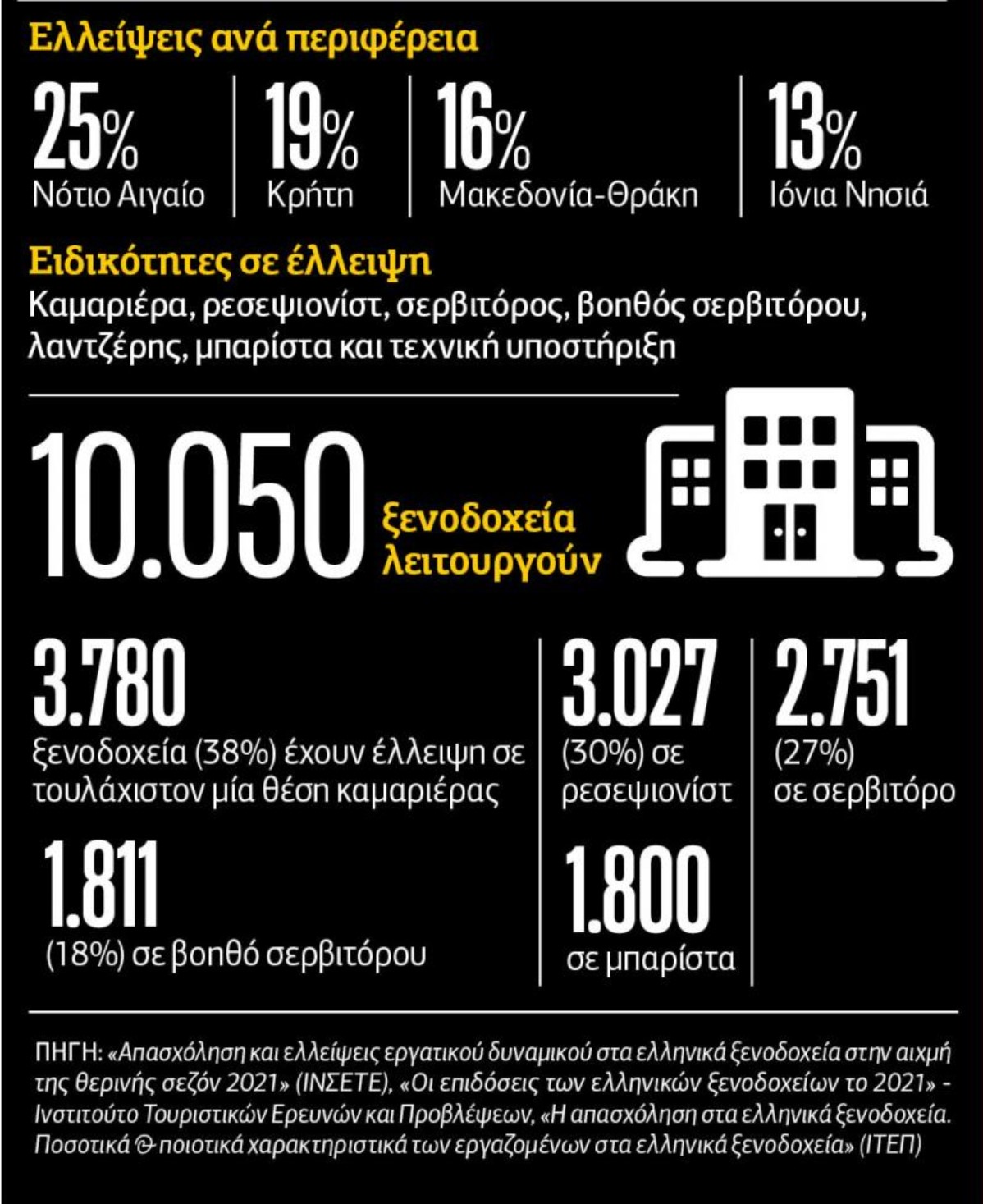
SETE sources told us that it is still too early to indicate a specific number of shortages of workers in tourism businesses for this season, referring us to last year's (2021) study by the Institute of the Association of Greek Tourism Enterprises (INSETE). As stated in the study's summary conclusions for 2021, the 53,249 shortages recorded at the peak of the season «are very high and significant and addressing them is a top priority issue for Greek tourism in order to maintain the high level of service and hospitality that is one of the strongest points of differentiation in international competition.».