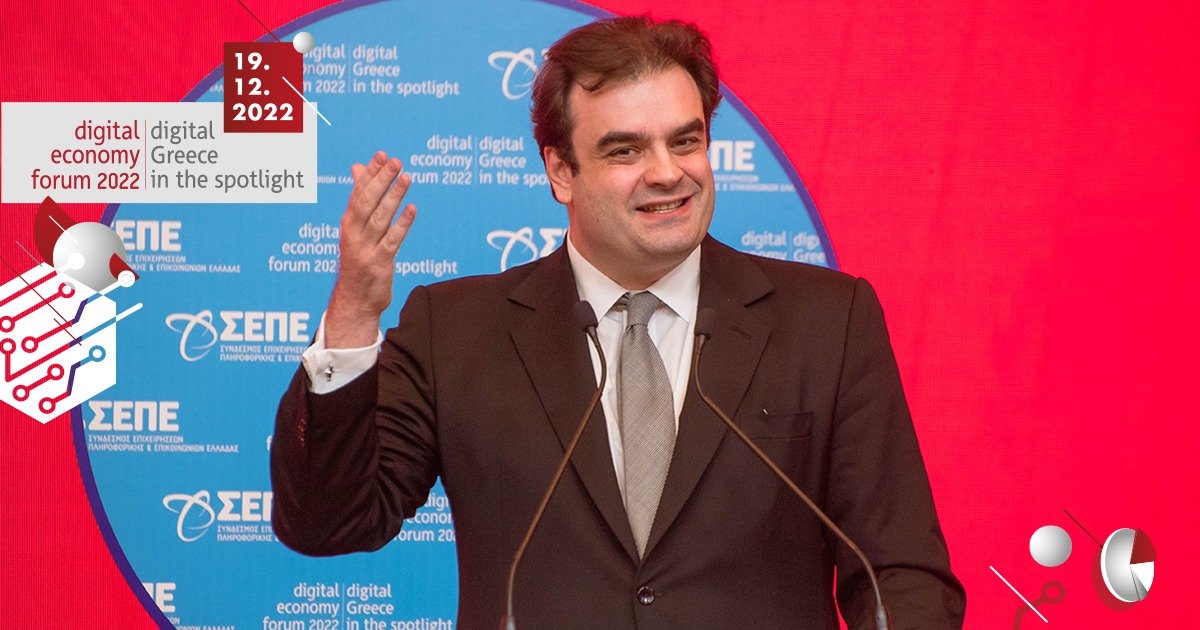
Speaking at the Digital Economy Forum organised by the Association of Information & Communications Enterprises of Greece (SEPE), the Minister of Digital Governance referred to the last «3.5 years of dense cooperation» and events which, as he commented, «are very interesting how one can» process them «in order to go forward».
Mr.Pierrakakis referred to his belief that «information technology and technology can have the greatest possible social contribution, the greatest possible impact to change and influence the problems of society» and to the preparation that had preceded his assumption of his duties as Minister both in terms of «scope» and «horizon». «The scope is what had been done well and what had not been done well. Systems that had worked: Greece had the legacy of Taxis, it had the legacy of prescription, many other systems. And in many things we had failures and we had failures, like everybody else. And of course the horizon in the sense that one only had to look at what had happened in other countries and learn from the mistakes of others - that's the most intelligent way to learn, from your own mistakes is the most effective way. The most intelligent way is to learn from the mistakes of others,» he said.
Referring to the government's choices, the Minister of Digital Governance noted that gov.gr was created in the first 9 months of government, while there was a reversal of strategy, starting «from the need we wanted to serve. I think the definition of the problem was conquered, which was that Greece was a bureaucratic country and we can leverage simple digital technologies to make it less bureaucratic,» adding the corresponding competencies in the ministry's portfolio to access «all the registers of the State with each other, to make them talk» to each other.
Taking stock, Mr.Pierrakakis referred to «three key achievements in this area of digital public services. First of all, we measured them, that is, we made an assessment of how many these services are, we didn't know until 2019. First question ”as we once didn't know how many civil servants there are in Greece”, first question to my colleagues ”how many services does the public sector provide digitally?” The answer is ”we didn't know”. We counted, basically, how many of these services there were and we found 501. We added two on the first day: the affidavit and the power of attorney. Today there are 1,500. So step one is tripling the number of services. What did the tripling of services produce? By 100 in uses. We had 8.8, million digital transactions in 2018, we have 1 billion digital transactions this year. You divide that by population and it captures the queues you avoided. And that in itself is the magnitude of this whole reform.».
In addition, 3.5 years later, «more than 220 major projects have been tendered for a total amount of 2.3 billion, more than 400 million in aid, more than 700 million in PPPs and within the next six months we will have another 600 million in tenders», Mr.Pierrakakis stressed, adding that all these projects were reflected «from the first day of 2019», in the «Digital Transformation Paper», to the implementation of which the Recovery Fund contributed decisively. «We started to do what is described as a gap analysis, that is, what is the gap per ministry, per department,» Pierrakakis said, continuing, «then came the Recovery Fund, the coronovirus, and allowed us to finance all the necessary and enter the realm of the desirable. In other words, with projects that talk to the future, not just to the needs of the country that we had in our hands at the time.
At the same time, as the Minister of Digital Governance said, reforms in telecommunications have progressed, where there is also «the double image», i.e. «in mobile telephony we are somewhere 25th in the world, while in fixed telephony we are 93rd-95th». «In mobile we did the most innovative spectrum auction in Europe and certainly one of the most innovative in the world through the creation of Phaistos and how we are investing in 5G. In fixed we started from 270 thousand Fiber to the Home lines at the end of 2019 to be 1.15 million today, from a denominator of 4.8 million potential lines to be covered by 2027 by private investment and by Ultra Fast Broadband. And there we are running fast. And that's where competition in Technology comes into the equation. And that's where we see Starlink now starting to broadcast in our country and being regulated by EETT,» he said.
As for «space», he commented that it is exploited «in an earthly way which provides and requires us to have microsatellites and secure state communications and to use them again for the daily problems we have in our country, such as fires. And there is a very large Recovery Fund program there.».
Referring to the coronavirus crisis, Pierrakakis said that «it was one of the best versions of the Greek state, which I feel very privileged to have had the opportunity to see and participate in. Whether it was the health system staff, whether it was the IT people - everyone is here, my colleagues, the Civil Protection staff, the Army staff without whom we could never have operated the logistics. Right down to running the algorithms, consulting firms that helped us, how we did the distribution of vaccines from five locations to 440. How it took all of us to become more expert at it and operational research.».
«The needle is moving and it is moving at the fastest speed it has ever moved. It is an unexpected reform, not in terms of its direction but in terms of its speed and acceleration,» Pierrakakis said of the progress that has been achieved, adding that «the point is that this infrastructure reform can continue regardless of the political cycle in the coming years, this will be the greatest possible achievement of all of us.».