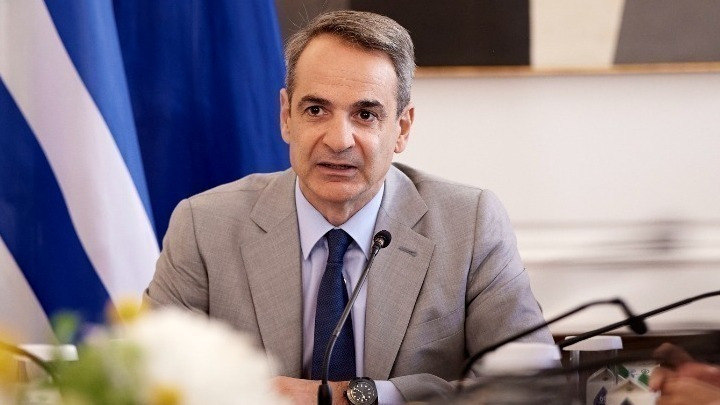
Prime Minister Kyriakos Mitsotakis, in his weekly review of the government’s work, referred to the infrastructure projects being implemented by the government, noting that these projects ultimately matter more than words, and emphasizing, «We are resolving issues that have been pending for decades and, at the same time, we are launching new, complex road projects in many regions of the country, facilitating travel, improving citizens» daily lives, and strengthening the local and national economy.”.
«The Skaramanga triple interchange falls precisely into this category, a project that will complete an unfinished transportation system of regional boulevards and grade-separated interchanges in Western Attica. Its construction, scheduled to be completed in 36 months, will significantly ease traffic congestion throughout the entire Athens basin, while also boosting the growth potential of the Port of Piraeus and the wider Aspropyrgos area,» he notes. The prime minister also refers to the projects underway in northern Euboea, which he visited in recent days.
It also refers to occupational insurance, emphasizing that this is a critical reform, as our country remains one of the least developed OECD countries in the field of occupational insurance.
Finally, the prime minister refers to this year’s European Commission Report on the Rule of Law. «The report confirms that Greece is making steady and measurable progress. From 2020 to the present, the Commission’s recommendations have decreased from seven to four, while for the third consecutive year, progress has been recorded on all of the previous year’s recommendations. »Ten member states have more recommendations this year than Greece, and five member states have the same number of recommendations as we do,” he notes.
«Greece, therefore, based on the most recent official European comparative data, is not a «dystopia» of poor institutions and a deficient rule of law, as the opposition would have us believe,» the prime minister emphasizes.
«And since we’re talking about the rule of law, its foremost principle is the presumption of innocence. Unfortunately, the opposition—which is otherwise «institutionally sensitive»—failed to respect this principle in the case of New Democracy officials who were investigated by the European Public Prosecutor’s Office regarding OPEKEPE. The dismissal of 9 out of 13 cases proves that ministers and members of parliament from our party were targeted and smeared for partisan gain even before the courts had reached a verdict. The same presumption, of course, applies to the remaining four officials, whose cases will be further investigated for misdemeanors through the expedited procedures we established to ensure there is no shadow of doubt,» he states.
Below is Prime Minister Kyriakos Mitsotakis's post:
«Good morning, everyone. I’ll begin today’s review with infrastructure, a sector in which we’ve chosen to invest systematically since 2019, because projects are ultimately what matter more than words. We’re resolving issues that have been pending for decades and, at the same time, we are launching new, complex road projects in many regions of the country, making travel easier, improving citizens’ daily lives, and strengthening the local and national economy.
The Skaramanga triple interchange falls precisely into this category, a project that will complete an unfinished transportation system of regional boulevards and grade-separated interchanges in Western Attica. Its construction, scheduled to be completed in 36 months, will significantly ease traffic congestion throughout the entire Athens basin, while also boosting the growth potential of the Port of Piraeus and the broader Aspropyrgos area. And I will repeat what I said at the contract signing: the Regional Governor of Attica, Nikos Hardalias, deserves praise for his persistence in securing the necessary national funding to make this project a reality.
Major road infrastructure projects are, of course, also being carried out outside the Athens metropolitan area. A few days ago, we opened the Rovies-Ilia section, a modern and safe road that makes the long-suffering northern Euboea more accessible to residents and visitors alike. In this way, we are fulfilling yet another commitment to the local community, addressing the problems caused by dangerous landslides and putting an end to time-consuming traffic detours.
The new road was funded by the Recovery Fund, as was the renovation of the Istiaia Health Center, one of a total of 110 health centers that were renovated throughout the country. There, we also established a Dialysis Unit with six dialysis machines, so that patients with kidney disease from the wider region—as well as visitors—no longer have to travel all the way to Chalkida. The Istiaia Health Center is staffed by 65 employees, including 37 new hires since 2021, and is supported by two Mobile Health Units from the 5th Health Region of Thessaly and Central Greece, while a Coast Guard floating ambulance is on 24-hour operational standby at the port of Oreon.
During my recent visit to northern Euboea, I had the opportunity to see firsthand both the road projects and the transformation of the local National Health System (ESY) infrastructure, as well as the efforts underway to restore the natural environment following the devastating wildfires and Storm Daniel. We are on the ground, addressing problems systematically and effectively, and providing practical support to local communities.
I’m changing the subject and moving on to occupational insurance. The new provisions included in the Ministry of Labor’s draft bill, which is currently under public consultation, create better retirement prospects for workers and strengthen the competitiveness of businesses, especially small and medium-sized enterprises. This is a critical reform, as our country remains one of the least developed OECD countries in the field of occupational insurance.
There are currently 27 Occupational Insurance Funds in operation, with nearly 55,000 insured members and an average individual account balance of approximately 10,500 euros. Their assets amount to less than 1% of GDP, whereas in OECD countries with mature occupational pension systems, the corresponding percentage approaches 50%. That is why we are establishing Open Occupational Pension Funds, so that even smaller businesses can gain access and retirement savings become easier for professionals. Contributions will be 100% deductible from taxable income, while full portability of benefits is being established, so that a change in employment or professional status does not result in the loss or reduction of accrued benefits, but rather in their transfer to a new occupational insurance provider.
Earlier this week, immediately after their enactment, the new measures for settling debts owed to the Independent Authority for Public Revenue (AADE), the EFKA, and financial institutions, so that more citizens can settle their outstanding obligations and protect their assets. It is now possible to repay debts owed to the government that were incurred by December 31, 2023, in up to 72 installments, while the scope of the out-of-court settlement mechanism is being expanded to include debts starting at 5,000 euros. Thanks to ongoing improvements to the primary residence protection mechanism, we have now reached 64,406 successful settlements, corresponding to initial debts totaling 19.67 billion euros. In June alone, 1,800 new repayment plans were finalized, with financially vulnerable households and individuals with disabilities accounting for 12.5% of the total. These specific payment plans correspond to total initial debts of 458.6 million euros.
I would now like to focus on this year’s European Commission Report on the Rule of Law. The report confirms that Greece is making steady and measurable progress. From 2020 to the present, the number of the Commission’s recommendations has decreased from seven to four, while for the third consecutive year, progress has been recorded on all of the previous year’s recommendations. Ten member states have more recommendations this year than Greece, and five member states have the same number of recommendations as we do. Greece, therefore, based on the most recent official European comparative data, is not a «dystopia» of poor institutions and a deficient rule of law, as the opposition seeks to portray it. These are the objective findings of a comparative European assessment that applies the same criteria to everyone. And that is why it holds greater value than the sweeping narratives that insist on dismissing every positive development.
This, of course, is no reason to become complacent. On the contrary, it is an incentive to move forward even more quickly. The constitutional revision we are proposing includes significant institutional changes to strengthen the independence of the judiciary, ensure accountability, protect journalists, and improve the quality of legislation. At the same time, we are implementing new initiatives to combat corruption more effectively, the digital registry of corruption cases, the completion of the framework for protecting journalists from abusive lawsuits, strengthening dialogue with civil society organizations, and improving the framework for transparency and oversight of lobbying. Our goal is for the next report to include even fewer recommendations and, by 2030, for Greece to rank among the top 20 countries in the world in the fight against corruption and in the operation of strong, transparent, and effective institutions. Because it is not enough for a modern European country to grow economically; it must also continuously improve the quality of its democracy.
And since we are talking about the rule of law, its fundamental principle is the presumption of innocence. Unfortunately, the otherwise «institutionally sensitive» opposition failed to respect this principle in the case of New Democracy officials who were investigated by the European Public Prosecutor’s Office regarding OPEKEPE. The dismissal of 9 out of 13 cases proves that ministers and members of parliament from our party were targeted and smeared for partisan gain even before the courts had reached a verdict. The same presumption, of course, applies to the remaining four officials, whose cases will be further investigated for misdemeanors, using the expedited procedures we established to ensure there is no shadow of doubt. At the same time, I would like to remind you that rooting out any practice that led to the misuse of agricultural subsidies remains a constant priority for us. I would like to point out that legal proceedings have been initiated against more than 2,900 individuals who, according to the authorities, received illegal subsidies, and the first convictions have already been handed down.
On the front lines of the fight against economic crime, another major success for the Internal Affairs Division of the Hellenic Police was the uncovering of a massive VAT fraud scheme involving a complex network of companies in Greece, Cyprus, the Czech Republic, and Bulgaria. The months-long investigation, in cooperation with the European Public Prosecutor’s Office, led to the identification of a ring that was trading in electronics within the European Union without paying the corresponding VAT and, at the same time, claimed tax refunds it had never paid. The loss to Greek and European coffers is estimated at at least 71 million euros. Authorities also seized cryptocurrencies and other digital assets worth approximately 5.5 million euros, the largest such seizure ever carried out at the national level, thanks to advanced digital forensic analysis by officials from the relevant departments of the Hellenic Police.
I will now turn to the protection of our natural resources. The Presidential Decree establishing the South Aegean Marine Park in the Southern Cyclades has been signed, and in the coming days the corresponding decree for theIonian Marine Park. Together, they create one of the largest protected marine areas in the Mediterranean. Greece is thus achieving the European targets ahead of schedule—by early 2027 instead of 2030— and to a greater extent, protecting 35% rather than 30% of its marine areas. In collaboration with local communities, local fishermen, scientists, and international partners, we want these parks to become true sanctuaries of life, protecting our biodiversity and marine habitats. They will be monitored using specialized vessels, one of which—the «Syrna,» acquired with funds from the Recovery Fund— has already been handed over to the Organization for the Natural Environment and Climate Change, which is being reinforced with 300 permanent staff members.
In the same context, a major reform aimed at holistic water management has been put out for public consultation. Currently, in our country, more than 735 different agencies manage water supply, sewerage, and irrigation issues, each with different financial circumstances, different capabilities, and varying levels of service. To illustrate the extent of this fragmentation, in Ireland these responsibilities are exercised by a single central agency. The current model leads to overlapping responsibilities, increased operating costs, and difficulties in implementing investments in networks and infrastructure. And this, in turn, results in inefficient water management, losses, and waste, as well as an inability to develop a unified national plan—at a time when water scarcity, climate change, and their consequences make this need more urgent than ever. Through the bill proposed by the Ministry of Environment and Energy, the National Water Strategy, and the funding of infrastructure projects throughout Greece, we aim to bring about a substantial improvement in the daily lives of millions of our fellow citizens, while fully preserving the public nature of water.
Three years after the major fire in Dadia, a comprehensive program for the restoration of forest ecosystems and fire prevention is underway, with a total budget of approximately 86 million euros. Erosion control measures have been completed, large-scale flood control projects are underway, targeted reforestation has been carried out with the planting of 54,172 saplings, and the new Raptor Observatory has become operational. At the same time, vegetation clearing and the maintenance of firebreaks continue through the Antinero program, strengthening the resilience of an ecosystem of unique value.
Also significant is the major national initiative to revitalize the country’s historic university infrastructure, through the use of a 160 million euro donation from the four systemic banks. We have chosen to direct the donation specifically toward old and iconic university buildings, where the investment will have a real and lasting impact on students, faculty, cities, and the public university system. The main funding is directed to the National and Kapodistrian University of Athens, while initiatives will also be implemented at the National Technical University of Athens and the Aristotle University of Thessaloniki. At the same time, the government has already initiated significant investments in most public universities, upgrading existing facilities and creating new, modern student housing in Thessaly, Crete, Western Macedonia, and Eastern Macedonia and Thrace, by increasing the number of faculty members and introducing new undergraduate and graduate programs aimed at making Greek universities more outward-lookingand attracting new students.
Another interesting development comes from Aristotle University of Thessaloniki, the country’s first public university to adopt electronic exams conducted via tablets and specialized software. The new process is fraud-proof, significantly reduces the time required for grading and announcing results, lightens the administrative burden on faculty, and saves thousands of sheets of paper. The system has already been used by more than 8,000 students across 27 departments and 165 undergraduate courses. I hope other public universities will follow suit, adopting what is now a well-established digital practice.
The initiative continues in the digital realm with the new «Eumaios» platform, which was created to remove barriers to access to culture. It is a modern digital information portal for people with disabilities, people with chronic or rare conditions, older adults, and, more broadly, all our fellow citizens who face barriers. The platform provides reliable and detailed information in Greek and English on accessibility conditions and available infrastructure, making it easier for people with disabilities to plan their visits. To date, 120 archaeological sites, museums, and cultural attractions across the country have been registered, with their accessibility certified by specially trained inspectors.
At the same time, the number of digital documents and services available to citizens on GovgrWallet is increasing. The 13th addition in a row is the Greek passport, which is now available in the app for identification purposes and as a travel document within Greece. All you need to do is update the app on Android and iOS devices.
I would also like to address the safety of sports facilities. Seismic inspections of 2,500 sports complexes across the country were completed in record time by trained and certified engineers, and on-site inspections of approximately 1,000 more will follow. The seismic retrofitting is being funded with 15.5 million euros from the Recovery Fund. For the first time, the government is systematically inspecting sports infrastructure, in an organized manner and using a unified scientific methodology, as part of the requirement we established for the issuance of operating permits, with the sole aim of protecting athletes, spectators, and employees. Provisions are also explicitly made for seating for people with disabilities, in proportion to the capacity of each facility. In short: temporary operating permits will not be granted unless all safety requirements are met.
On Lesbos, four completed cultural projects were unveiled to residents and visitors: the northern enclosure of Mytilene Castle, the roofs and domes of the Church of Saint Therapontas, the modernized Resin Museum, and the restored medieval Gatelozoi Tower in Ampeliko. These projects were preserved and brought back to life with funding from the Recovery and Resilience Fund. These initiatives are part of the Cultural Charter for Development and Prosperity and view cultural heritage not as a static imprint of the past, but as a living pillar of identity, cohesion, and sustainable development.
I’ll conclude today’s review with a figure beloved by all of Greece. It was with deep emotion that I, too, bid farewell to Maro Kontou, a distinguished lady of the «Golden Age» of Greek cinema and theater, who dedicated herself to the arts as well as to public service, having served as a member of parliament for our party and as an Athens city councilor. We will all remember her with respect, tenderness, and love.
»We’re taking stock of what’s been accomplished this week; we’re well aware of how much more needs to be done, and we’re continuing our work with a plan, consistency, and without complacency. Have a great rest of your day!".