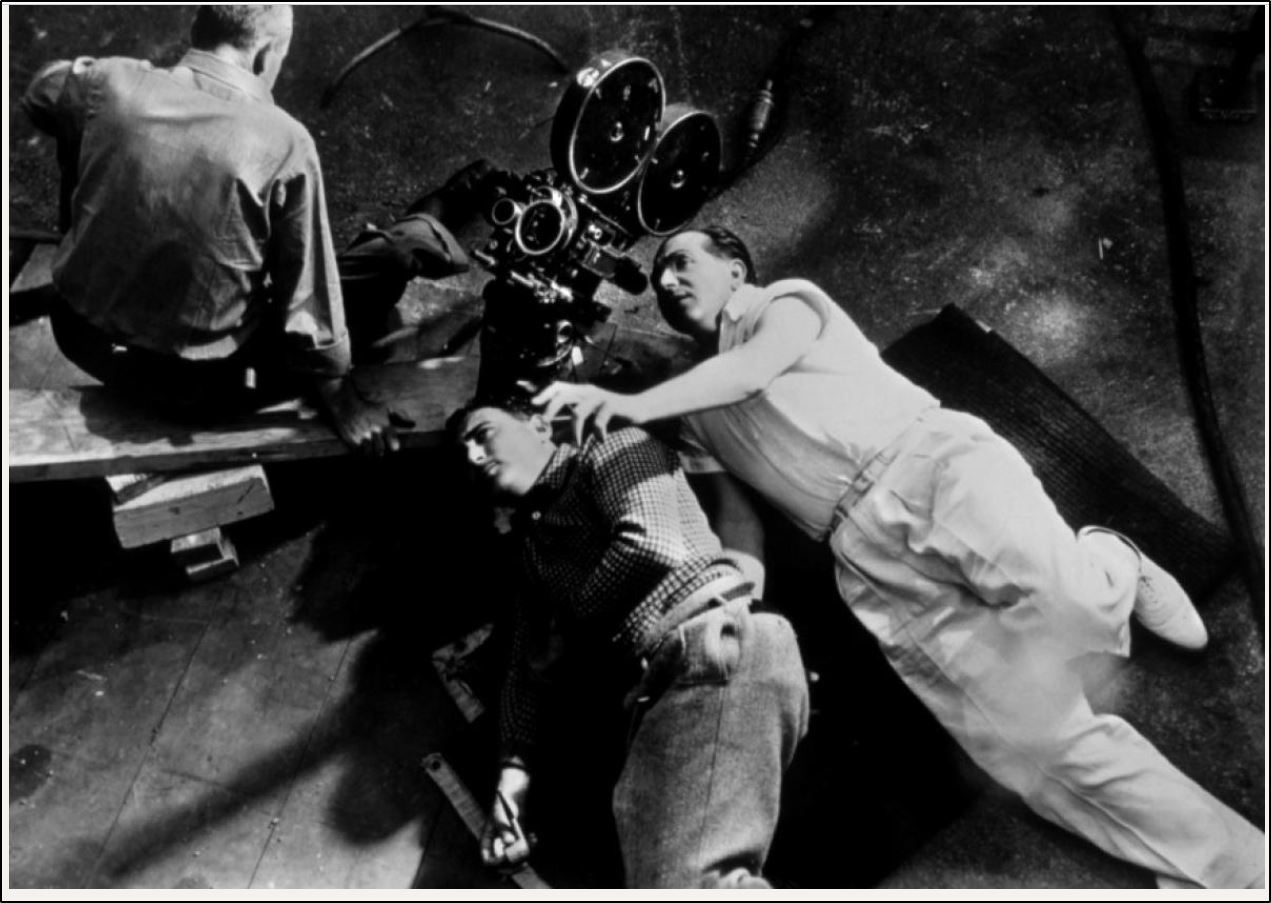
«But who was that Fritz Lang;». This is one of the questions young film lovers ask when they come across the name of the genius Austrian director, as a reference point in contemporary cinema, in films of all kinds, which are still being made today.
Fritz Lang, a key spokesman for German expressionism in cinema, along with Friedrich Wilhelm Murnau, he was one of the leading directors, who worked for many years, especially in his German era, and left his indelible imprint on 7th Art, creating an unsurpassed school.
Expressionism in cinema
The film movement of German expressionism will have, as long as there are people, the madness of power, the manipulation of the crowd, the ideologies of hate. This is because it is not just a cinematic style, a technique, but a deep look at the history of Europe, stemming from the coming of Hitler to Germany, the macabre, the ominous, combined with surrealism.
Its basic characteristics, as shaped by Lang-Mournau, can be summarized in the distorted sets, the imbalance, the latent perspective, the intense shadows, the information-laden shots, with the details having their value and signifying the mental instability or the anguish of the protagonist.
The golden period
Fritz Lang was born 130 years ago in Vienna (December 5, 1890). He studied civil engineering, but quickly turned to painting. For five years (1910-1914) he travelled in Europe, Asia and North Africa, and with the outbreak of the World War I returned to Vienna to join the army. In 1916 he was seriously wounded and during his recovery he began to write screenplays.
After overcoming health problems and nervous disorders from the bombings, he would work briefly as an actor, then as a screenwriter, before eventually turning to directing and working with companies such as “UFA” and the “Nero Film”, without, however, leaving scriptwriting.
With the actress Thea von Harbu wrote some of the most iconic scripts of his career, including “Dr. Mabuse der Spieler” (1922), “Die Nibelungen” (1924), “Die Iππότες της Ομίχλης” (1924), “Metropolis” (1927), and “M” (1931).
It is the golden period for him and his work, as he will magnificently bring out the criminal nature, the destiny, the dark depths of humanity, but also prophesy the hideous future of Nazism, fascism, and even all those who will exhaust the limits of power, madness, and hatred.
Escaping from the “embrace” of Goebbels
He and Tea von Harbou would marry in 1922 and divorce in 1933. The year that Third Reich will ban the screening of his film “Testament des Dr. Mabuse”, but at the same time Josef Goebbels will offer him the position of director of the German Film Institute, the heart of the German film industry.
Fascinated by the power of Lang's films, the grandeur of the images and the futuristic style, the Nazi propaganda chief had a problem only with the messages and themes of his films, believing that these could be corrected, like the imperfections of the human species.... Of course, Lang refused and had no choice but to flee to Paris and a year later arrive in USA.
The American period
In 1936, in the Hollywood By now, he would sign a contract with MGM and over the next 20 years he would direct several films, including the excellent noir films “The Human Beast” (1954), starring Glenn Ford and Gloria Graham, “The Great Burn” (1953) with the same leading duo, “The Tracks Were False” (1956) with Jane Fontaine and Dana Andrews, “Nemesis” (1936) with Spencer Tracy, “While the City Sleeps” (1956) with Dana Andrews, Vincent Price, Ida Lupino, George Sanders, “The Blue Gardenia” (1954) with Anne Baxter, Richard Conte. Also, exciting erotic dramas such as “The Bitch” (1945) with Joan Bennett and Edward J. Robinson, “The Showcase Woman” (1944), again with Bennett and Robinson, and spy films against Nazism, most notably “Love in the Shadow of Fear” (1944), with Ray Milland and Marjorie Reynolds, “And Executioners Die” (1943), with Anna Lee, Brian Donlev, Walter Brennan and “Manhunt” (1941), with Walter Pidgeon, Joan Bennett, George Sanders and John Carradine.
But he would also make brilliant romantic adventures, such as “The Tomb of the Indian” (1959), “The Queen of Baghdad” (1959), “Siren of Cabaret” (1952) with Marlene Didrich, etc., as well as westerns, most famously “Bloody Dawn”, with Randolph Scott.
The inglorious end
In 1963 he would play a typical role, having a great deal of fun playing essentially... himself, in his famous film Jean-Luc Godard “Contempt” next to Michel Piccoli and Brigitte Bardot. The following year, he will be almost blind as president of the Cannes Film Festival. The perfectionist and difficult character no longer needed his eyes. The cinema had now penetrated every part of his body. From the skin, to the nerves, to the arteries and straight to the brain and heart.
He would die quietly in California in 1976 of a stroke and was buried in Hollywood Hills, with no special honors. It would be some years before his contribution was recognized, especially by the famous Cahiers du cinéma and them François Trifo and Jacques Rivette. If it weren't true it would still be a black, bitter comedy...