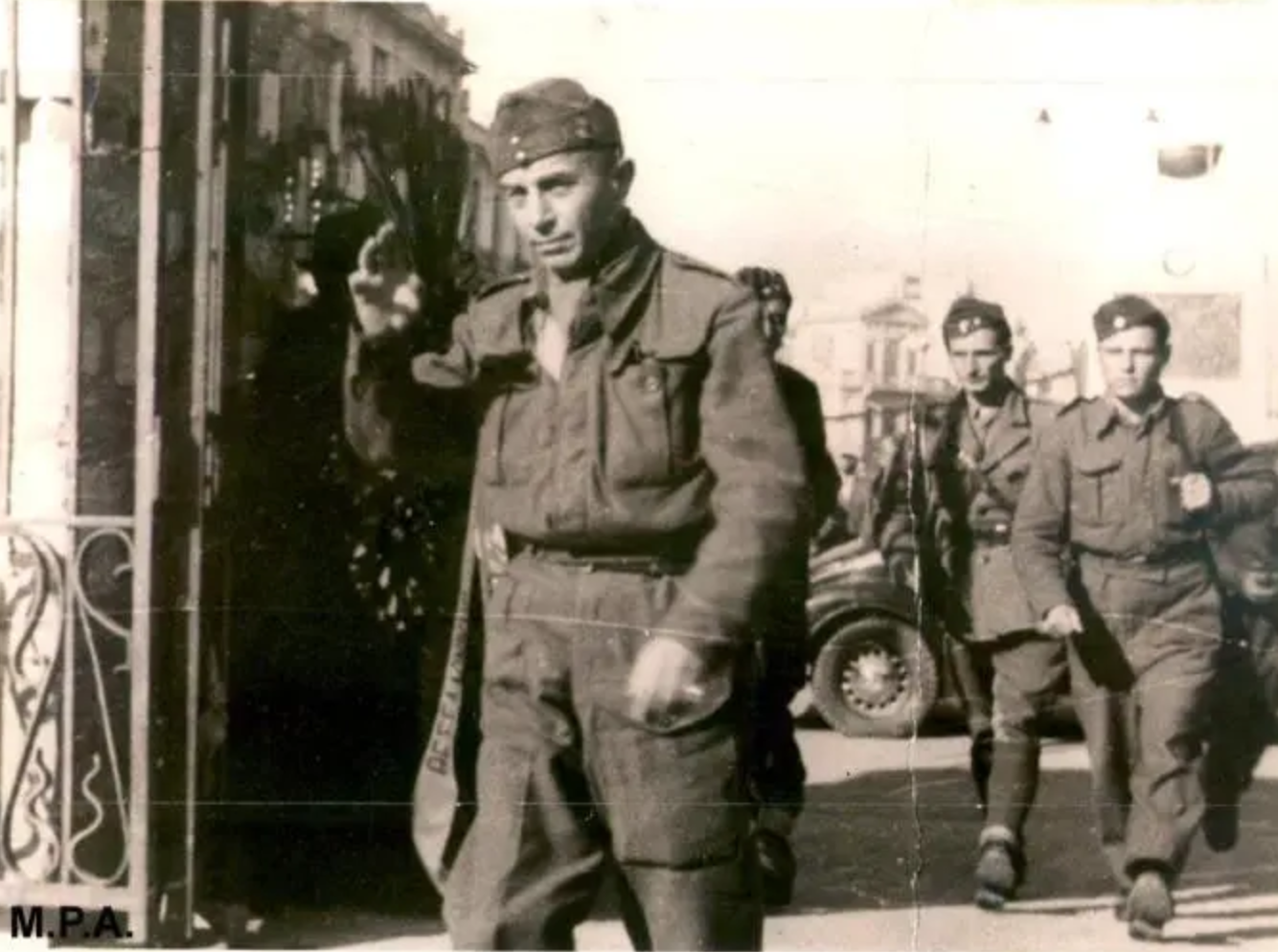
Today marks the 128th anniversary of the birth of Euripides Bakirtzis, the first chairman of the Political Committee for National Liberation of the «government of the mountains» during the years of the occupation—the officer who participated in all the major moments of modern Greek history, most notably the National Resistance against the Nazi occupiers. We will trace the career of this officer, who had «a life dedicated to the Greek people,» as the newspaper *Rizospastis* wrote on May 11, 1947, we will trace in this article, with particular emphasis on his role in the liberation of Thessaloniki and the entry of the ELAS, despite the conflicting provisions of the Caserta Agreement, as well as the circumstances under which he passed away in May 1947 in Fournoi, Ikaria, where he had been exiled by the civil war regime.
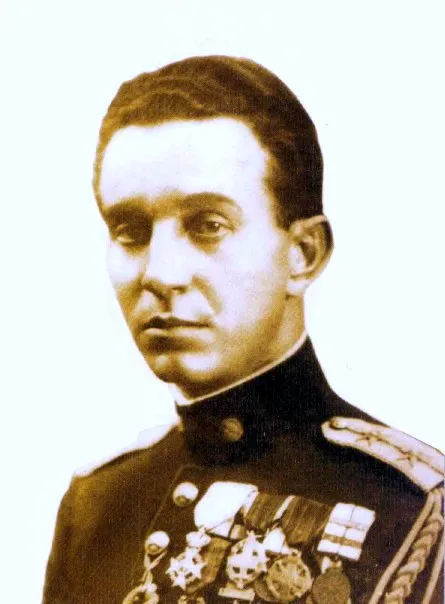
Euripides Bakirtzis was born in Serres in 1895. He attended the Military Academy and took part in the Balkan Wars of 1912–1913. In 1916, he joined the «National Defense» movement in Thessaloniki and took part in the battles fought by the Entente forces on the Macedonian Front. In 1918, he went to Paris to study at the École Supérieure de Guerre. Upon his return, he took part in the campaign in Asia Minor, and in September 1922, following the defeat, he participated—now as a major—in the Plastiras-Gonatas movement, serving as Plastiras’s aide-de-camp and secretary of the Revolutionary Committee. From then until 1935, he followed Plastiras in all his activities.
In 1923, he played a significant role in suppressing the pro-monarchist Gargalidis–Leonardopoulos movement in the Thessaloniki area.
Three years later, in 1926, he took part in the movement led by Nikolaos Plastiras, which went down in history as the «Tzavela-Bakirtzis movement.» He was sentenced to death but not executed, and he returned to the army in 1928. From 1930 to 1931, he served as a military attaché in Sofia and Bucharest, and in 1935, now a colonel, he took part in the failed Venizelos-Plastiras uprising. He was defrocked and exiled, first to Agios Efstratios and then to Antikythira.
The Legend of the «Red Colonel»
Prompted by the publication in *Rizospastis* in the 1930s, notes indicating that their authors had a very good understanding of what was happening within the army, a rumor began to circulate in several circles which persisted for many years, of the «red colonel»—and indeed that Euripides Bakirtzis was the man behind this nickname. Even today, there are quite a few people who, when referring to the ’Red Colonel,« mean Bakirtzis.
Even today, many readily attribute the anonymous letter signed ’anti-fascist officer« that was published in *Rizospastis* on February 26, 1935. The author of the letter revealed that a military coup was being planned, organized by Colonel St. Sarafis, retired General K. Vlachos, and Captain A. Kolialexis.
Let’s take things in order, starting with the letter to *Rizospastis* in February 1936. The author could not have been Bakirtzis for the very simple reason that he, commander of the Kavala garrison at the time, was one of the key figures in that coup d’état organized by Venizelos from Chania and by Plastiras from France, and
broke out on the 1stη in March 1936, a few days after the article appeared in *Rizospastis*. The letter was written by Navy officer Papazoglou, who was affiliated with the Communist Party of Greece (KKE) at the time.
As for Bakirtzis, following the failure of the Venizelist-Plastas coup, he fled to Bulgaria, along with General Kammenos and other officers. He returned from Bulgaria after the coup plotters were granted amnesty.
The Attack on Plastiras
One year later, on July 3, 1936, the newspaper *Anexartitos* published an article by Bakirtzis titled «Response to General Nikolaos Plastiras.» A few days earlier, a letter from Plastiras had been published from Beirut, where he had taken refuge; in it, he advocated the idea of a personal dictatorship and called on the Greeks to rally around him.
In his response, Bakirtzis—apparently influenced by the formation of the Popular Front in France at that time— openly labeled Plastiras a fascist, while at the same time presenting a series of ideas that revealed the influence of Marxist theory on him. ’Only «class dictatorships» exist,« he noted, adding that the key to history is the class struggle and that only »class dictatorships” had ever existed:
«…either as a political manifestation of the oppressed, who, following decisive political struggles, become aware of their situation and fight to radically change the political and social order and prepare the conditions for socialist society, or as a violent reaction by the ruling clique against the rise of the worker-peasant class.».
He also classified Plastiras as a representative of Hitlerism as part of the «violent reaction of the ruling clique.».
Bakirtzis even went so far as to openly support the dictatorship of the proletariat:
«…the dictatorship of the proletariat is a progressive force in history. Because it tears down and builds up. Because it abolishes old institutions and creates new ones. Because it is the indignant voice of history…».
And while he rejected Plastiras’s position on «reconciliation of the Greek people» as an attempt to reconcile the old Venizelists and the royalists, he noted that if there was a political crisis at the time, it was because «…the working people have not yet awakened to demand a more just distribution of the national wealth, while at the same time preparing to take over the governance of the country (…)The conditions for the worker-peasant class to seize power have not yet ripened…».
At the end of the article, he called on Plastiras to reconsider his «political beliefs» and to join him in the struggle to create a left-wing front similar to the Popular Front in France.
It is a fact, as Yiannis Kordatos notes, that Bakirtzis, in the 1920s, had come into contact with Marxist literature through the historian with whom he had a friendly relationship.

However, there is no evidence to suggest that he had any contact with the groups of officers sympathetic to the KKE that had existed since the early 1930s and remained active until 1941, after which their members joined the Hellenic Police (ELAS); one such group, for example, was the ’Friends of the People,« led by Captains V. Venetsanopoulos, I. Palaska, G. Samaridis, G. Kalianesis, N. Koukoura, I. Pantelakis, I. Timogiannakis, and others.
In 1937, Bakirtzis moved to Athens from Antikythira, where he had been in exile. Officials of the Metaxas regime suggested that he collaborate with them, but he refused. They allowed him to leave the country and go to Bucharest, where he remained until the declaration of war in 1940–41. He then returned to Greece and asked to enlist as a private to fight the Italians. However, his request was denied.
In December 1940, Bakirtzis met with the writer Giorgos Theotokas and Giorgos Kartalis—who would later become the leader of the EKKA organization—along with Colonel Psarros. In his «Diary Notebooks» (entry dated December 18, 1940), Theotokas writes about the impression Bakirtzis made on him:
«… That evening with Kartalis, I met the famous Euripides Bakirtzis for the first time. I was very curious to meet him, but I didn’t find in him the combative and opportunistic demeanor I had expected. He is more reminiscent of the Educational Society, the progressive educators of 1925…’.
The Period of Occupation
After the Germans entered Greece in late summer 1941, a representative of the KKE leadership met with Colonels Bakirtzis and Sarafis. Petros Roussos, one of the leading figures of the KKE during the Occupation and the Civil War, wrote about this meeting:
«We were unable to make immediate contact with Euripides Bakirtzis, who in certain circles was known by the nickname «the Red Colonel.» He was familiar with Marxist ideology.
Late in the summer, a representative of the Communist Party of Greece (KKE) met with both Colonel Bakirtzis and Colonel Stefanos Sarafis, another defector from the Venizelist movement of 1935. And nothing practical came of the meeting on the part of those two well-known and capable officers. We later learned that both were preparing to organize forces under the influence of one or another of the Venizelist parties (Sofoulis, etc.). The organization in question was the AAA (Three Alpha). Bakirtzis had a reputation as a highly educated and capable artillery officer, well-versed in socialist theory, but he was characterized by indecisiveness. At the time, he was one of the organizers of the «Prometheus» espionage group, which was linked to British intelligence and the government in Cairo. It was reported that his ambitions within the progressive movement exceeded his actual political abilities. This did not prevent him, as events unfolded, in 1944, from assuming the presidency of the Political Committee of National Liberation, the highest body of provisional authority in the areas liberated by the EAM and ELAS, in its first composition…».
After the formation of the «Prometheus» organization, Bakirtzis left in August 1942 for Cairo, where he remained until September 1943, when he returned to Greece. This was followed by his joining Colonel Psarros’s EKKA and the organization A (Gon) A (Northosis) A (Peleftherosis) with Stefanos Sarafis; and finally, faced with the dead ends he saw in the path of these organizations, he aligned himself with the EAM and assumed the presidency of the first Political Committee for National Liberation (PEEA) in March 1944 (Saraphis’s trajectory was similar, as is well known).
The Dirty Deal Between the British and the Nazis Over Thessaloniki
During the days of Greece’s liberation from the Nazis, Bakirtzis served as commander of the Hellenic Police’s Macedonia Division, with the division’s captain, Markos Vafeiadis, at his side, and Leonidas Strigos, the KKE Political Bureau’s representative for the region.
For the British, Thessaloniki was a crucial hub for implementing their policy in the Balkans and maintaining control over Greece. As revealed in a 1976 interview with journalist Vassos Mathiopoulos, Hitler’s Minister of Armaments, Albert Speer, the British and the Nazis had agreed during secret talks held in Lisbon on the terms of the German withdrawal from Macedonia. Speer, citing what the Chief of the German General Staff, General Jodl, had told him, informed Mathiopoulos that, under the agreement, the British would assist in the evacuation of Greece from Nazi troops without harassing them, in exchange for the unopposed occupation of Thessaloniki by British troops, before ELAS forces could enter the city. And the British honored the agreement, allowing the Nazis to withdraw unhindered:
«The news of this strange «gentlemen’s agreement» between London and Berlin came as a surprise to those who heard about it,’ Speer said. And, indeed, the British honored it. German warships and transport vessels loaded troops from the Greek islands—which they had evacuated—and sailed on, in the fall of 1944, unhindered right under the British noses and right through the British submarines in the Aegean and the Mediterranean. The price of the agreement, in my opinion, was for the Germans to hand over Thessaloniki to the British without a fight, thereby bringing Greece into the Western camp. And, of course, Hitler would keep his own forces, which occupied Greek territory, intact.».
Not only that, but the British, by personal order of General Scobie, issued to the military commander of ELAS, Stefanos Sarafis, on November 4, 1944, prohibited ELAS from continuing operations outside Greek borders in pursuit of the retreating Nazis.
The violation of the Caserta Agreement
and the liberation of Thessaloniki
On September 7, 1944, the General Staff of the ELAS, by order of General Sarafis to the Macedonian Division Group, directed its forces to prepare for the capture of Thessaloniki: ’…The main body of the Group’s forces must be directed toward the plain and the city of Thessaloniki. Thereafter, the Group’s command must establish immediate contact with the Thessaloniki Hellenic Police (ELAS) command in order to draw up a joint plan for the capture of that city.«.
On September 26, the agreement of the same name was signed in Caserta. Unlike Athens, for which the ban on the entry of the ELAS was clear, the relevant article regarding the fate of Thessaloniki was vague: «Subsequently, Thrace (including Thessaloniki) will be under the administration of an officer to be appointed by the Greek Government.».
This was followed by an order from Scobie, implementing the agreement that prohibited ELAS forces from entering the zone between the Axios and Strymon rivers, which included Thessaloniki. With this order, the city was effectively handed over to the collaborationist organizations, which had rushed to don the uniforms of EDES (approximately 5,000 to 6,000 armed men) and the rural police.
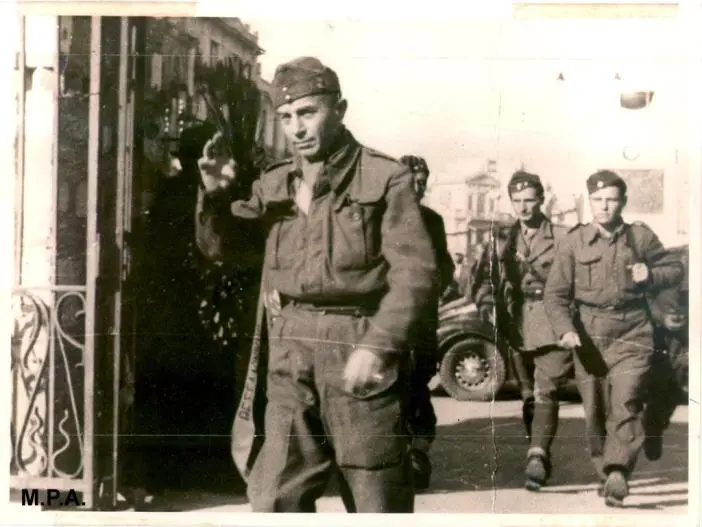
In an order issued by the General Staff of the ELAS to the Macedonia Division Group on October 18, 1944, a few days before the Germans withdrew from Thessaloniki, it is stated that «following prior consultation with the Metropolitan and the mayor of Thessaloniki, units of the XI (ed. ELAS Division) entered the city as soon as it was abandoned by the Germans.» However, the same order explicitly stated: «… Kazerta’s decisions are to be applied to all…».
Despite Scobie’s orders, and the remarks from the General Staff of the ELAS demanding explanations (which were merely formal and, one might say, intended «for public consumption»), the leadership of the ELAS and the KKE in Macedonia continued to direct the ELAS divisions (X and XI) toward Thessaloniki and their crossing east of the Axios River. In fact, to circumvent the ban on crossing the Axios River, in accordance with the commitments of the Caserta Agreement, sections of the ELAS were transported by sea from Chalkidiki to the Thessaloniki area. On October 26, 27, 28, and 29, they struck the retreating Germans, and on the 30th of the month, the 19th entered the City.ο Constitution of the Hellenic Police.
On the day of liberation, a delegation from the Higher Command of the Macedonian Gendarmerie appeared at the building of the Third Army Corps, where the Macedonian Divisional Group had established its headquartersand demanded that authority be handed over to them, citing the Caserta Agreement and Scobie’s orders. The response was that the Gendarmerie was being disbanded due to its collaboration with the occupiers. In fact, the gendarmes were given a one-hour deadline to surrender; otherwise, the Hellenic Police (ELAS) would attack them. At the same time, ELAS units surrounded the YMCA building where the rural police had barricaded themselves. Representatives of the Higher Gendarmerie Command refused to surrender, but the Hellenic Police entered the building, disarmed the gendarmes, and confined them to a military camp.
After all this, all authority in the city passed to the EAM and ELAS, and Georgios Modis, the General Commander appointed by Papandreou, was confined to playing a purely ceremonial role, shut away at the «Mediterranean» hotel. One day later, the first British detachment arrived in Thessaloniki and set up camp in the eastern part of the city.
The liberation of Thessaloniki, the dynamic capture of the city—which effectively violated the Caserta Agreement—was an exception to the rule followed by the leadership of the resistance movement in the rest of the country. This occupation was planned by Leonidas Strigos, General Bakirtzis, and Markos Vafeiadis.
«The circumstances surrounding the death are suspicious.»
In September 1946, Euripides Bakirtzis was exiled to Ikaria, first to Agios Kirykos and then to Fournoi, along with other high-ranking officers of the ELAS. There he began writing his book, which remained unfinished, titled «The Political and Military Significance of the Eastern Mediterranean.» Before the UN Commission of Inquiry that visited the island, he accused the local population and the British of being responsible for the Civil War.
On the evening of Friday, May 9, 1947, the Central Committee of the EAM received a telegram from Gerasimos Stefanatos, the representative of the exiles in Ikaria, which stated:
«Early this Friday morning, General Bakirtzis was found dead with a wound to the heart inside his room in Fournoi, Ikaria. The circumstances surrounding his death are suspicious. The commander of the Ikaria Gendarmerie refused to allow the exiles’ doctor and a committee of exiles to go to the scene to ascertain the circumstances under whichthe death occurred. We requested that the body be transported to Athens and that the Samos District Attorney arrive to conduct an investigation.
For the Exiles of Ikaria
»Gerasimos Stefanatos.".

From the very beginning, the Civil War government was quick to attribute Bakirtzis’s death to suicide. However, from the very beginning, significant questions arose that remain unanswered to this day for the simple reason that the authorities of the Civil War regime refused to allow any substantive investigation, conducted everything «in secret,» and rushed to cover up the case, hastily burying the Resistance general.
Bakirtzis, who lived on the upper floor of a small house, was in a good mood that day and was getting ready for his daily walk with his fellow exiles. One of them said of that day: «We saw Euripides on the balcony in his shirt. He’d cut himself while shaving, which is why he was late. He told us he was coming down. Shortly afterward, a gunshot rang out. We ran upstairs and saw the general lying on the bed with a wound to his chest. The pistol that killed him was lying next to him, but we didn’t see any blood on the white shirt or any smoke.’.
The Unanswered Questions
So, the first question is: How was the revolver found, given that the rural police conducted continuous, daily, and thorough searches of the exiles? Another fellow exile who was constantly by his side reported: «I knew the general and often helped him pack his bags, so I know perhaps better than anyone else. Euripides did not have a pistol.».
Second question: How is it that a strong-willed soldier—who is even preparing a paper that he constantly discusses with his fellow exiles, and has asked his relatives to send him relevant books, suddenly turn up dead, just as he is getting ready to go for a walk with the other exiles on the island?;
The report by the *Rizospastis* correspondent on the island also states the following: «The body remained in the same spot until the authorities arrived (the police Commander of Ikaria and, later, the justice of the peace and two exiled officers). The Samos district attorney, although notified by telegram by the exiles, did not go. The bullet was found beneath the general’s body. The wound was a through-and-through shot to the heart and caused instant death. The bullet casing was not found. An examination of the fingerprints that would have been on the pistol could have greatly aided the investigators» work. But the necessary measures were not taken. The police officers were grabbing people and frisking them.
»Usually, people who commit suicide leave a note. They explain their actions and the reasons behind them. No note from Bakirtzis was found."
Third question: Why wasn’t a thorough investigation (including a forensic one) conducted, even after the body was hastily buried? Under pressure from Bakirtzis’s relatives and resistance organizations, the authorities finally sent a commission, and—for the sake of appearances—fourofficers who had been exiled alongside Bakirtzis were invited to observe its work for public appearances. However, all of this took place after they had already rushed to bury Bakirtzis.
The only concession the prosecuting authorities made was to allow the exhumation of his remains and their transfer for burial in his hometown, with only his relatives in attendance.
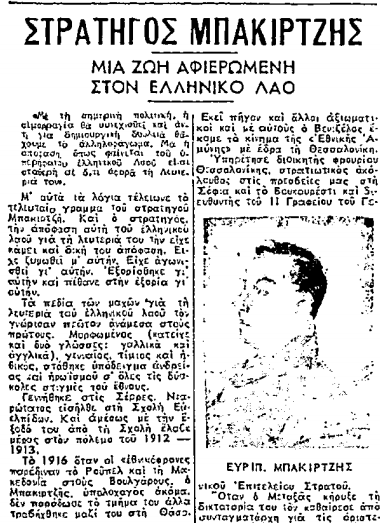
The lawsuit filed against persons unknown regarding the death of Bakirtzis by his sister, Maria Dimitriou, also came to nothing and went unanswered. In the telegram she sent to Minister of Justice Apostolos Alexandris, she stated:
«The version of events regarding the suicide of my brother, General Bakirtzis, who was exiled to Fournoi on Ikaria, which was indefinitely endorsed by the official communiqué of the Minister of Public Order, is completely implausible, given the absence of any reason whatsoever for it.”.
I am certain that he was murdered by his political opponents. The secretive and irregular manner in which it was carried out, according to journalistic reports, the police investigation, attests to an effort by government authorities to conceal the truth and prevent their responsibility from coming to light. By filing this complaint against persons unknown, I believe that, in order to fully clarify the matter, a comprehensive investigation must be ordered, during which my brother’s fellow exiles will be examined, and that a medical examiner be sent immediately from Athens to perform an autopsy in the presence of any exiled physician; and I hereby declare that I intend to appear as a civil plaintiff for emotional distress.’.
That, in a nutshell, was the life of an officer who, at one of the defining moments in the history of this country, chose a side. That of the people…