By Tonia A. Maniatea
«The story not only touches the tongue, but also intersects it...» wrote the Jewish-born German philosopher Theodor W. Adorno in the middle of the last century, at a time when humanity and history were blushing with anger and shame at the atrocities of the Nazis. Adorno himself proclaimed that language is easily transformed from an instrument of political diplomacy into a murderous tool in the hands, or rather, in the mouths of its users. His later, also Jewish-born, French-American philosopher Georg Steiner was more precise in trying to answer the question «how words can lose their human meaning under the pressure of political brutality and lies» and finding the language falling away, because «Nazism drew from it exactly what it needed to give expression to its savagery» he concluded: «When you use a language to plan, organise and justify Belsen, to draw up specifications of the gas chambers, to destroy humanity in twelve years of deliberate brutality, something bad will happen to that language.».
The language, then. This tool that caresses and speaks, the «namesteos that bone thlattei», as Solon used to say. In its modern history, Greece too has experienced the instrumentalisation and abuse of its language. Possessing an already weighted... infrastructure of bilingualism (the long dispute between the Katharevousa and the Demotic, the «language issue»), which from the very first year of the 20th century. and for many years afterwards, the expressive tool of the people also falls under the «clutches» of two dictatorships, which use it at will in the name of both a Christian Orthodox ideology, serving the doctrine of «order and morality», and the obsessive persecution of dissident communists who... «undermine» this very «venerable» character.
Just four months after the imposition of the Metaxas regime, on 4 August 1936, the Minister of Education, K. Georgakopoulos, issued a circular in which he characterized the previous educational reforms as an attempt to prepare for the communist invasion: «... Incompetent people tried to undermine religion, the homeland and the family [...] they presented their disintegrative effort as “educational reform” [...] the school was not infrequently used as a means of preparing for communist imposition.»! Indeed, in the form «Education after the 4th of August», circulated by the regime in 1937, it is stated that «August 4, 1936 found education under the unrelentingly growing influence of the red organs of communism.» and how «for many years, the educational directions were given by the deputy leader of the communist party» (he means the demoticist Demetrios Glinos, pioneer of the famous «language and education reform»).
Possessed by a logic that «the bouzouki is an instrument, the policeman is an instrument, therefore the policeman is a bouzouki», Metaxas is convinced that the school, where the educational reforms of ’17 and '29 establish and strengthen the demotic, encourages the communist presence. But because he himself is a defender of the demotic, he does not intend to ... cede it to the communists. He must detach it from them and tie it to the chariot of national duty...
«The accident is that the ruling class up to the present day has been willing to confuse demoticism, which is a purely national movement, with communism. This confusion is no longer allowed, because it benefits only the communists.» he states in an interview on 15 September 1936, in the newspaper «Vradini», attempting to take on his side intellectuals of the 1930s generation, such as Triantafyllidis, Venezis and Myrivilis, who were distinguished for their progressive ideas on the language issue and their contribution to the cultural life of the country. In the end, he will be able to enjoy their collaboration in writing educational-pedagogical books, as they (and some 20 other demoticists), devoutly devoted to the goal of establishing the demotic, have not in fact understood the social and political causes that ’water the roots« of conservatism in the country.
However, with this and that, the Metaxas period passes painlessly for the very structure of language. The dictator turns it into a vehicle for fascist propaganda, but does not alter it.
THE DICTATORSHIP OF '67 - THE SEVEN-YEAR PAINFUL ADVENTURE OF THE GREEK LANGUAGE
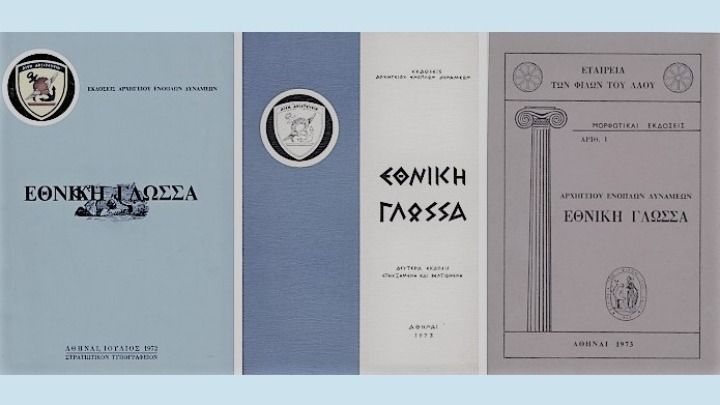
The era of its outrageous abuse will dawn with the junta of the colonels, which will even proceed to distribute a publication under the title «National Language», the publication of which is «signed» by the Ministry of the Armed Forces, and where demotic is characterized as «idiom of the Greeks abroad (implies the demotic linguist Yannis Psicharis, who has developed a rich scientific activity in France and Germany) and the communists»! The anonymous author of the text states the «non-negotiable rule» that the national language should be linked to the nation's past and understood by the people, who should make a lifelong effort to understand it...
The content of the multi-page publication, which will be released «improved» in more than two editions, revolves around the «superiority of the Katharevousa over the demotic», while an effort is made to remove, as unfounded, the arguments of the demoticists. The Greeks need to identify the elements that had made Greece great and to regenerate themselves, says the author of the text, who finds these elements in ancient Greek culture and in the katharevousa, which is the continuity of the ancient Greek language and therefore guarantees the continuity of the nation. «If Socrates had breathed a sigh of relief, he would have understood our language» says.
The author's view is elitist and narcissistic. The text as a whole is dominated by a mood of comparison between the «highest» katharevousa and the «lowest» demotic. And the admonition that the people should strive to understand the language is not accidental, because these people are treated contemptuously as illiterate, «incapable of understanding any measure aimed at defending the language and creating new words». The «illiterate» people are even accused of misusing words because of their profound ignorance.
In general, the publication «National Language», which is a monument to the insult of the Greek people and which the author sensibly avoids signing, is the attempt of the colonels to reverse the outcome of a game they see being lost, attempting to keep a balance between their hated demotic and their beloved katharevoussa, which they have also taken care to abuse.
[The question of who is the author of the publication will never be answered. In one version it is the Chief of the Armed Forces, Odysseus Angelis, the so-called and «academic» for the sake of the special education he is said to have. In another version, he is a university man, as the text contains linguistic examples, rules and exceptions, as well as valid points about the gaps in the demotic language. In addition, names of writers, their works and scholars are given, which could only be attributed to a deep knowledge of the field].
Like a number of totalitarian regimes, dressed up in the mantle of protecting and promoting the national good, the Seven Years is no exception, this particular decline of the traditional Greek bourgeois state, on the subject of language, he throws one on the nail and one on the horseshoe. Her speech - written and spoken - is a caricature of Katharevousa, a degrading hybrid of Greek, full of slang and grammatical inadequacies, but she does not dare to give it official status. The Constitution of 15 November 1968, published in Official Gazette No 267, Article 6, does not precisely define the language: «The official language of the State and of education is that in which the Constitution and the texts of Greek legislation are written.». The reason why the demotic is not... displaced and legislated into the fire is the already known from the previous dictatorship: the fear that its renunciation by the «official state» will mean its cession to the... red danger. «Should we leave it to communism, should we give it to them?;» The question of the Minister of Education, Th. Papaconstantinou.
The regime knows that since the 1964 educational reform, which formalised the teaching of demotic, the time required for it to become entrenched in the consciousness of the people has passed. Moreover, however «diligently» they may have tried to communicate the «sacred goal of the revolution to protect the nation from the communist threat», the Aprilists are well aware that in reality they have no foothold in the popular base and such a direct deep cut into the people's communication tool will not serve their popularity. Finally, several people believe that Papadopoulos is obviously trying to reach out to expatriates abroad, whom he considers it reasonable that they do not speak Greek well. Thus, in difficult periods when he invokes the defining characteristics of national identity, such as national consciousness and religion, he avoids reference to language.
For the time being, however, the Aprilists are content with the messages sent by the «fiery» statements of President Papadopoulos in... fluent «clear»: «The country was going through a crisis, looking for a way out of a political axe-axe into which it had entered [...] None of the political leaders took it upon themselves to help the supreme ruler who was seeking a solution within the constitutional framework of his irresponsibility (!) in order to get the country out of the deadlock.»...
They are trying, by turning the hybrid of katharevousa, which they themselves use in their daily appearances, into a Trojan horse, to «capture» the field of demotic, in which, however, they are forced to offer some concessions in order to get along with everyone... So, while with the A.N. (Compulsory Law) 129/1967 («General Education provides education on the basis of the ideals of the Greek-Christian culture...»), the demotic language is restricted to the first three grades of primary school and the Katharevousa language is reintroduced in the remaining grades of primary school, in secondary school, in pedagogical academies and in all higher schools in general, as «an organ of expression, both written and oral, of teachers and students», in 1970, with the Law 651 (Legislative Decree) the teaching of Demotic is extended to one more class of the primary school and in 1971 to the whole primary school. In addition, in order to support the national economy, the junta turns to technical and vocational education, establishing schools where demotic is gaining ground due to the origin of students from low-income classes.
[It is noted that A.L. 129/1967 was warmly welcomed by the university professor G. Kourmoulis, president of the Society of Greek Philologists, who in the 26th general assembly of the society states: «The reform of 1964 brought chaos and confusion, introducing the overthrow of the Greek name in a direct, fanatical, hasty, unsuccessful manner and spreading anxiety, surprise and terror among teachers and all Greeks. Fortunately, in 1967 a new wind blew and Greek Education was restored on a sound basis.»].
Meanwhile, the creepy chord of the fascist vocal metal of the «arch-enemy» continues its... dissonances...
(From the speech of G. Papadopoulos) «The Greeks, both by historical tradition and by basic understanding and education, are never susceptible to communism, because communism can have nothing in common with Greek Christianity, which is the basis of the education of the Greeks along the path of their history...»!
(Greece already five years in the «plaster» - from a speech by G. Papadopoulos in the Parliament) «We enjoy the good of peaceful, peaceful and orderly social coexistence. Each Hellene is developing his activities in which, in addition to these indicators, I will give basic achievements and some indicators of prosperity so that we all realize at this level what we are living as a result of our efforts of recent years...»!
The truth is that the promotion of the idea of the direct connection of modern Greeks with the ancient Greek world had already taken place within the intellectual universe of the Greek Enlightenment. Language, as a pillar of national identity, has been travelling since antiquity and the katharevousa holds firmly the mite of ancient Greek. But with the dawn of the 20th century, the climate is ideal for the overthrow of archaism. The social and intellectual ferment after the unfortunate outcome of the war of 1897 and the obvious symptoms of national decline, favour the search for innovations. The Goudi Revolution (1909) paved the way for Venizelos, the Balkan Wars (1912-13) and World War I (1914-18) led to the expansion of the borders of the state, which now included many non-Greek-speaking populations. The new facts give rise to the need for a simple linguistic tool to evolve them. Demoticism flourishes, archaism loses ground. Translations from ancient or foreign texts are attempted. The attempt to render the Gospels (Evangelica, 1901) and ancient dramas (Oresteia, 1903) into demotic meets with angry opposition, and associations of demoticists are founded, seeking to introduce demotic into education. And just when everything seems to be on the road to freshness and renewal, nostalgics for the... glorious past put on the brakes (Metaxas) and even worse, regress (the Seven Years) to an era of conservatism and decay, putting the country and the language in a cast. The junta of the colonels is remembered as the period in which crimes were committed against language. Such was the expressive castration, such was the verbal confusion, such was the uncritical and frivolous use of language, that its abuse reached the point of undermining even its very structure.
SOURCES OF INFORMATION AND PHOTOS
THE DEBATE ON WRITTEN NEW GREEK LANGUAGE - A brief history of the language issue, Gunnar Hering (University Publications of Crete - Heraklion, 2020)
METAXAS' DICTATORSHIP AND THE WAR OF '40, Ioannis S. Koliopoulos (PARATIRITIS - Thessaloniki, 1996)
THE BIRTH OF NEOPHASISTSHIP IN GREECE 1960-1974, Yannis Katris (PAPAZISISIS Publishers - Athens, 1974)
LANGUAGE AND LIFE - An analytical study of the linguistic question, Eliss Yanidis (Kalvos Publishers - Athens, 1974)
THE REPUDIATED DECLARATIONS OF GEORGIO PAPADOPOULOS, C. Leontaritis (ELEFTHERI ORA - Athens, 2012)
The reform that did not happen, ed. Al. Demaras - Historical Documents B 1895-1967 (ESTIA Publishers - Athens, 1987)
AMPHISBISHMENT, Dem. Tsatsos (Gavrielidis Publishers - Athens, 1993)
HELLENIC TRAGONY - FROM LIBERATION TO SYNTAGATORS, K. Tsoukalas (Patakis Publishers - Athens, 2020)
Official Gazette of the Government, Articles 267, 235
The municipal language and the junta of the colonels M. Bodila (bookpress.gr)
The transition from katharevousa to demotic for the legal language: efforts, obstacles, results, K. Vadasi - K.Th. Frantzi (Nomiko Vima, vol. 70)
Constitutional History, Parliament of the Hellenes
GREEK LANGUAGE III - NEW GREEK (General, The language issue, Modern Greek vocabulary, Modern Greek dialectology), M. Margariti-Roga, D. Kyriazis, N. Liosis, C. N.L., N.Lorios, N.Lorios, N.G., N. Papanastasiou (University Publications - Thessaloniki 2016)