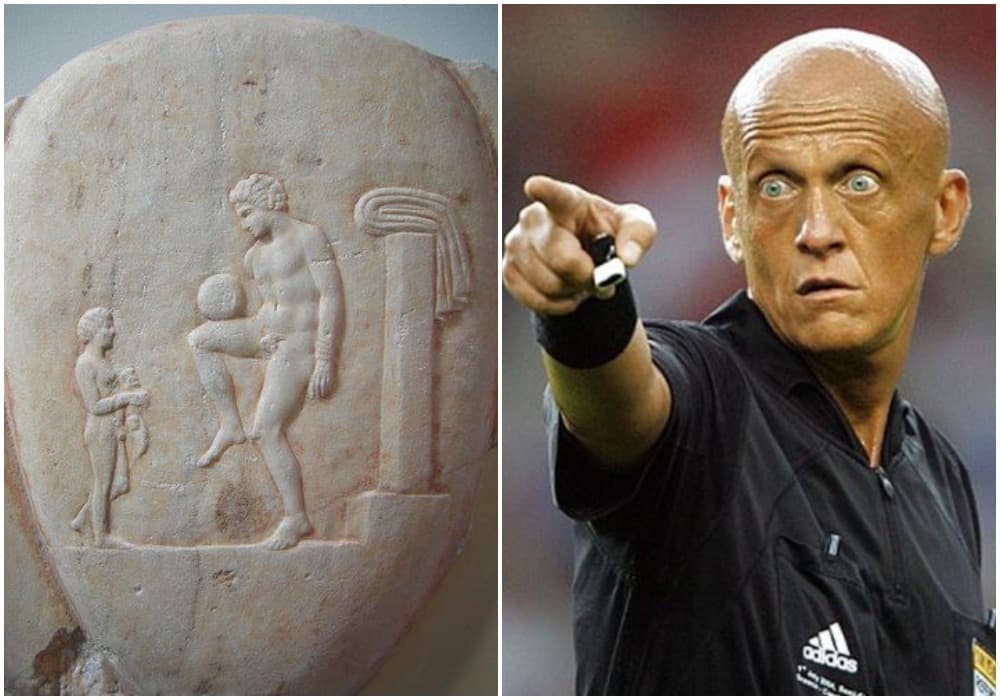
It was found in the Samothrace, ball from 275–250 B.C. The episkuros It was played mainly by men, but women also practiced it.
The ball was made of pieces of leather sewn together with animal intestines. On the outside, it was painted in bright colors. Various ancient authors mention that there were leather balls, which were inflated with air using the bladder of a large animal, usually a pig. However, they may also have been made of fabric stuffed with straw.
Games played with this type of ball are also described by Homer. The Romans It seems they adopted the sport from the Greeks and named it «harpastum».
The International Federation of Association Football (FIFA) recognizes eskimo as one of the earliest forms of soccer.
So let's start from the beginning. The English people They were the first to organize a soccer league, while so-called «mob soccer» (mob football) was very common in Britain, where teams with an unlimited number of players from neighboring towns or villages tried to move the ball (a ball) to the local church in the opponents’ territory in order to win. However, A depiction on an ancient Greek lekythos, showing a young man balancing a ball on his right thigh, proves that the sport was most likely invented in Ancient Greece! The ball game played in Ancient Greece was called «episkuros.» In fact, the International Federation of Association Football (FIFA) recognizes episkuros as one of the earliest forms of soccer.
How was soccer played in Ancient Greece?;
The episkuros was played mainly by men, usually naked, but women also played it. The ball was made of pieces of leather sewn together with animal intestines and was painted in bright colors on the outside. Two teams, usually consisting of 14 players (with an equal number of players on each team), were separated by a line, which they marked on the ground with a stone, which they called «skyros.» Two other lines were drawn behind the two teams. They placed the ball on the center line, and the team that caught it first had to throw it over the opposing team, which had to catch it while it was in motion and throw it back to the other team.
This went on until one team managed to push the other past the line behind it. Essentially, This game was called «episkuros» because it was played in an area marked off with black stones. According to historical accounts, the Romans later renamed the game «harpastum.».
In general, Ball games, as described by Polydectes (Onomasticon I.X. 103–107), were the episkuros, phaininda, aporaxis, and ourania. The episkuros was also called the ’adolescent” and “common” (for many). In the “aporraksi” stroke, one had to hit the ball hard against the ground, then catch the ball as it bounced back into one’s hand and hit it again. The number of hits (or bounces) was counted. Similarly, “sky ball” was played by one player who leaned backward and threw the ball into the air, while the others tried to catch the ball before it hit the ground. They would then bounce the ball back and forth against a wall and count the number of bounces. The loser was called a donkey and had to do whatever he was told, while the winner was the king and could give orders!
Some references to ball games by ancient poets include, among others, that of Homer (Ode 9, lines 370–379), who describes a game resembling a combination of volleyball and dance: «Then Alcinous commanded Laodamas and Alios to perform the dance alone, for they knew the art better than anyone else. And they took a purple ball in their hands, which Polybos had fashioned for them with his wise craftsmanship, and one would fling it high into the clouds, bending backward, while the other, leaping high above the earth, caught it before his feet touched the ground again. And after they had tested their skill with the ball, which they threw straight up into the air, they danced across the varied earth and performed a thousand and two somersaults; they clapped their hands.’.
Arrian, in Book 14 (46), specifically states: «[…] if you’re able to hit it with a quick stroke—with your left hand—it’s yours. Can’t you? If not, you’re out—pass the ball to someone else[…].» Antiphanes, a comic poet of the 4th century B.C., writes: «[…] he caught the ball and laughed as he tossed it to a player, simultaneously signaling that he would pass it to someone else. He shoved another player who was blocking his path, while shouts and cries rang out: ’Out of bounds! Throw it over his head! Back!![…]«.
Finally, Galenos states that: «…Even the poorest person can play soccer, because it requires neither nets, nor weapons, nor horses, nor hunting dogs…”… And what could be more convenient than a game in which anyone can participate, regardless of their wealth or occupation? Playing with a ball isn’t just good exercise for your legs—it’s also great for your arms… You’ll also realize that playing with a ball trains the eye, if you consider that anyone who can’t predict its trajectory won’t be able to catch it either. Furthermore, the player will also sharpen their critical thinking skills.» And here’s the… military perspective: «It’s not hard to see that playing with a ball trains you in the most important maneuvers that the laws of the city entrust to its generals: to attack at the right moment and remain undetected… To seize what belongs to your enemies, either by rushing upon them with force or by surprise, and to hold on to the spoils you have taken.».