
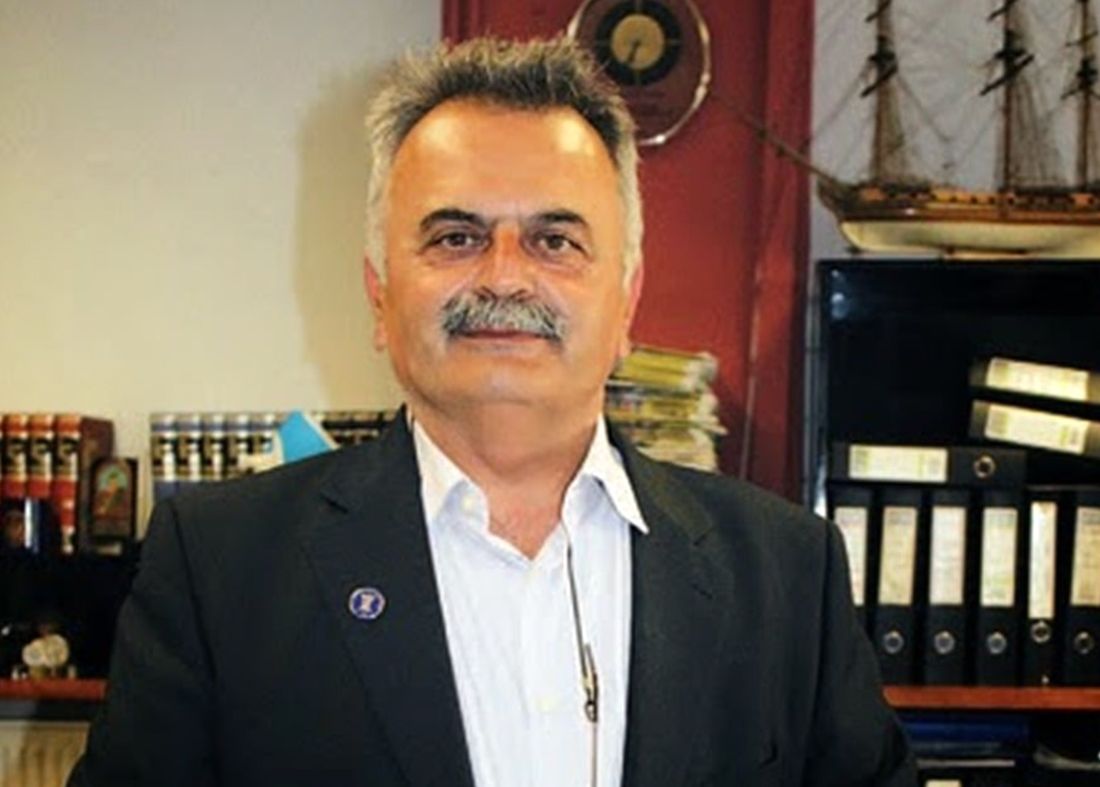
Systematic studies per region are needed for water management and the enrichment of the aquifer in order to avoid extreme water scarcity in our country, said Professor of Geology at the University of Patras and head of the Institute of Hydrocarbons Abraham Zelilidis in an interview. He mentioned the interventions that the state must make so that rainwater is not lost simply by flooding entire areas, while he referred in detail to the negative effects of the installation of wind turbines and photovoltaic panels in the mountains.
«On the issue of climate change, we have a reduction in rainfall and snowfall and a reduction in duration, the rainfall is there, it is torrential, it is short with a lot of water. This water goes into the rivers, creates floods and goes out to sea. Conclusion, the aquifers are not being recharged, what can drilling do, it will deplete the already depleted aquifer. We have been proposing to the state for 15 years, it is not a current phenomenon, water scarcity is plaguing all of Greece, every day we have news that this or that lake or river has dried up, springs have dried up, Agia Varvara in Drama will soon not produce water, etc. All these phenomena will slowly intensify, so the state must intervene immediately, it should have done so, but everything will be done when the problem is no longer reversible.
«Let's say I have a river that sometimes suddenly brings water and floods an area, I can make small dams in the riverbed so that water is held back behind these dams to help the water flow into the waterway. So we need targeted projects, you can't do them everywhere, you have to know where there are faults, where there are water permeable rocks to intervene. But at the same time, because we will have flooding in the winter, these projects can also inhibit the flood load. These projects can be done soon and because we have an NSF that is starting to be implemented so all the municipalities can incorporate these projects, we need some quick studies to see where these can be done.
«In a second phase, after the aquifers are enriched, you will see the springs reborn, the lakes refilled, but is that enough? Today I was chatting about the technical lake of Mornos that feeds Athens and slowly the level is dropping and the villages that were flooded are beginning to be revealed. But there are particular conditions for each project, that is, the Mornos lake is in the flow of the Mornos river and it doesn't seem to be fed by smaller springs around it so that you can say I am enriching this spring, I am enriching that one, etc. In this case because we are talking about the Pindus which has no snow in recent years or has very little snow and has very fast rainfall, we can make a second artificial lake which means a decade.».
«So there are projects that are short term and projects that are long term, but we have to think about what we want to address. The artificial lake of Mornos supplies water to Athens, so we have to design a new project because Mornos does not hold all the water, it has overflows and a lot of water goes to the sea. We can see a second such project, big cost but also big need to serve the 50% population. On the smaller islands that have tourism we need to think about different approaches, most islands have the characteristic of being cut like baklava by the rifts and the rainwater drains the coastal zone. Whichever island you go to you will be told that they have a punta, that is a spring in the sea that brings out cold water. This is because the aquifer is damaged, the water reaches the sea and gushes into the sea. Indeed we can find solutions to drill wells to prevent the water from being lost in the sea and to take it to altitude zero, that is, where the sea is not drawn. All these projects need planning but to date no one has said to do a record of what we have done and what we have not done. There are some management plans but they are ... philosophical.».
«Only some mayors who see before them that desalination is not the solution, drilling is not the solution, and they want to address their areas as a whole, understand this. To make a reservoir 10 years down the line and to think about hydroelectricity, tourism development, etc., it takes good planning and such mayors with visions, who will say that I will be four years but after four years someone else will find the project in progress, unfortunately do not exist. There are few who think like that. River interventions with dams need to be studied that can be done to avoid worse flooding, and you don't do one, you might do 4-5-6, it depends on the rocks around, it depends on the faults affecting the area etc. But you need a study first to see where you're going. In the Evros because the problem will be exacerbated, we will get water from what is left over from Bulgaria, that is, when there are heavy downpours and Bulgaria goes to drown, it will leave the water and the Greek part will come to drown. So the only thing you can do there is bypass, i.e. flooding areas that are not inhabited in order to defuse the river's flood load. We can do such bypasses by flooding areas that are dry, barren on the Evros, and that has not been studied either. At the height of Soufli it is too close to a large mountain range that I can make bypasses and flood some other basins that will at the same time act as an enrichment of the water table. But they need study, someone to do systematic work looking at the soil, rocks, slopes etc. Then you have to do a significant amount of work on what the dam is going to be, how that dam is going to work, how the diversion is going to be done, how the flood load is going to be avoided. The same goes for the Nesto and all rivers, they want mapping, let the river move freely and not infrastructure development without any control.».
«I was reading an article that really bothered me and I started to believe it, it said that the wind turbines destroy the microclimate of the area, causing drought because the surface water vapour would collect and because of the different speed and condensation it would reach the top of the mountain and become rain. Now where there are wind turbines they do not allow this moisture to condense and as a result in areas where it was raining because of this phenomenon today with the wind turbines there is no rainfall, exacerbating the phenomenon of water scarcity in this area. These mountains used to act as aquifers, enriching the aquifers, it is not only the ecological and geological that is destroying the mountain, now it seems to be affecting the microclimate with the rainfall. But they keep giving permits to all the mountain tops for wind turbines.
«Now what is growing even more is photovoltaics, so I was called the other day in an area to see such a photovoltaic centre on a rock. Initially I was not against putting photovoltaics on dry mountain tops or slopes but going there one finds that at the base of this mountain range there are springs. You go on a hill like that to do a photovoltaic and underneath you have a spring which supplies water to 5-6 villages, maybe more, and you wonder who gave permission to do that? Has anyone considered that a leak in such a photovoltaic which is toxic will irreversibly and irreversibly contaminate these springs? The same thing that applies to wind turbines also applies to photovoltaic panels, when you put panels and cover a mountainous volume then you reduce the amount of water that will go into the water table, therefore in Greece nothing is done by study, but by design.».
Avraam Zeligidis
Professor of Geology Abraham Zelilides in the media on the problem of water scarcity
The problem of water scarcity is here to stay and measures are now being sought to address the severe water shortage in the heart of summer. Professor of Geology Abraham Zelilidis talks to Ionian about the steps that need to be taken.
Watch the professor's interview with OPEN:
Zelilides: «We have been warning for years about water scarcity and nobody listened»
Professor of Geology Abraham Zelilidis talks to Ionian about the steps that need to be taken:
We will suffer another 5 years of water scarcity if we do not move forward with projects
In an interview with Valuenews.gr and the journalist Giota Hadjitheodorou, Professor of Geology at the University of Patras Abraham Zelilidis points out the necessity of an integrated plan to tackle the phenomenon of water scarcity that plagues Greece.
Biography
Abraham Zelilidis was born in 1960 in Naoussa, Imathia, Macedonia, Greece. He received his B.Sc. in Geology in 1984 and his Ph.D. in Sedimentology in 1988 from the University of Patras, Greece. He worked as a Lecturer since 1993 and as a Full Professor at the Department of Geology, University of Patras, since 2009. He was the Dean of the Faculty of Natural Sciences of the University of Patras during 2006-2010. He is an expert in Sedimentary Basin Analysis, Sequence Stratigraphy and Petroleum Geology. He has carried out several research projects on hydrocarbon evaluation for oil companies, using both surface and subsurface data, and has also conducted several field seminars for oil company executives. He has published more than 100 papers in international scientific journals, most of which focus on the potential development of hydrocarbon fields in Greece and presented many of these papers at international conferences around the world (Japan, Europe, Africa and America). He was a supervising professor on ten PhD theses related to petroleum geology. He has worked in the Gulf of Suez and has published papers linking the geological evolution in the Gulf of Suez, Egypt, with areas of Greece of international interest.













It will all be done sloppily as always when we have reached the amen and the people will complain with direct awards and with prices 10 times higher (reason for the necessary cases) .. This is a trick we have seen for many years now.
Then they come out with dudes and pockets full
Can you explain to us, Professor, how photovoltaic panels reduce the amount of water that ends up in the water table? So the water that falls on them magically disappears? Does it not roll off them eventually ending up in the ground? The same thing that has been happening for millions of years in forests all over the earth? Do dear readers we need to start being more critical of all kinds of professors whose only interest is to eat the guild interests of the NSF of the day.
Unfortunately they have sold off this public good, water. All that Zelidis says is that the Dutch and whoever else will come to the rescue and do the obvious and at the same time tell you to take 5 euros per cubic metre. But they won't do anything... I'm sorry.
About wind turbines and photovoltaics he doesn't know what's going on with the professor. So why is he talking. “Master, you taught...” But ignorant are also the journalists who interview ignorant people.
It just won't happen and that's because their minds can only think ahead for a year or so.