The Cretan syllabic scripts appear to date to the middle of the 3rd millennium BC, previously referred to as Minoan scripts, that is, 500 years earlier than the established view, which dated them to 1900 BC. Thus, these scripts date from the same period as the script in the Indus River Valley, around 2400 BC, while Egyptian hieroglyphs are dated to approximately 3000 BC.
These points are highlighted in a paper by Dr. Minas Tsikritsis, a researcher of Aegean scripts, and Professor of Archaeology Adamantios Sampson in the American academic journal*Annals of Archaeology* (April 2023), available on Academia.edu and ResearchGate, titled «Symbols of Minoan Hieroglyphic Script and Linear A in Melos from the Middle of the 3rd Millennium BC.».
As noted in the study by the two researchers, at the Rivari site on the western side of Milos, a group of 90 clay vessels from the Early Cycladic III period (Kastri phase) dating to the second half of the 3rd millennium (2500–2200 BCE). In this article, archaeologist A. Sampson conducts a systematic study of the similarities among the vessels in order to date them by comparison with others found at Troy IV, Poliochni on Lemnos, Agios Kosmas, Manika, Marathon, and Kea, which date to the Kastri period.
Of the 39 finds by A. Sampson, 18 unadorned, shallow, glossy brown or orange-red bowls bearing engraved symbols (Figure 1), commonly referred to as «potter’s marks,» which somewhat resemble the Greek capital letters L, M, P, N, T, X, and O. Meanwhile, in 1997, archaeologist Christina Televantou discovered 16 small hemispherical vessels with similar incised marks in an adjacent laconic-style tomb, as well as a symbolon a beaked jug, which she published in 2008.
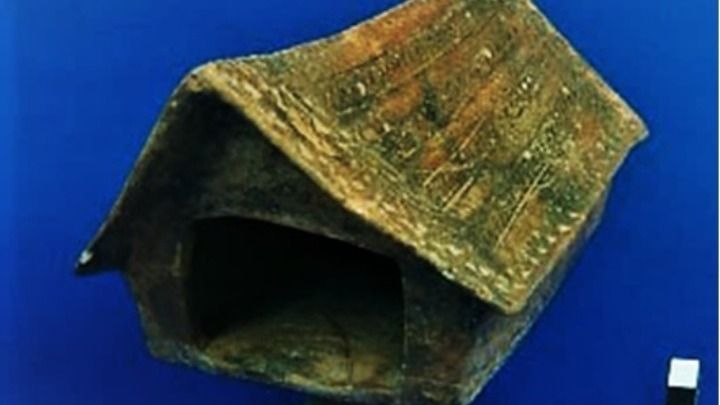
In addition to the discovery of small hemispherical vessels bearing incised symbols, another interesting find is the presence of a unique model of a house roof. This model features a gabled roof with tiles. The find is striking and difficult to interpret for this period.
According to the epigraphic study by researcher Dr. Tsikritsis, it appears that 12 different symbols, which are repeatedly engraved in the center of the small hemispherical vessels, bear a resemblance to and can be identified with the syllabic symbols of Linear A and Cretan Hieroglyphic script at a rate of 50% for each script. The results of this study indicate a shared use of the symbols of the Cretan scripts dating back to approximately 2500 BC.
It is surprising that the appearance of the 12 different symbols of Minoan script is not accompanied by finds of Minoan pottery in the burials at Rivari on Milos. Thus, at Rivari, we find Cycladic pottery of “Eastern inspiration” bearing Minoan symbols. Although the sample of 12 different symbols corresponds to a total of 10% in Minoan script, it raises the question of whether this script should be considered a Cycladic creation, which at some point spread to Minoan civilization. During the same period in Crete, cultural elements from the Cyclades (figurines, Eastern-style vases) were found at Agia Foti, Petras, and Archanes. In the past, there has been debate among researchers regarding the existence of Cycladic colonies on the island of Crete (Doumas 1976), (Davaras and Betancourt 2004, Betancourt 2008) and (Sampson 1985, 1988).
The syllables near the base of the vessels appear to have been incised by the potter before firing. They likely indicate the workshop, the use, or the contents of the vessel (Figure 3, Table of vessels with engraved symbols).
Of the total of 39 vessels bearing the 12 incised recurring syllabic symbols, the arrow symbol «á» or «â» (row 2 in Table 1,2), which corresponds to the Linear A barley symbol; it has the highest frequency of occurrence, approximately 30%, and appears on 6 small hemispherical vessels. Possibly, this symbol indicates that the small hemispherical vessels were likely used as offerings containing some kind of “barley” for the deceased’s afterlife, a fact that reinforces the argument that Rivari was a cemetery.
It is likely that the remaining symbols appearing on the small hemispherical vessels in Table 1 are the initial sounds of syllabic words, suggesting that the corresponding hemispherical vessel was used as an offering vessel for products such as grain, honey, oil, etc.
The Aegean script found at Rivari on Milos challenges the established view that the script first appeared in the Minoan civilization around 2000 BC.
The significant development of Cycladic civilization, as evidenced by advances in house-building technology (see Figure 2), in the surviving Cycladic figurines that indicate developed social structures, and in its astronomical knowledge reflected in the pan-shaped vessels with their records of planetary alignments, lead to the conclusion that there was a developed maritime network, in which the development of writing was necessary to meet the needs of trade.
Based on the epigraphic study conducted by Messrs. Tsikritsis and Sampson, it appears that of the total of 12 different recurring symbols, half belong to Cretan Hieroglyphic and Linear A script; that is, 500 years earlier, an Aegean script may have developed, which was subsequently adopted and developed after the 2nd millennium in the Minoan civilization.
«»The number of symbols found corresponds roughly to 10% of a developed syllabic script, and we hope that even more will be uncovered in the future, which will reinforce our view that AAegean script dates back to the 3rd millennium BCE,” Dr. Tsikritsis told the Athens-Macedonian News Agency (ANA-MPA).
T. Metsios