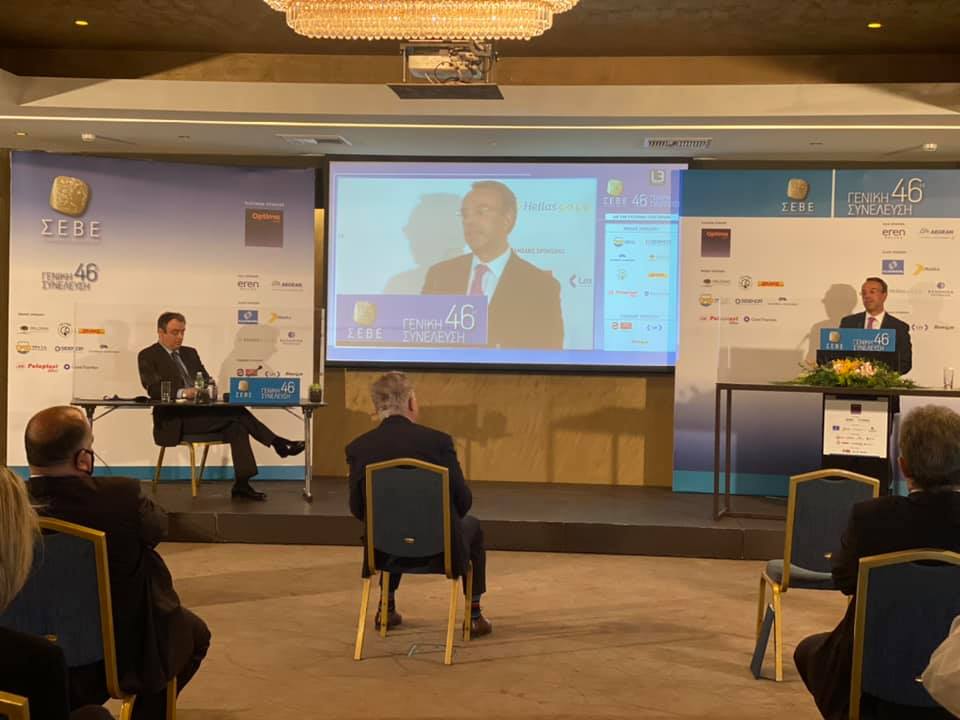
«Realistic optimism» for the gradual return of the economy to normality, are inspiring developments, as the Minister of Finance said at the 46th General Assembly of the Exporters' Association (SEVE), Christos Staikouras, who described as feasible and realistic, the targets set by the economic staff for: economic growth rates above 3% in the medium term from 2021 onwards, fiscal balance with a zero primary deficit in 2022, reasonable and realistic primary surpluses from 2023, achievement of the so-called «investment tier» in 2023 and a single-digit non-performing loan ratio in 2022.
The Minister also pledged that, «as soon as additional budgetary space is found in the near future, the will and priority of the government is the targeted further reduction of taxes and social security contributions».
As to the Recovery Fund, after recalling that the government does not «do what it wants with the resources», since they are allocated on the basis of four pillars and 18 sub-pillars, he pointed out that «The aim is for the private investment boom to exceed 20%, compared to the level it would have been at in the absence of the Recovery Fund».
He added that the government's aim is to close the investment gap that currently exists, through a matrix of policies aimed at increasing the contribution of exports to around 40% of GDP by 2025 (compared to around 30%-31% today) and investment to 17% from 11%.
«High sustainable growth, changing the production model, creating good jobs and social cohesion are our goals», he stressed, adding that the government's main project is to improve the quality of wealth through increased exports and investment, as consumption is a key component of the economy, but it is not enough.
Attention and discipline for the return to full normality
According to the minister, the Greek economy is slowly returning to normal after a six-month battle with the second and third wave of the pandemic, but a return to full normality requires care and discipline, so that fiscal easing not to become a fiscal derailment.
Summing up the government's objectives for the next period, he singled out five priorities: 1) prudent and careful fiscal policy, with the use of fiscal flexibility in order to make targeted further reductions in taxes and contributions, 2) the strengthening of the stability of the banking system, with the extension of the Hercules programme and the reduction of non-performing loans, 3) the implementation of the privatisation programme and the utilisation of the public service («in Northern Greece, the privatisation of the public service is proceeding on schedule,» he said.
Mr.Staikouras pointed out that during the pandemic, the government managed not only to keep the economy and society on its feet, but also to create conditions for a dynamic restart and a strong recovery. «In our own estimates, in 2021 we are projected to have an economic growth rate of 3.6%, when the Commission estimates that the country will run at 4.1%. This shows the realism of the Greek government's estimates and forecasts,» he said.
He added that in the context of measures to support households and businesses, more than 1000 Joint Ministerial Decisions have been passed in the last year and «many of these measures have subsequently been used by other eurozone Member States». By way of example, he mentioned, among others repayable advances, the special purpose compensation for businesses and workers, the TEPIF, the guarantee schemes, the deferrals, the Bridge I and II schemes, the non-payment of rents, the subsidisation of part of fixed costs and the permanent reductions in taxes and social security contributions.