The newspaper “Avgi” accuses the Regional Governor of Attica, George Patoulis, of plagiarism, as it “finds” in his 130-page doctoral thesis excerpts from earlier doctoral theses by nine other scientists.
We read in the online edition of the newspaper:
«We often say, sometimes seriously and sometimes jokingly, that great minds think alike when we want to describe the similarity of views and ideas between two people. In the rare case where at least nine minds meet, and indeed meet within the same doctoral thesis of one person, then the case goes beyond the familiar adage and enters into suspicious and possibly reprehensible territory.
Because it is extremely rare, if not intellectually impossible, for the opinions of so many people to be identified in a 130-page scientific text bearing the signature of only one. In our case, we are dealing with a doctoral thesis in which a careful reader will find and identify numerous verbatim excerpts from earlier doctoral theses by eight other scientists, none of which are in quotation marks and none of which are referenced in any way. However, our case becomes even more complicated as it is overshadowed by a series of gray areas to which the author of the thesis owes answers, since the title of Doctor of the Medical School of the University of Athens requires complete transparency and cannot be disputed. And it is Giorgos Patoulis who is called upon to provide the answers, having presented his thesis in January 2020 and been sworn in before the president of the Medical School, Petros Sfikakis, and the vice-president, Gerasimos Siassos.
The body of the crime
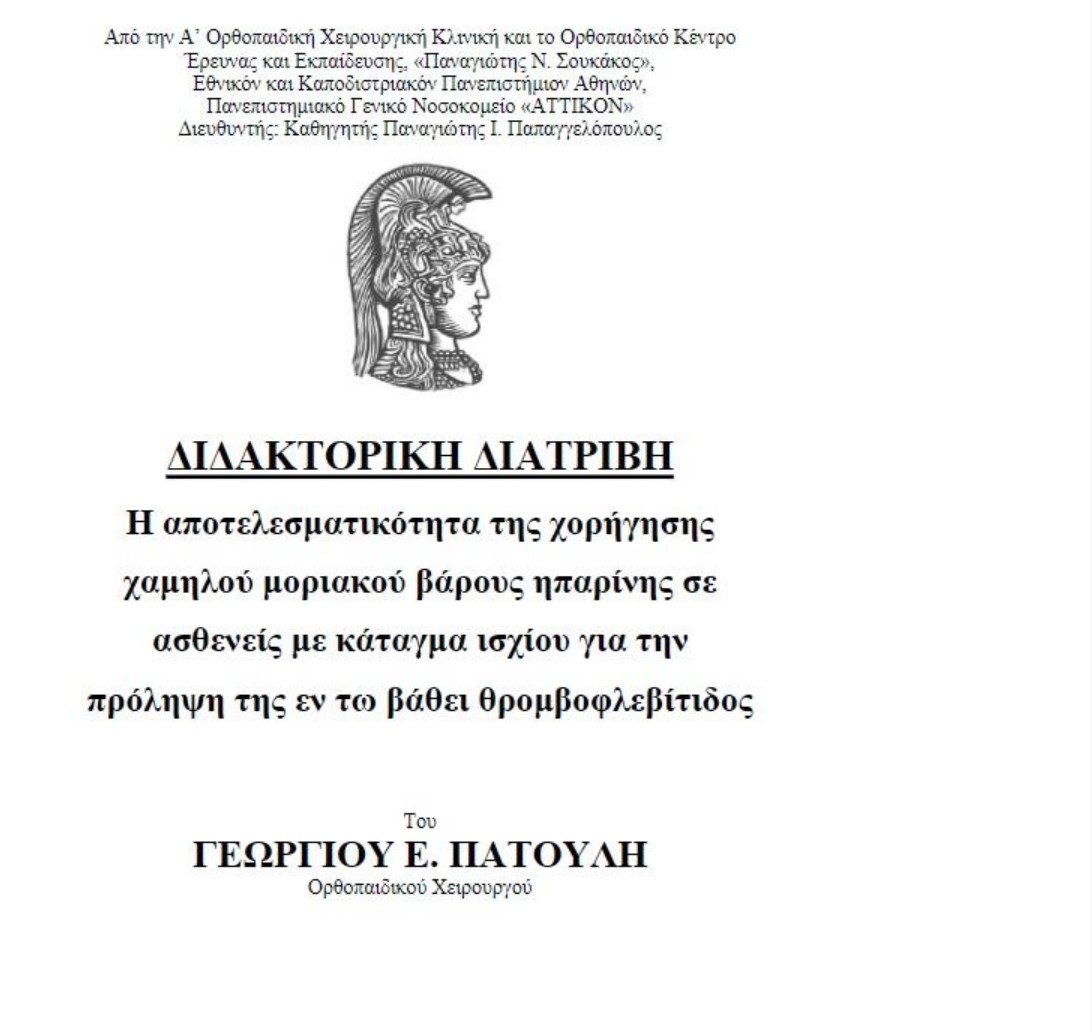
G. Patouli's «dissertation» is 130 pages long. The main text is 77 pages long (from page 15 to page 92). The rest are introductory pages (acknowledgements, Hippocratic oath, table of contents, etc.) and a bibliography. The bibliography contains only foreign-language works and is relatively extensive (330 entries), but the footnotes within the «dissertation» are very sparse, almost non-existent – the bibliography listed in the table is not referenced within the text.
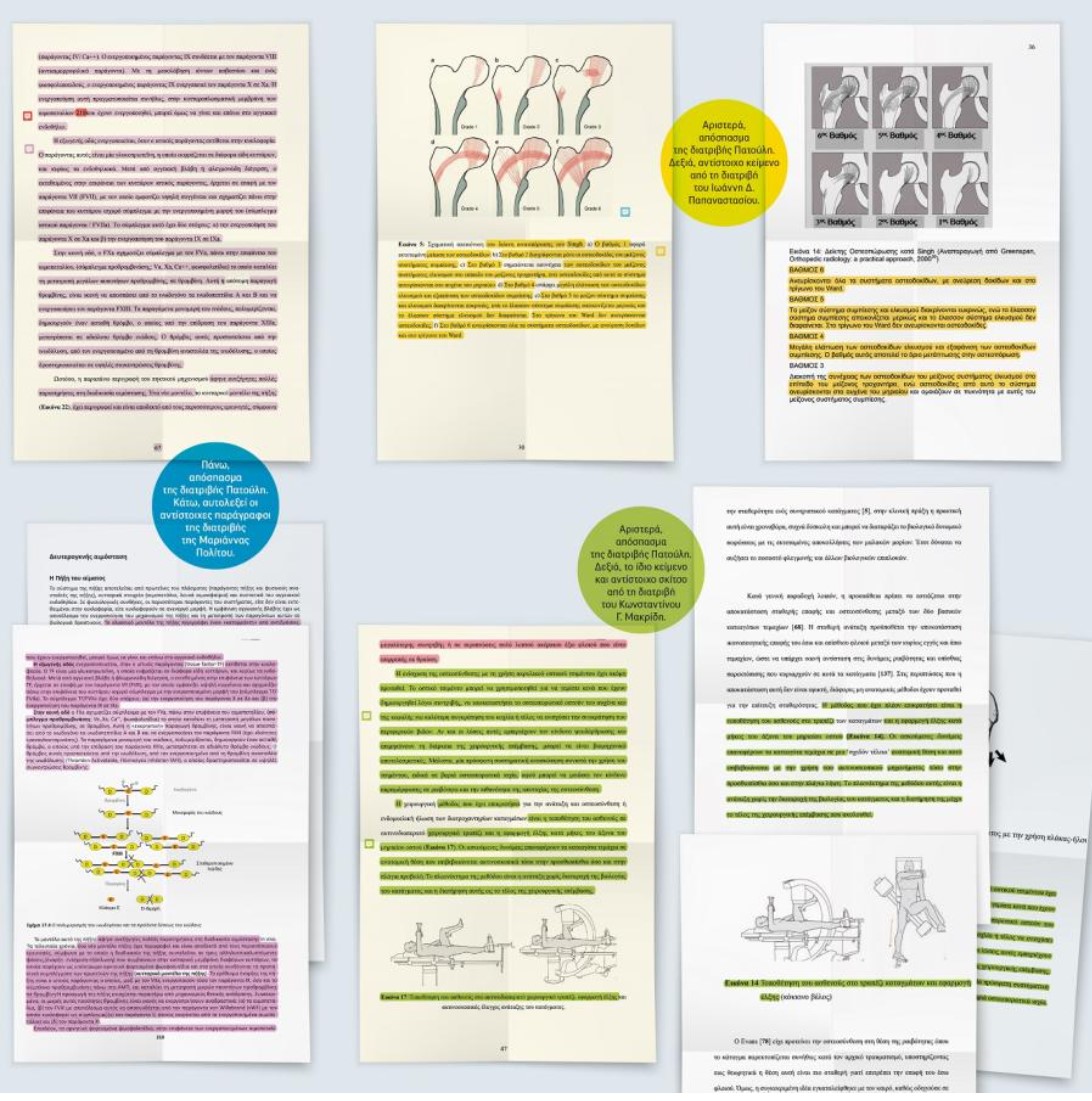
The most important issue, however, is plagiarism. With the assistance of a team of independent researchers, we ran G. Patoulis« thesis through plagiarism detection software and found that 62 of the 77 pages of the main text are simply copies or verbatim compilations of sections mainly from other theses.
In other words, they do not belong to G. Patoulis, but, among others, especially to Ioannis D. Papanastasiou («Biomechanical and clinical study of osteosynthesis of subcapital femoral fractures with three divergent cannulated screws similar to a wedge,» Athens, 2012), Ioannis P. Galanopoulos («Clinical and biomechanical study of reverse oblique hip fractures,» Athens, 2019), Konstantinos G. Makridis («Prospective study of the postoperative evolution of patients with hip fractures and assessment of the factors that may influence it,» Larissa, 2016), Christos Th. Vottis (Athens, 2019), Vasiliki V. Papakonstantinou (Athens, 2005), Georgios S. Trellopoulos («Study of inflammatory response and coagulation disorders following endovascular treatment of abdominal aortic aneurysms,» 2015), Charalambos S. Pata («Factors predisposing to thromboembolic disease in orthopedic hip replacement surgery,» Athens, 1993), Michalis Gionis [«Assessment of blood coagulability in high-risk patients for thromboembolic disease receiving prophylaxis with low molecular weight heparin (doctoral thesis research protocol), 2015], Marianna Politou («Lessons in Haematology», 2015). Below are some examples of pages from the «dissertation» alongside the pages from which their content was stolen.
AVGI has at its disposal—and at the disposal of any academic, political, or judicial authority, as well as any person with a legitimate interest—the «dissertation» by G. Patoulis and the dissertations and other publications by the authors from which the plagiarism was taken.


Technology and plagiarism
Since 2017, the University of Athens has subscribed to Turnitin plagiarism detection software, which, in addition to the Internet, can detect possible plagiarism in papers submitted to the system, as well as in content from publishers that is not freely accessible on the Internet, as confirmed in Parliament by Deputy Minister of Education Vasilis Digalakis.
The National and Kapodistrian University of Athens, implementing the decision of the 83rd Rectors' Conference on February 6, 2017, based on the relevant approval of the University Senate of the University of Athens during its 19th session of the academic year 2016-2017, which took place on June 13, 2017, has acquired an annual subscription to the Turnitin plagiarism detection software for the needs of the institution's academic community. Specifically, the subscription is for the Turnitin Originality Check product, which is part of the Turnitin Feedback Studio package. This software is used in more than 15,000 educational institutions, by 1.6 million teachers and 26 million students worldwide. Turnitin's huge database, against which student work is compared, includes over 50 billion web pages, over 600 million student papers, over 160 million articles from academic books and publications in collaboration with the world's largest publishing houses (CrossCheck, Gale, Emerald Journals, SAGE Reference, Pearson, McGraw-Hill, ABC CLIO, Ebsco Host, Wiley, etc.).
In this context, Turnitin, apart from the Internet, can detect possible plagiarism in papers submitted to the system as well as in content from publishers that is not freely accessible on the Internet (via the Crossref network). This was categorically confirmed by the Deputy Minister of Education, Vasilis Digalakis, in response to a relevant question in Parliament (July 13, 2020), emphasizing that «Greek universities, with the support of the Ministry of Education and Religious Affairs, are tackling the issue of plagiarism with determination and modern digital tools.».
The history and gray areas
The coincidence of the plagiarist's scientific rise with his rise in the Region and the rise of the New Democracy's best in the government
At doctoral level, science «courted» G. Patoulis on July 17, 1992, when he submitted an application to write a doctoral thesis. A year later, the three-member advisory committee required by law was appointed and the topic was determined: «The effectiveness of administering low molecular weight heparin to patients with hip fractures for the prevention of deep vein thrombosis.» On July 18, 1994, doctoral candidate G. Patoulis submitted his first progress report. And then he waited, and waited a long time: twenty-five whole years. When it began to appear that he had a good chance of winning the regional elections, he realized that the time had come for a «New Beginning» not only in Attica, but also in the progress of science. He submitted a second «progress report» on February 28, 2019 (three and a half months before the first round of local elections). He submitted the third and final «progress report» of his thesis on October 23, 2019, just a few weeks after taking office in the Region. In other words, between February and October 2019, after a twenty-five-year hiatus from his doctoral studies (there is no trace of his doctoral progress during those years), he was healing science, organizing his electoral success, and taking over the Attica Region!
(The question of how the final approval of the thesis is compatible with the Regulations for Doctoral Studies in Medicine, which stipulate six, or at most seven, or eight years for its completion, is another issue, as is the issue of concealing—despite Article 9 of the Regulations for Doctoral Studies in Medicine—the names of the initial Three-Member Advisory Committee from the thesis. These issues should probably be addressed by a joint committee of doctors and lawyers...).
The «scientific» rise of G. Patoulis is therefore in line with the political rise of his party, with the political rise of New Democracy and Kyriakos Mitsotakis.
The Medical School?;
The Athens Medical School also has its peculiarities. For example, the Council of State, in its decision 2035/2021, annulled the election of its president, accepting that his third consecutive term in office was unlawful. The decision was issued after the end of the president's term, but it is not without legal and, above all, academic value.
Today, the Medical School is called upon to examine how it escaped the attention of both the Three-Member Advisory Committee (which, by law, recommends that the thesis be accepted) - namely Professor of Orthopedics Panagiotis Papangelopoulos, Professor of Vascular Surgery Ioannis Kakisis, and Associate Professor of Orthopedics Olga Savvidou—but also the entire school, and especially its more specialized members.
We ran plagiarism detection software and found the... goat on the back of the «doctor.» Medicine? Today, it is called upon to immediately revoke his doctoral title and take all measures for his legal punishment. After all, Articles 10 and 13 of the Regulations for Doctoral Dissertations in Medicine stipulate that «plagiarism is considered a serious academic offense» and therefore «the presentation of any documentary material, even from the candidate's own studies, without relevant reference, as well as the falsification of results, may constitute grounds for a decision by the Departmental Assembly to expel him.».
Opinion
The issue is eminently political.
The German Minister for Family Affairs resigned in May 2021 because suspicions had arisen that she had committed plagiarism. Similarly, in January 2021, Austria's Minister of Labor also resigned—again on suspicion, not on proven plagiarism at the time of her resignation. Ten years earlier, in 2011, Germany's (highly popular) Defense Minister resigned after it was revealed that he had plagiarized his doctoral thesis. The same happened in 2013 to the German Minister of Education, when her doctoral title was revoked for the same reason. The same happened in 2013 to the French Minister of Budget. The same thing happened in 2016 to two Romanian education ministers...
That's beside the point. Of course, New Democracy is not responsible for the academic achievements of its leading figure in the capital's suburbs. However, it will be judged by how it reacts. G. Patoulis himself must resign. For reasons of dignity and political order, if nothing else. New Democracy—whose ranks include ’excellent« members, we will not dispute that—must remove G. Patoulis here and now. And if he does not resign, the government, through the minister who exercises disciplinary oversight of local government organizations, must take the necessary disciplinary measures. If it fails to do so, it will be complicit.
Comment by George Patoulias
Regarding your question about my published doctoral thesis, please note that:
- The research study for my thesis was conducted at the Orthopedic Clinic and Radiology Department of the Laiko Hospital in Athens, headed at the time by E. Douni and G. Tzortzis, respectively.
It is a primary randomized controlled trial of postoperative FTE of hip fractures, with a large number of venograms.
This research study was conducted between 1993 and 1996, with the participation of 72 patients with hip fractures (44 intertrochanteric and 28 subcapital) and no similar study had been conducted in our country.
The relevant protocol had the written consent of the Scientific Council of the People's Hospital and the written consent of the patients who participated.
Specifically:
After a random draw, patients were divided into two groups that received low molecular weight heparin for 12-14 days, the classic heparin as a prophylaxis.
At the end of treatment, all patients underwent ascending venography on days 12–14 using a modified Kakar protocol and the Deweese and Rogoff diagnostic criteria.
The results showed deep vein thrombosis in 9 out of 36 patients in group A and in 8 out of 36 patients in group B.
There was no statistically significant difference in deep vein thrombosis between the groups, nor between the different fractures.
In group A, 8.3% (3) had pulmonary embolism (one massive fatal), while in group B, 5.6% (2) had one fatal.
A superficial infection was recorded and there was no clinical manifestation of HIT syndrome.
Prevention with low molecular weight heparin proved to be just as effective as classic heparin, which has the disadvantage of requiring frequent laboratory testing.
- The research study in question was presented at at least four medical conferences, specifically:
a. «Autumn Conference of the Hellenic Society of Orthopaedic Surgery and Traumatology. Athens, October 26-29, 1994,» on «The impact on intra/postoperative bleeding of prophylaxis of deep vein thrombosis in hip fractures.».
Participants: S. Sourmelis, G. Patoulis, T. Korakis, A. Daras, A. Anastasiadis
Summary, in the summary volume, pp. 27-28.
b. «2nd Panhellenic Conference on Angiology – Vascular Surgery, December 9-11, Divani Caravel, Athens 1994,» on «The effectiveness of administering low molecular weight heparin for the prevention of deep vein thrombosis in patients with hip fractures.».
Participants: S. Sourmelis, G. Patoulis, I. Moundanos, S. Stathopoulos, G. Tzortzis.
Summary, in the book of summaries, p. 56.
c. «2nd Panhellenic Conference on Angiology – Vascular Surgery Divani-Caravel, Athens, December 9-11, 1994,» on «The treatment of deep vein thrombosis above the knee with low molecular weight heparin.».
Participants: S. Sourmelis, G. Patoulis, S. Sotiropoulos, I. Moundanos, G. Tzortzis.
Summary, in the book of summaries, p. 57.
d. «Joint conference of the Hellenic Society of Orthopaedic Surgery and Traumatology, the Swedish Orthopaedic Society, and the Cyprus Orthopaedic Society. Rhodes, October 24-28, 1995» on the topic of «Prevention of deep vein thrombosis in patients with hip fractures.».
Participants: S. Sourmelis, G. Patoulis, A. Anastasiadis, C. Rifiotis, P. Krikis, G. Tzortzis, E. Dounis.
Summary, in the book of summaries, pp. 25-26.
- For the writing of my doctoral thesis, in the general part I present what I took into account from the study of 330 foreign-language and Greek publications, up to the year 2019, which are also referenced. Moreover, it is obvious that all dissertations on hip fractures concern the same hip anatomy, the same classification of hip fractures, the same surgical treatment, etc.
In the specific section, I present my primary research study with great precision, which, according to the opinion of distinguished professors, is original and its data will facilitate related future studies.
- It should be noted that the clinical part of my thesis was completed in 1996, but due to my administrative duties from 1998 to the present, its writing was delayed until 2019. It was approved in 2019 by the relevant three-member committee of the National and Kapodistrian University of Athens, consisting of the professor of orthopedics at the Athens Medical School, Mr. Panagiotis I. Papangelopoulos, Associate Professor of Orthopaedics at the Athens Medical School, Ms Olga D. Savvidou, and Professor of Vascular Surgery at the Athens Medical School, Mr Ioannis D. Kakisis.