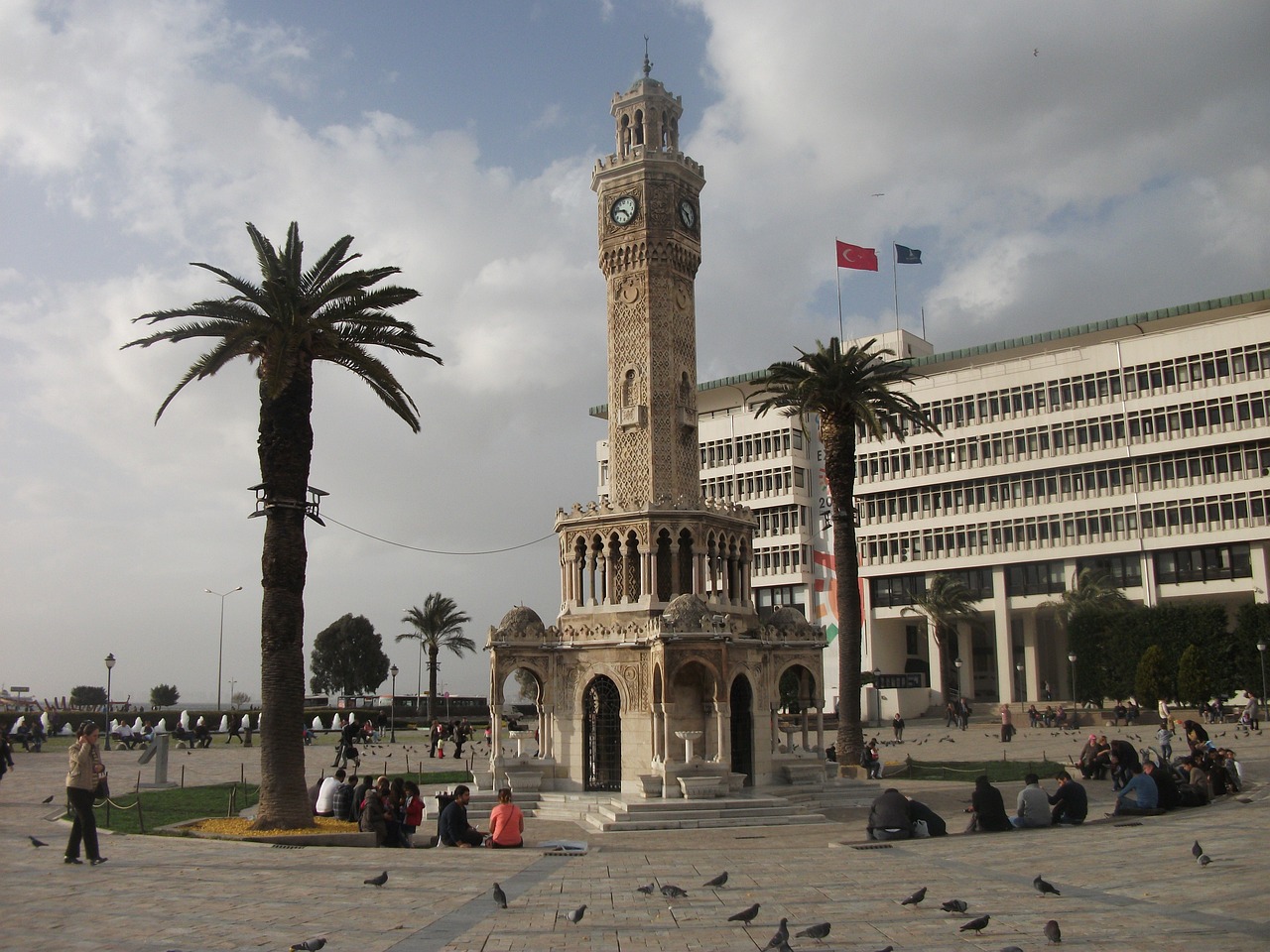
icy Smyrna in the past week. Frozen by the low temperatures. Frozen by the news of thousands of dead on the Turkish-Syrian border. It wasn't so long ago that it too mourned the dead from a major earthquake.
This frost can be seen in the bustling other days of Cordon, the Roman Cordon, on the state's historic Hellenistic beach. There where raki on other days flowed abundantly in proof to Ankara's holdouts that «Smyrna remains unfaithful (giaur Izmir).».
You ascend one of the main streets carved on the ruins of Smyrna, burnt in 1922, and arrive at Basmaneh. The once multicultural neighborhood behind the train station, the building built (and exploited along with the railways in exchange for debts) by the High Gate Allies in the last years of the Ottoman Empire. In the old ruined houses, Roman, Turkish, Jewish and Frankish, that survived the fire, there in the remains of the bel-epoch megalopolis, along with the old hotels of the oteler shogaji (the street of hotels) that had been built for the station's passengers, you meet hundreds of Africans. Men and women and children. The latter running through the alleys in search of an illusion of childishness. The women are looking for God knows what, some of them walking down the main street at night for a living in makeshift brothels and the latter in old crumbling houses. And the men plow everything. Looking for a way to collect the 500-700 euros needed for the journey of a lifetime. The passage to the islands, the passage to Europe...
Among them are the slave traders. And the poor devils, many of them refugees from the last war in the Middle East, who know their way around and work for a fee of 100 euros as intermediaries with the trafficking rings.
There in Basmane in the mid-2010s and especially since 2015, human trafficking has flourished. Hundreds of thousands of people, the vast majority of them Syrians, were stranded waiting, also looking for a way to cross into Europe. With the acquiescence of the state (sometimes with the participation of its officials in the alsiberian trade), whose market was funnelling billions of euros, many times more than the amount the European Union was giving it to tidy up the situation.
In the winding winding alleys of the neighbourhood, in the dirty and dilapidated houses of Basmane, the refugees of the war in Syria were housed and sold off in order to survive and make it to the promised land.
And now, as if nothing has changed except the colour of the people living in these houses, you meet Africans. You think the black continent in Smyrna is empty.
Their aim is to go to the islands, and from there to the other Europe. The road brings you out of a house you remember from earlier journalistic pursuits. The house is empty, still for sale. «Eight years on the market,» you think.
You remember the story at the time. Word for word the same as it was then. Nothing has changed. Boats with people jumping and drowning in the sea, and Ailan on the shore. The kid who drowned in Kusadasi and became a symbol, but now he's forgotten too. The drawing was by Muhamet, a teacher from Aleppo. I wonder where you are, Muhammad. He lost two of his three children in a bombing. He buried them along with the leg his wife had lost in that bombing. With her and their third child, they arrived in Smyrna. There, in the ruined house of Basmane, he painted his pain.
Now there are Africans living in the house. In the evenings they warm up by burning cardboard boxes. There are more than a few houses that have been burned down like this. Everywhere you go you can smell it burning.
These people are very scared when you talk to them. Some people tell you that they came to Turkey on holiday with the Turkish airline flights, the women run to hide, they ask you if you are a policeman, you make up a thousand things to get a conversation with them.
Robbie is 26 years old. He says his name is Robbie. He came from Somalia to Istanbul. And from there he went to Smyrna. This is where all the money he's saved from selling his field back home has come from. For a year now he's been collecting paper and aluminum from the garbage. He lives in one of the houses in the old neighborhood with 20 others. You ask him to take you to his house. «They'll kick me out if I take you,» he says. He pays 20 pounds a day to stay in this house. He's going to say, by how much less than a euro. He saves another 500 euros to save up the 500 euros needed «to get by». In a year and a half he thinks he'll have it made. And then? «Then God will give us a chance to move on,» he says.
What's he eating? «Whatever I find...» he replies. Whatever he finds, whatever they give him. Whatever is left over and he discovers in the garbage cans looking for paper and aluminum.
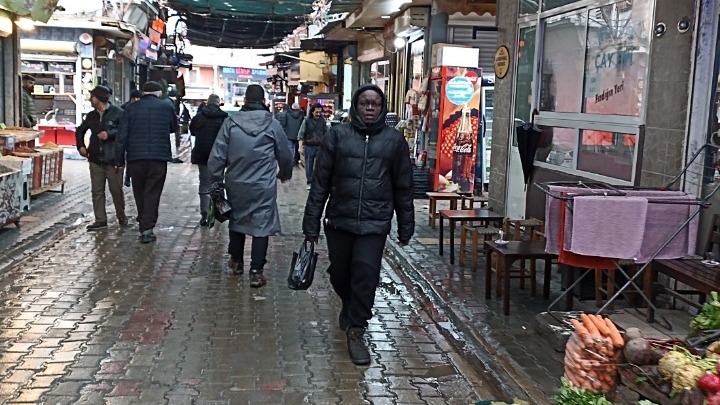
On the «market» street of Bassmanet, all sorts of Africans like Robbie get scared when they see a camera. The Turks are scared too. The former get lost in the shops, the latter stare at you.
In an alley, a group of Africans stuck on top of each other are talking. Two women carry crates of oranges. And a third lifts a paper sack of long loaves of bread.
Hassan, you learn on the corner, in the food shop, is one of the merchants of hope for Africans. In his shop, where you enter to ostensibly buy a bottle of water, you notice three mobile phones on the table. Tools for closing businesses. Once the boat reaches 50 «passengers» it starts. 25,000 euros take out the cost, it's not 500 for the boat and the disposable outboard motor, take out three or four grand for those who look the other way, close to 20 grand is profit...
Even fake life jackets are no longer given to those who dare to cross the Aegean.
You pass by Yusuf's bakery on your way out. In the years of the Great Depression there was a sign on its glass that said «Put a loaf of bread in it so that no one goes hungry». The Turks bought their bread and left what they could or wanted for a loaf of bread for the refugees. A lot of people ate bread, then.
Now there's no more paper on the glass. You haven't seen Yusuf. Some of them even looked at you a bit wildly when you asked where he was. Two Africans were unloading kernels... The freshly baked bread didn't smell as nice as it used to.
It started to sleet. In the dilapidated houses in Bashmaneh in Smyrna with the Africans waiting to cross to the islands, this weather is a nightmare.
The house you see in front of you reminds you of something. You saw it eight years ago, didn't you? A heavy cast-iron door, MHT 1900. Eight years, nothing's changed «100 years since its preachers left, nothing's changed» you think.
In Basmanet, trying to understand the tangled web of people's movement for many years now.
by S. Balaska